
U.S. Factory Activity Contraction Faster Than Expected: Market Reaction and Analysis
Unlock More Features
Login to access AI-powered analysis, deep research reports and more advanced features
About us: Ginlix AI is the AI Investment Copilot powered by real data, bridging advanced AI with professional financial databases to provide verifiable, truth-based answers. Please use the chat box below to ask any financial question.
Related Stocks
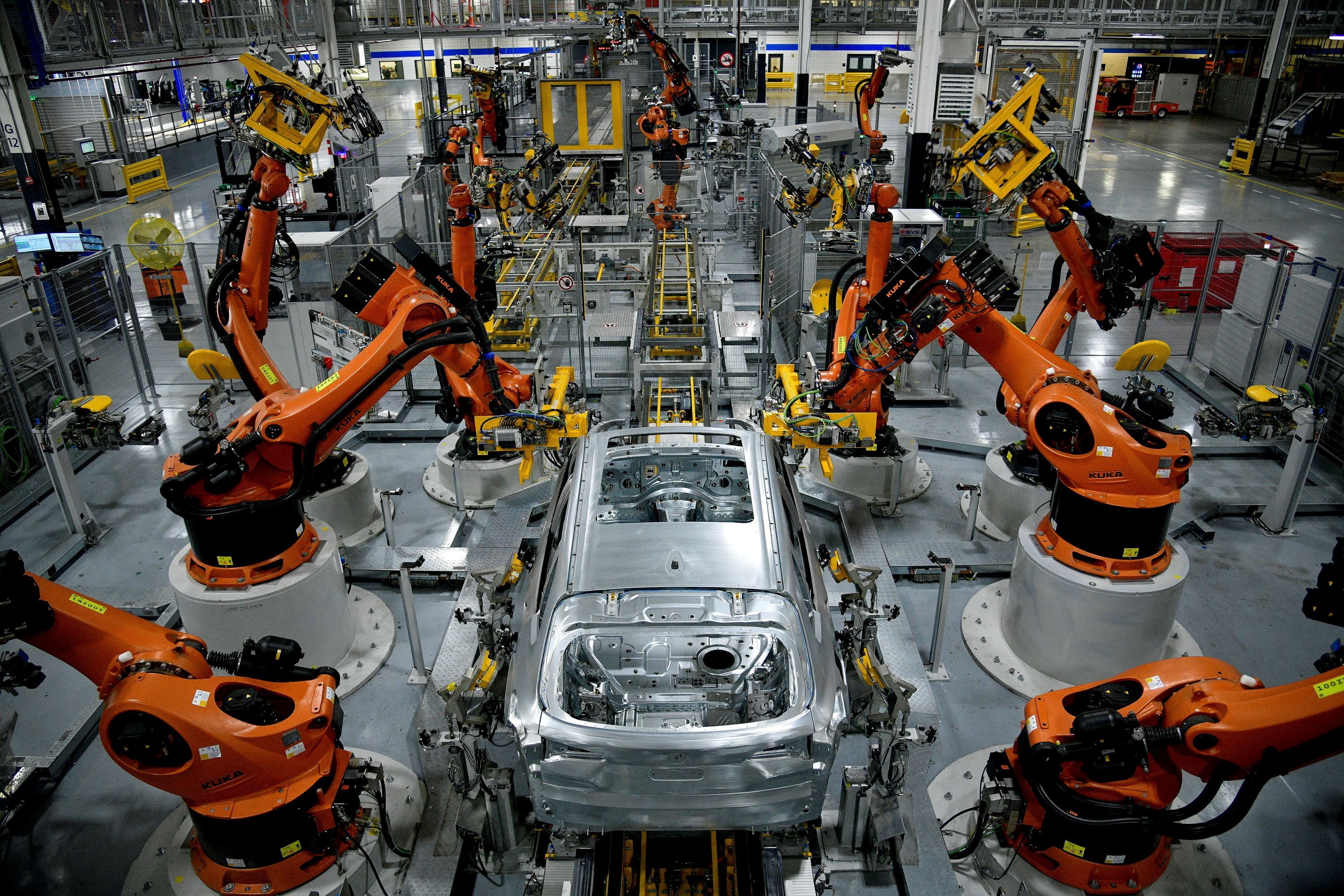
The Institute for Supply Management (ISM) reported on December 1, 2025, that U.S. factory activity contracted at a faster pace than expected in November, marking the ninth consecutive month of contraction [1]. The decline was attributed to higher tariffs impacting businesses, with pullbacks in supplier deliveries, new orders, and employment [1]. Four manufacturing sectors reported growth (Computer & Electronic Products; Food, Beverage & Tobacco Products; Miscellaneous Manufacturing; Machinery), while most others contracted [1].
Following the report’s release, U.S. stock markets showed mixed reactions on December 1: the S&P 500 closed up 0.26% at 6,830.17, the NASDAQ Composite rose 0.58% to 23,306.01, and the Dow Jones Industrial Average fell 0.25% to 47,460.04 [0]. The Industrials sector overall recorded a 0.70% gain [0], but the Industrial Select Sector SPDR Fund (XLI), a key ETF tracking the sector, closed flat at $152.53 (down just 0.01%) with open/high/low of $152.54/$153.00/$152.17 and 4.75M in volume [0]. The moderate market reaction may stem from the contraction being a 9-month trend (no new surprise) and the Technology sector’s 0.79% gain offsetting manufacturing concerns [0].
A key discrepancy emerged between PMI surveys: while ISM indicated contraction, S&P Global’s November manufacturing PMI of 52.2 signaled expansion [2]. This divergence likely reflects ISM’s focus on large manufacturing firms versus S&P Global’s broader coverage of small and medium enterprises.
- Muted Market Reaction Due to Trend Continuity: The ninth consecutive month of contraction means the news was largely priced in, limiting negative market impact [0].
- Tech Sector Strength Offsets Manufacturing Weakness: The Technology sector’s outperformance (driving NASDAQ and S&P 500 gains) mitigated concerns from the ISM report [0].
- PMI Survey Divergence Indicates Manufacturing Segmentation: ISM’s contraction for large firms contrasts with S&P Global’s expansion for broader manufacturing, highlighting potential disparities in the sector’s health [2].
- Prolonged Manufacturing Contraction: Nine consecutive months of decline may lead to ripple effects on related industries and employment over time [1].
- Tariff Policy Uncertainty: The ISM report explicitly linked contraction to higher tariffs, emphasizing ongoing trade policy risks for manufacturers [1].
- Conflicting Economic Signals: Discrepant PMI data creates uncertainty about the true state of U.S. manufacturing, complicating market outlook assessments [2].
- Sectors Less Exposed to Manufacturing: The Technology sector’s strong performance suggests potential resilience for industries insulated from manufacturing headwinds [0].
- Event: ISM reported faster U.S. factory activity contraction in November 2025 (ninth consecutive month) due to tariffs [1].
- Market Performance: Mixed reactions (S&P 500 +0.26%, NASDAQ +0.58%, Dow -0.25%); Industrials sector +0.70% but XLI ETF -0.01% [0].
- PMI Data: ISM (contraction, exact November number unavailable; October = 48.7 [2]) vs. S&P Global (52.2, expansion [2]).
- Unresolved Questions: Exact November ISM PMI, other December 1 macroeconomic data, and reasons for the Industrials sector/XLI ETF performance discrepancy [0].
Insights are generated using AI models and historical data for informational purposes only. They do not constitute investment advice or recommendations. Past performance is not indicative of future results.
About us: Ginlix AI is the AI Investment Copilot powered by real data, bridging advanced AI with professional financial databases to provide verifiable, truth-based answers. Please use the chat box below to ask any financial question.