
Chicago Fed's Goolsbee Expresses Caution on Rate Cuts Amid Government Shutdown Data Blackout
Unlock More Features
Login to access AI-powered analysis, deep research reports and more advanced features
About us: Ginlix AI is the AI Investment Copilot powered by real data, bridging advanced AI with professional financial databases to provide verifiable, truth-based answers. Please use the chat box below to ask any financial question.
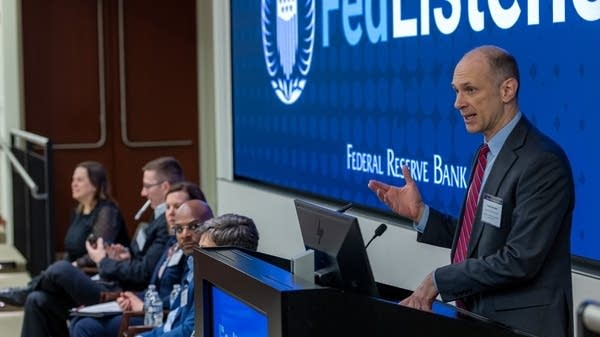
This analysis is based on the CNBC report [1] published on November 6, 2025, which reported Chicago Federal Reserve President Austan Goolsbee’s cautious stance on further interest rate cuts due to the ongoing government shutdown’s impact on economic data availability. The shutdown has created a critical data blackout, halting key inflation reports including October CPI and PCE data, leaving Federal Reserve policymakers effectively “flying blind” in their decision-making process [1][2].
Goolsbee’s remarks represent a significant departure from his typically dovish stance, highlighting how data limitations are fundamentally altering Fed communication strategy. His statement about being “uneasy about front-loading rate cuts” without inflation data suggests a more cautious bias emerging within the Federal Reserve [1]. This shift is particularly noteworthy given Goolsbee’s upcoming voting role at the December FOMC meeting.
The current situation creates a dangerous asymmetry in Fed policy visibility. While labor market deterioration would be immediately apparent, inflation problems would face delayed detection due to the data blackout. Goolsbee noted that if inflation issues develop, “it’s going to be a fair amount bit of time before we see that,” creating a natural bias toward maintaining current rates rather than cutting [1][2].
Current market data shows negative sentiment potentially reflecting this Fed uncertainty, with the S&P 500 down 0.47%, NASDAQ down 0.77%, and Dow down 0.41% on November 6 [0]. This market reaction suggests investors are pricing in increased policy uncertainty and the possibility of a more hawkish Fed stance than previously anticipated.
- Data Dependency Risk: The Fed’s inability to access crucial inflation metrics creates a fundamental blind spot in monetary policy decision-making [1][2]
- Policy Timing Risk: With Goolsbee having a December vote but rotating to alternate status in 2026, his current caution may have outsized influence on near-term policy [1]
- Market Volatility: The combination of data uncertainty and shifting Fed communication could lead to increased market volatility ahead of the December FOMC meeting
- Alternative Data Monitoring: Private-sector inflation indicators and the Chicago Fed’s updated labor market dashboard may provide valuable insights during the data blackout [1]
- Shutdown Resolution Tracking: Progress on congressional negotiations and funding bills could signal when normal data flows will resume
- Policy Clarity: Any additional FOMC member statements following Goolsbee’s comments could provide further clarity on the Fed’s collective thinking
The government shutdown has created an unprecedented situation for Federal Reserve policymaking by halting the release of key economic data. Chicago Fed President Goolsbee’s cautious stance reflects a broader institutional concern about making policy decisions without adequate information. The September CPI showed inflation running at a 3% annual rate with core inflation at 3.6% annualized pace pre-shutdown, providing the last clear inflation benchmark [1].
The timing is critical as markets approach the December FOMC meeting with heightened uncertainty about economic conditions. The Fed’s traditional data-dependent approach has been compromised, potentially leading to more conservative policy decisions until the data blackout resolves. Market participants should monitor both the shutdown resolution timeline and additional Fed communications for signals about policy direction.
Insights are generated using AI models and historical data for informational purposes only. They do not constitute investment advice or recommendations. Past performance is not indicative of future results.
About us: Ginlix AI is the AI Investment Copilot powered by real data, bridging advanced AI with professional financial databases to provide verifiable, truth-based answers. Please use the chat box below to ask any financial question.