
Bank of Canada Governor Macklem Testimony: Rate Policy Appropriateness and Economic Outlook
Unlock More Features
Login to access AI-powered analysis, deep research reports and more advanced features
About us: Ginlix AI is the AI Investment Copilot powered by real data, bridging advanced AI with professional financial databases to provide verifiable, truth-based answers. Please use the chat box below to ask any financial question.
Related Stocks
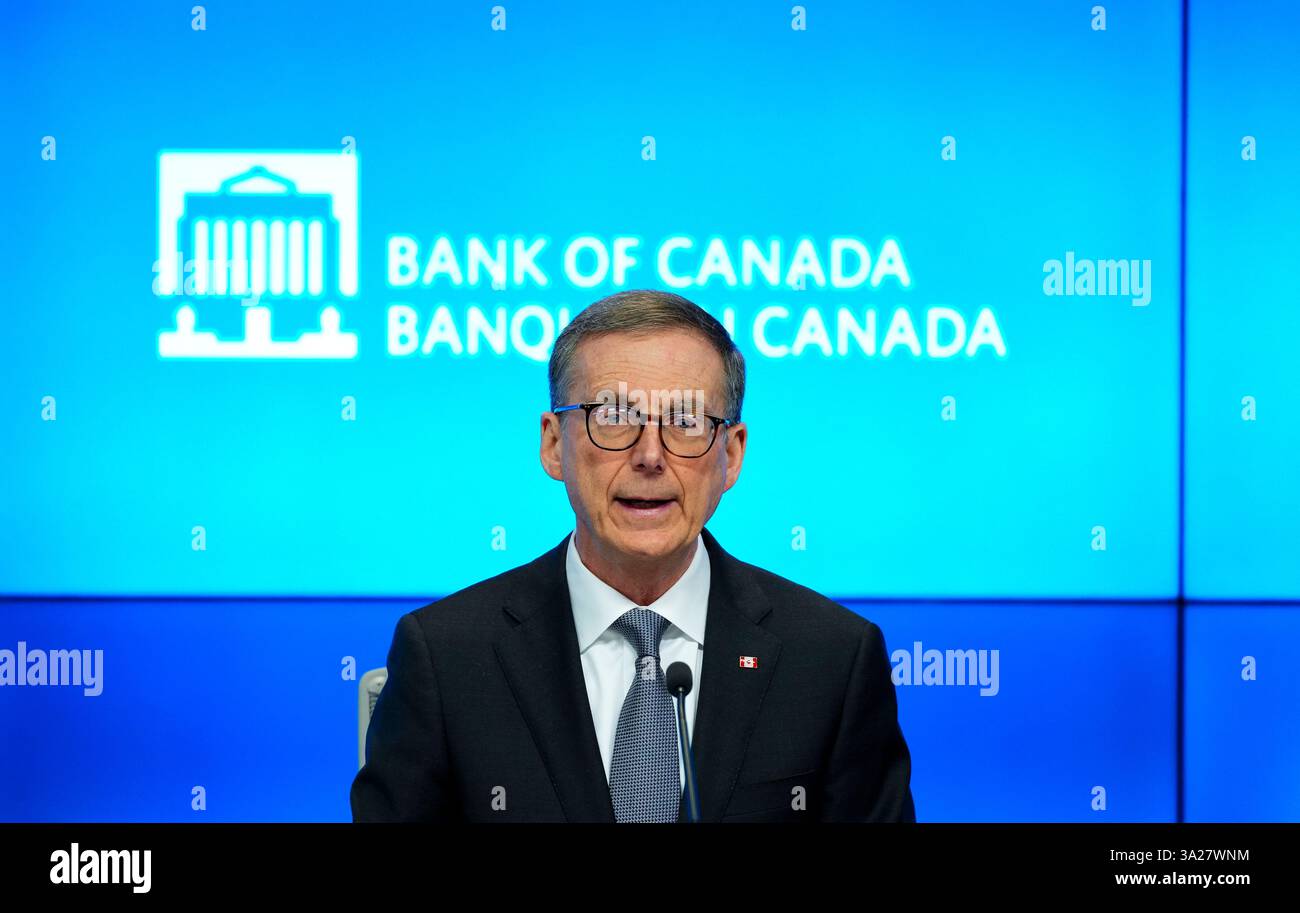
This analysis is based on the Wall Street Journal report [2] published on November 5, 2025, covering Bank of Canada Governor Tiff Macklem’s testimony before the House of Commons Standing Committee on Finance.
Governor Macklem’s testimony confirmed that the Bank of Canada’s current policy rate of 2.25% (following two consecutive 25-basis point cuts) represents an appropriate balance between inflation control and economic support [3][4]. The economic outlook remains challenging, with growth expected to average approximately ¾% through the second half of 2025, improving to about 1½% by 2027, but remaining below the 2% threshold [3][4]. Current inflation metrics show CPI at 2.4% in September with underlying inflation around 2½%, while the unemployment rate stands at 7.1% [3][4].
Canadian equity markets demonstrated resilience despite economic headwinds. The S&P/TSX Composite Index has gained 21.3% year-to-date in 2025, driven by lower borrowing costs and gold price rallies [7]. However, the index experienced volatility, closing at 29,777.82 on November 4th, down 497.24 points (-1.642%) from the previous session [8]. The Canadian dollar maintained relative stability, trading around 0.710086 against the USD on November 4th, with the USD/CAD pair ranging between 1.38 and 1.44 [5].
The banking sector remains well-positioned to support the financial system. According to the Bank of Canada’s Financial Stability Report 2025, major Canadian banks including Royal Bank of Canada (RY), Toronto-Dominion Bank (TD), and Bank of Nova Scotia (BNS) maintain strong capital levels, good funding access, and sufficient liquidity [6].
Macklem emphasized that Canada’s economic weakness extends beyond cyclical factors to represent a structural transition [3][4]. The US trade conflict has inflicted permanent damage on Canada’s economic prospects, with tariffs reducing productive capacity and increasing costs. The Bank of Canada projects that by the end of 2026, GDP will be 1.5% lower than expected in the January 2025 Monetary Policy Report [1].
A critical insight from Macklem’s testimony is the acknowledgment that “monetary policy cannot undo the damage caused by tariffs” [3][4]. This admission highlights the constraints facing traditional monetary tools in addressing structural economic damage from trade conflicts. With nearly 25% of Canada’s economy dependent on US exports, prolonged trade tensions have created a permanent downward revision to growth potential.
Despite ongoing trade challenges, Canadian markets have shown remarkable resilience. The TSX’s 21.3% year-to-date gain suggests that trade tensions, which significantly influenced trading earlier in 2025, have had increasingly little impact on market sentiment [7]. This decoupling may reflect market adaptation to the new trade reality or focus on other positive factors like commodity prices and monetary easing.
Canadian banks’ strong fundamentals position them as crucial stabilizers during the economic transition. Their elevated capital levels, strong credit performance, and sufficient liquidity provide a buffer against economic shocks and support continued lending activity [6]. This resilience contrasts with the broader economic weakness and suggests the financial system remains robust despite structural challenges.
The analysis reveals several significant risk factors that warrant attention:
- Trade Dependency Vulnerability: Canada’s heavy reliance on US exports (25% of economy) creates sustained vulnerability to prolonged trade tensions [3][4]
- Policy Limitation Risk: Traditional monetary tools have reduced effectiveness in addressing structural damage from trade conflicts [3][4]
- Structural Adjustment Dislocation: The transition to a lower growth path may create sector-specific disruptions, particularly in export-oriented industries
Key factors requiring ongoing attention include:
- US trade policy developments that could further impact Canadian economic prospects
- Commodity price movements given Canada’s resource-heavy economic structure
- Productivity initiatives to address long-term growth challenges
- Inflation trajectory that could constrain the Bank of Canada’s policy flexibility
Macklem’s testimony confirms that the Bank of Canada has adopted a policy stance appropriate for current economic conditions, maintaining the policy rate at 2.25% to balance inflation risks while providing economic support [3][4]. The economic outlook projects tepid growth through H2 2025 with gradual improvement in 2026, though growth will remain below 2% [3][4].
Structural challenges from US trade tensions have permanently reduced Canada’s growth potential, with GDP projected to be 1.5% lower by end-2026 than previously expected [1]. Despite these headwinds, Canadian markets have shown resilience, with the TSX up 21.3% year-to-date and the banking sector maintaining strong fundamentals [6][7].
The limited effectiveness of monetary policy in addressing structural trade damage suggests that coordinated policy responses beyond traditional tools will be necessary for Canada’s economic adjustment [3][4]. Decision-makers should focus on sector-specific fundamentals, trade policy developments, and productivity initiatives rather than relying solely on monetary policy signals.
Insights are generated using AI models and historical data for informational purposes only. They do not constitute investment advice or recommendations. Past performance is not indicative of future results.
About us: Ginlix AI is the AI Investment Copilot powered by real data, bridging advanced AI with professional financial databases to provide verifiable, truth-based answers. Please use the chat box below to ask any financial question.