
Treasury Yields Decline as Investors Await Crucial CPI Report Amid Government Shutdown
Related Stocks
This analysis is based on the MarketWatch report [1] published on October 22, 2025, which highlights investor nervousness ahead of a crucial CPI inflation report during the ongoing government shutdown.
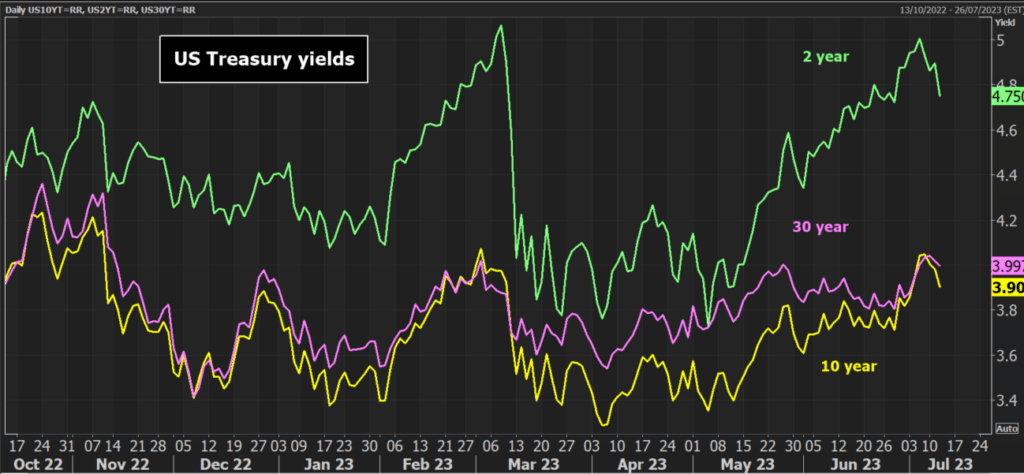
The current market environment reflects a complex interplay between data scarcity, policy expectations, and risk aversion. The delayed September CPI report, originally scheduled for October 15, represents the first major economic indicator to be released during the fourth week of the U.S. government shutdown [4]. This data vacuum has created unusual market dependency on single data points, amplifying the significance of the upcoming inflation reading.
A significant shift has occurred in the Federal Reserve’s policy focus. Market analysis indicates that “investors have accepted Federal Reserve Chair Jerome Powell’s steer that policy is being driven by employment, not inflation” [2]. This represents a fundamental change from the inflation-centric approach that dominated monetary policy for the past two years.
The Fed has already cut rates to a range of 4.00%-4.25% in September 2025, its first reduction since December 2024 [2]. Futures markets are pricing in additional rate cuts through 2025 and into 2026, with markets betting on a 51-basis point drop by year-end [1]. The yield curve suggests Fed Funds could reach 2.87% by the end of 2026 [1].
The government shutdown has created an unprecedented information landscape where market participants must operate with incomplete data. This “data blackout” environment [4] has several implications:
-
Single Data Point Dependency:Markets are unusually sensitive to individual releases, particularly the delayed CPI report, due to the lack of corroborating economic indicators.
-
Policy Over Fundamental Analysis:Market movements are increasingly tied to Fed policy expectations rather than fundamental economic indicators [2], creating potential disconnects between market pricing and economic reality.
-
Self-Reinforcing Cycles:There’s risk that “labor market concerns depress yields, exacerbating fears that the economy is slowing, which could, in turn, maintain the downward pressure on yields” [2], creating feedback loops that may amplify market movements.
Despite concerns about potential inflation upticks, analysts suggest that even if the CPI reading comes in higher than expected, it’s “unlikely to spark a jump in yields” due to the market’s focus on employment risks [2]. Current expectations include:
- Headline CPI potentially rising from 2.9% to 3.1% [5]
- Core inflation remaining sticky around 3% [1]
- Tariff policies potentially pushing inflation higher [1]
This decoupling between inflation data and market reaction represents a significant structural shift in market behavior.
-
CPI Surprise Risk:A significantly higher-than-expected inflation reading could challenge market assumptions about Fed policy and trigger volatility [5]. The market’s current complacency regarding inflation surprises may be misplaced.
-
Policy Credibility Risk:If inflation proves more persistent than expected while the Fed continues cutting rates, it could create policy credibility issues and force abrupt policy shifts.
-
Data Vacuum Complications:The extended government shutdown could delay other crucial economic indicators, prolonging the period of information scarcity and market uncertainty.
-
Volatility Potential:The combination of data gaps and policy uncertainty creates conditions for sharp market movements around key data releases, particularly the October 24 CPI report and the Fed’s October 28-29 policy meeting [5].
-
Yield Curve Dynamics:The current decline in yields may not be sustainable if inflation proves more persistent than expected, potentially creating rapid reversals in bond markets.
-
Sector Rotation Opportunities:The risk-off environment may create opportunities in defensive sectors while growth stocks face continued pressure from higher discount rates.
- September CPI report release on October 24, 2025 [4]
- Fed’s October 28-29 policy meeting decision [5]
- Government shutdown resolution timeline
- Trend in labor market data post-shutdown
- Inflation trajectory and Fed response
- Treasury yield curve dynamics and potential steepening/flattening
The current market environment presents several unique challenges for market participants. The information asymmetry created by the government shutdown has forced investors to rely heavily on single data points, with the delayed CPI report serving as a crucial test of market resilience and policy credibility [4].
Market sentiment reflects a fundamental shift in how investors are pricing risk, with employment concerns now taking precedence over inflation worries in Fed policy expectations [2]. This shift has led to declining Treasury yields despite potential inflation upticks, creating an unusual market dynamic where traditional relationships between inflation data and bond yields may be temporarily broken.
The delayed CPI report represents not just an economic indicator but a crucial inflection point that could validate or challenge current market assumptions about Fed policy direction. Market participants should be prepared for potential volatility around this release, as the combination of data scarcity and policy uncertainty creates conditions for sharp market movements [2][4].
[0] Ginlix Analytical Database - Market indices data for October 22, 2025
[1] Greystone - US Treasuries Market Commentary: October 20, 2025
[2] Reuters - Global markets trading day graphic, October 22, 2025
[3] Financial Content - Bullish Dollar Signals Emerge Ahead of Delayed CPI, October 22, 2025
[4] CNBC - Treasury yields hold steady as investors look ahead to inflation print, October 22, 2025
[5] S&P Global - Week Ahead Economic Preview: Week of 20 October 2025
Insights are generated using AI models and historical data for informational purposes only. They do not constitute investment advice or recommendations. Past performance is not indicative of future results.