Ginlix AI

U.S. Services PMI Surges to 52.4 in October, Driving Market Rally on Economic Strength

#services_pmi #economic_indicators #market_analysis #federal_reserve #sector_performance #inflation #ISM
Positive
US Stock
November 5, 2025
U.S. Services PMI Surges to 52.4 in October, Driving Market Rally on Economic Strength

Related Stocks

MAR
--
MAR
--
JPM
--
JPM
--
V
--
V
--
Integrated Analysis

This analysis is based on the Wall Street Journal report [1] published on November 5, 2025, which detailed the Institute for Supply Management’s Services PMI data showing significant acceleration in U.S. services sector activity.

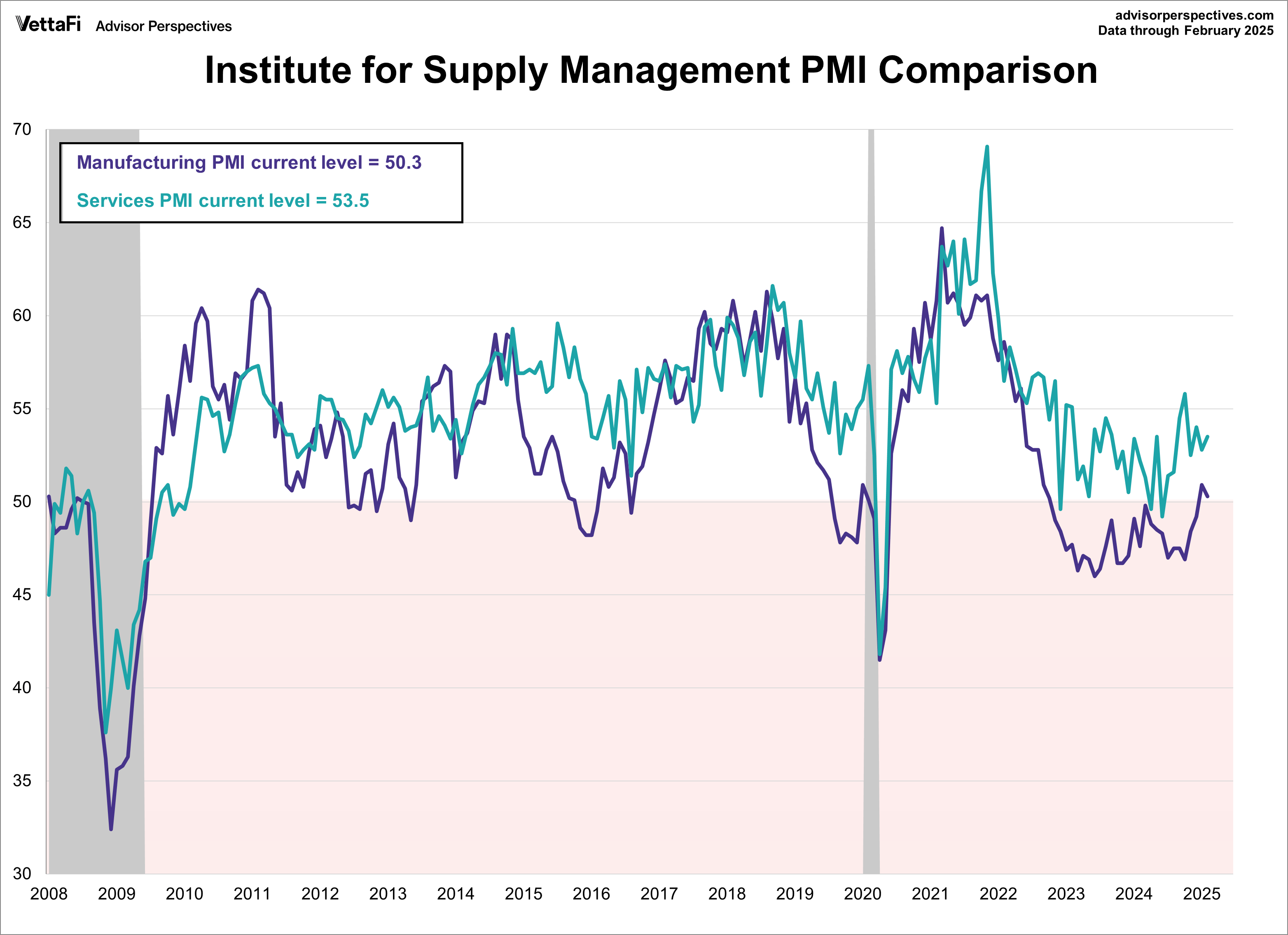
The Services PMI climbed to

52.4 in October
from
50.0 in September
, representing the strongest expansion since February 2025 and significantly exceeding economists’ forecasts of 50.8 [0][2]. This 2.4-percentage point increase signals that the services sector has returned to robust expansion territory after stagnating in September. The Business Activity Index showed even stronger improvement, rising to
54.3% from 49.9%
, a 4.4-percentage point increase that returned the index to expansion territory [2].

The market reaction was immediate and broadly positive, with major indices posting gains on November 5, 2025 [0]:

  • S&P 500
    : +27.92 points (+0.41%) to 6,797.69
  • NASDAQ Composite
    : +153.91 points (+0.66%) to 23,511.98
  • Dow Jones Industrial Average
    : +37.73 points (+0.08%) to 47,135.04
  • Russell 2000
    : +18.90 points (+0.78%) to 2,448.03

Sector performance reflected the services strength, with Energy (+3.21%), Industrials (+1.33%), and Technology (+0.81%) leading gains, while Consumer Cyclical (-1.09%) and Consumer Defensive (-0.99%) sectors underperformed [0].

Key Insights

Economic Acceleration Beyond Expectations
: The Services PMI’s significant beat of the 50.8 forecast suggests underlying economic strength that may not have been fully priced into markets. Given that services represent approximately 80% of U.S. economic activity [2], this acceleration carries substantial weight for overall GDP growth prospects.

Inflation Dynamics Show Improvement
: Despite the strong activity, the Prices Index continued its declining trend at 40.8% versus 47.3%, suggesting companies are successfully reducing backlogs while keeping up with new orders [2]. This declining price pressure could influence Federal Reserve policy considerations positively.

Sector Divergence Raises Questions
: The mixed performance across sectors and individual service companies suggests investors are being selective. While Marriott International (MAR) gained 3.25% to $281.08, Visa Inc. (V) declined 1.04% to $336.75, indicating that services strength may not translate uniformly across all service industries [0].

Manufacturing-Services Split Persists
: The services strength contrasts with continued manufacturing weakness, as the Manufacturing PMI at 48.7% (down from 49.1%) indicates ongoing contraction in the goods-producing sector [2]. This divergence creates a complex economic picture with different sectors moving in opposite directions.

Risks & Opportunities
Key Risk Factors

Monetary Policy Uncertainty
: Market commentators note that while services data is strong, “This doesn’t look like data that argues for cutting rates in December” [3]. The elevated Prices Index above 60% in some components suggests persistent inflation concerns that could maintain Federal Reserve caution.

Single-Month Data Limitations
: The strong October reading, while encouraging, represents only one month of data. Establishing a clear trend will require confirmation in coming months, especially given the recent period of stagnation around the 50-point threshold.

Sector Rotation Complexity
: The underperformance of Consumer Cyclical and Defensive sectors despite services strength raises questions about the breadth of economic recovery and suggests selective investment approaches may be warranted rather than broad-based exposure.

Opportunity Windows

Services-Exposed Investments
: Companies directly benefiting from services expansion, particularly in travel, hospitality, and business services, may continue to see positive momentum as the sector recovery gains traction.

Inflation-Sensitive Positions
: The declining Prices Index suggests opportunities in companies that benefit from reduced input cost pressures and improved margin potential.

Broad Market Participation
: The Russell 2000’s strong performance (+0.78%) indicates that small-cap companies may be positioned to benefit from the services recovery, potentially offering growth opportunities beyond large-cap service providers.

Key Information Summary

The October Services PMI reading of 52.4 represents a significant acceleration in U.S. services sector activity, with the Business Activity Index reaching 54.3% [2]. This strength contributed to broad market gains, particularly in technology and small-cap stocks. However, the data presents a mixed picture with persistent inflation concerns, manufacturing weakness, and sector divergence suggesting selective opportunities rather than uniform benefits across the economy.

The declining Prices Index at 40.8% indicates improving inflation dynamics, which could influence Federal Reserve policy considerations favorably [2]. Nevertheless, market analysts caution that the data may not support rate cuts in December due to remaining inflation pressures [3].

For decision-makers, the key consideration is that services sector strength may not translate uniformly across all industries, with individual company performance varying significantly despite the overall positive trend. The divergence between sector performance and individual stock reactions suggests that careful stock selection within the services universe may be more important than broad sector exposure [0].

Ask based on this news for deep analysis...
Deep Research
Auto Accept Plan

Insights are generated using AI models and historical data for informational purposes only. They do not constitute investment advice or recommendations. Past performance is not indicative of future results.