
Treasury Market Analysis: Year-End Seasonality vs Fed Policy Uncertainty
Unlock More Features
Login to access AI-powered analysis, deep research reports and more advanced features
About us: Ginlix AI is the AI Investment Copilot powered by real data, bridging advanced AI with professional financial databases to provide verifiable, truth-based answers. Please use the chat box below to ask any financial question.
Related Stocks
This analysis is based on the MarketWatch report [1] published on November 5, 2025, which examines how positive year-end seasonality in the U.S. Treasury market may overcome investor disappointment regarding Federal Reserve Chair Jerome Powell’s message that a December rate cut is “not a foregone conclusion.”
The Treasury market is currently experiencing a fascinating dynamic where seasonal tailwinds are beginning to counterbalance Federal Reserve policy uncertainty. Current market data reveals relative stability in Treasury yields despite the hawkish messaging from Fed Chair Powell following his October 29, 2025 press conference [2]. The 10-Year Treasury (^TNX) stands at 4.09%, down 0.97% over the past 30 days, while the 30-Year Treasury (^TYX) is at 4.67%, down 1.68% over the same period [0]. This stability in longer-term yields suggests that seasonal factors may indeed be providing support to the Treasury market.
Treasury ETFs are showing consistent positive momentum, with TLT (20+ Year Treasury ETF) trading at $89.94, up 0.22% on the day, and IEF (7-10 Year Treasury ETF) at $96.62, up 0.12% [0]. Both ETFs are trading closer to their 52-week highs than lows, indicating underlying strength in the Treasury market that appears to be driven by seasonal patterns rather than Fed policy expectations.
The divergence between Fed policy uncertainty and seasonal Treasury strength creates several important insights:
-
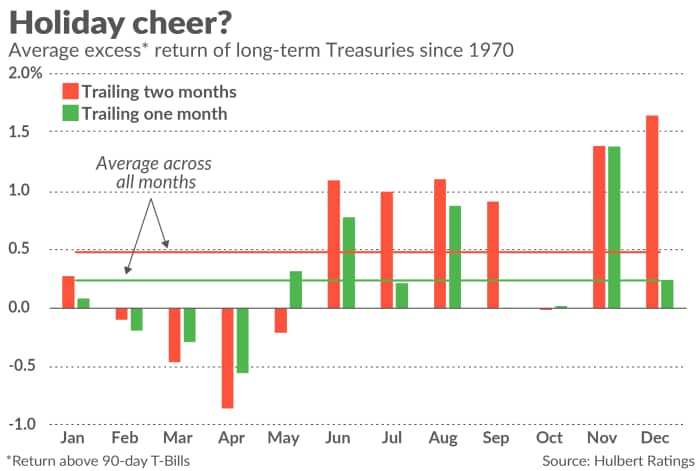
Historical Seasonality Dominance: Research indicates that long-term Treasuries have historically shown strong seasonal performance, particularly in November and December [3]. This pattern is attributed to year-end portfolio rebalancing by institutional investors, increased demand for safe assets as investors lock in gains, and holiday trading patterns that typically favor fixed income.
-
Market Resilience: Despite Powell’s hawkish messaging initially causing Treasury yields to rise (with the 10-year yield jumping to 4.05% from 3.98%) [2], the market appears to be looking beyond short-term Fed policy uncertainty to focus on seasonal patterns that historically favor Treasury bonds during year-end periods.
-
Technical Positioning: Treasury yields are approaching key technical levels that could trigger either breakout moves or reversals, making the current environment particularly sensitive to both policy developments and seasonal positioning indicators.
The analysis reveals several risk factors that warrant attention:
-
Fed Policy Surprise: If the Fed unexpectedly maintains rates in December or signals a more hawkish stance, it could override seasonal tailwinds and potentially cause Treasury yields to spike [0][2].
-
Inflation Data: Higher-than-expected inflation readings could undermine Treasury demand regardless of seasonal patterns, as real yields may become less attractive.
-
Fiscal Policy Uncertainty: The upcoming Trump administration’s tariff policies and fiscal approach could impact Treasury supply and demand dynamics, potentially disrupting historical seasonal patterns [0].
-
Technical Breakdown Risk: Treasury yields are at critical technical levels where adverse policy developments could trigger sharp movements.
-
Seasonal Tailwinds: Historical patterns suggest Treasury bonds typically perform well during year-end periods, potentially offering opportunities for fixed income exposure [1][3].
-
Portfolio Rebalancing: Institutional year-end rebalancing may create sustained demand for Treasuries through December.
-
Safe Haven Demand: Market uncertainty around policy transitions may increase demand for safe assets, benefiting Treasury prices.
Current Treasury market data shows [0]:
- 10-Year Treasury yield: 4.09% (down 0.97% over 30 days)
- 30-Year Treasury yield: 4.67% (down 1.68% over 30 days)
- TLT ETF: $89.94 (up 0.22% daily, 52-week range: $83.30-$94.85)
- IEF ETF: $96.62 (up 0.12% daily, 52-week range: $91.08-$97.77)
The market appears to be in a transitional phase where seasonal factors are gaining traction over policy concerns. However, investors should be aware that historical seasonal patterns may not hold in the current policy context, particularly given the upcoming administration’s potential impact on fiscal policy and inflation expectations. The divergence between Fed policy uncertainty and seasonal Treasury strength creates a complex market environment that requires careful monitoring of both fundamental and technical factors [0][1][2].
Insights are generated using AI models and historical data for informational purposes only. They do not constitute investment advice or recommendations. Past performance is not indicative of future results.
About us: Ginlix AI is the AI Investment Copilot powered by real data, bridging advanced AI with professional financial databases to provide verifiable, truth-based answers. Please use the chat box below to ask any financial question.