
Global Tech Sell-Off Driven by AI Valuation Concerns Impacting European Chipmakers
Unlock More Features
Login to access AI-powered analysis, deep research reports and more advanced features
About us: Ginlix AI is the AI Investment Copilot powered by real data, bridging advanced AI with professional financial databases to provide verifiable, truth-based answers. Please use the chat box below to ask any financial question.
Related Stocks
This analysis is based on the CNBC Squawk Box Europe coverage [1] published on November 5, 2025, which reported on a global tech sell-off driven by AI valuation concerns spilling into European markets.
The global technology sector experienced a coordinated sell-off on November 5, 2025, as concerns over artificial intelligence valuations triggered widespread investor anxiety. The market decline originated from U.S. markets but quickly spread to European and Asian exchanges, creating a synchronized global technology correction [1].
- U.S. markets showed significant weakness with the Nasdaq Composite declining 0.47% to 23,348.64, while the S&P 500 fell 0.25% to 6,771.54 [0]
- European markets opened lower across the board, with the Stoxx 600 Europe Technology Index dropping 1.2%, while major indices including the FTSE (-0.1%), DAX (-0.7%), and CAC 40 (-0.4%) all posted losses [1]
- Asian markets were particularly affected, with Japan’s Nikkei 225 plunging below 50,000 and South Korea’s Kospi experiencing significant declines [1]
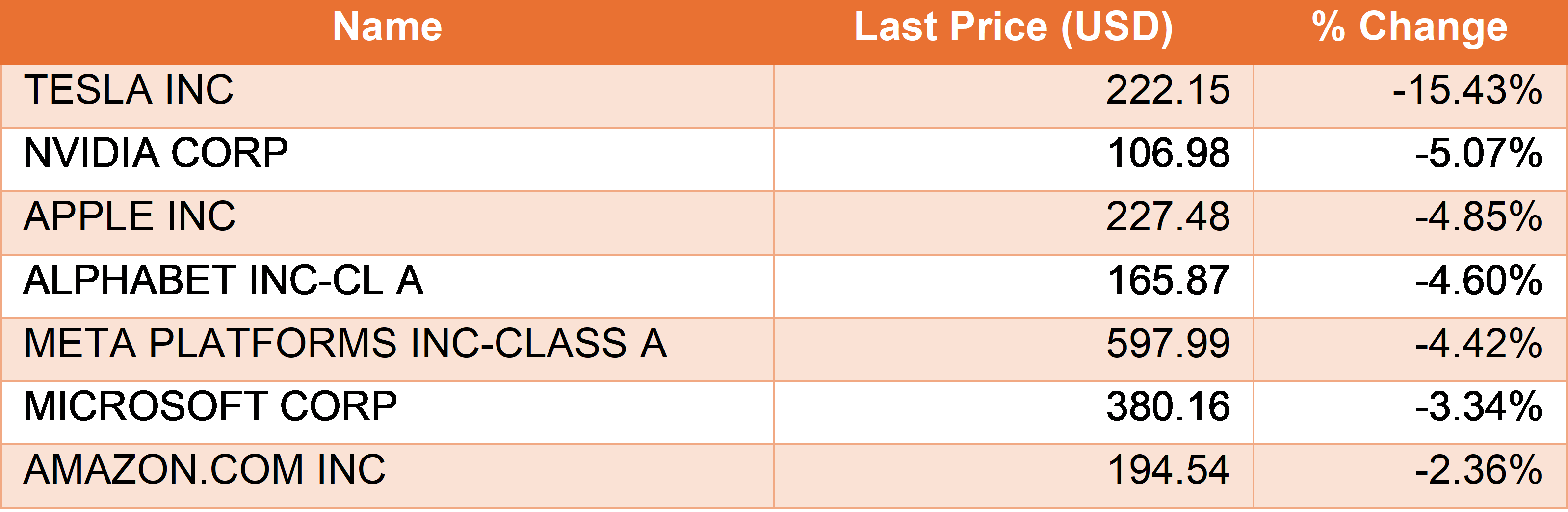
Semiconductor stocks bore the brunt of the selling pressure, reflecting their central role in AI infrastructure development. NVIDIA declined 3.96% to $198.69, Taiwan Semiconductor fell 3.55% to $294.05, and ASML Holding dropped 3.44% to $1,030.14 [0]. The chipmaker sector’s decline was particularly pronounced in European markets, where technology stocks led the broader market sell-off [1].
The current AI market displays unprecedented valuation metrics that suggest a potential bubble formation. NVIDIA has reached a $5 trillion valuation, representing approximately 8% of the entire S&P 500 index - a concentration level that exceeds historical norms by 3-4 times [2]. Palantir Technologies trades at an extreme P/E ratio of 433.50, implying investors would need over 400 years to recoup their investment through profits alone [0].
The fundamental economics of many AI companies raise serious questions about long-term viability. OpenAI’s ChatGPT generated $4.3 billion in H1 2025 while posting $13.5 billion in losses, resulting in a 314% loss-to-revenue ratio [2]. MIT research found that 95% of businesses deploying AI systems have generated zero measurable value from their implementations [2], suggesting widespread inefficiency in current AI adoption patterns.
Major financial institutions have issued increasingly urgent warnings about AI sector risks. Goldman Sachs CEO David Solomon warned of a potential 10-20% market correction within the next year [2], while Deutsche Bank analysts characterized current AI investment levels as fundamentally unsustainable, noting the industry would need to generate $2 trillion in annual revenue by 2030 to justify current investment levels [2].
- Valuation Correction Risk: Extreme P/E ratios (300-700x) suggest significant downside potential [2]
- Market Concentration Risk: Single-company concentration (Nvidia at 8% of S&P 500) creates systemic risk [2]
- Liquidity Concerns: High trading volumes in declining stocks suggest institutional selling pressure [0]
- Revenue Sustainability: Track AI companies’ ability to reduce loss-to-revenue ratios below 100%
- Regulatory Impact: Monitor antitrust investigations and securities regulation changes affecting AI companies
- Supply Chain Dependencies: Assess semiconductor supply chain resilience during market corrections
The current correction may present opportunities for selective investment in companies with:
- Sustainable business models and clear paths to profitability
- Diversified revenue streams beyond AI hype cycles
- Strong balance sheets capable of weathering extended market volatility
The November 5, 2025 tech sell-off represents a significant market event driven by fundamental concerns over AI sector valuations and sustainability. Key data points include:
- Global Market Impact: Coordinated declines across U.S., European, and Asian markets with technology stocks leading losses [0, 1]
- Valuation Extremes: NVIDIA at 8% of S&P 500, Palantir at 433x P/E, OpenAI at 314% loss-to-revenue ratio [0, 2]
- Institutional Warnings: Goldman Sachs predicting 10-20% correction, Deutsche Bank calling AI investment unsustainable [2]
- Sector Concentration: Semiconductor stocks experiencing the steepest declines due to AI infrastructure exposure [0, 1]
The analysis reveals that while AI technology represents genuine long-term potential, current market valuations appear disconnected from underlying business fundamentals and revenue generation capabilities. The high concentration of risk in a few major AI companies creates potential for systemic market impact if corrections accelerate.
Insights are generated using AI models and historical data for informational purposes only. They do not constitute investment advice or recommendations. Past performance is not indicative of future results.
About us: Ginlix AI is the AI Investment Copilot powered by real data, bridging advanced AI with professional financial databases to provide verifiable, truth-based answers. Please use the chat box below to ask any financial question.