
Wall Street's Failed Opposition to NYC Mayor-Elect Mamdani: Market and Policy Implications
Unlock More Features
Login to access AI-powered analysis, deep research reports and more advanced features
About us: Ginlix AI is the AI Investment Copilot powered by real data, bridging advanced AI with professional financial databases to provide verifiable, truth-based answers. Please use the chat box below to ask any financial question.
This analysis is based on the Wall Street Journal report [1] published on November 4, 2025, which documented the financial sector’s unprecedented but ultimately unsuccessful campaign to prevent Zohran Mamdani’s election as New York City mayor.
The financial industry mounted one of the most expensive mayoral opposition campaigns in NYC history, with at least 26 billionaires contributing $22 million to groups opposing Mamdani [2][5]. Michael Bloomberg alone donated $13 million across primary and general election cycles [5]. Wall Street firms in investing, advising, and wealth management “overwhelmingly donated to pro-Cuomo groups” according to Business Insider analysis [2]. Other major contributors included Bill Ackman ($1.75 million), Airbnb co-founder Joe Gebbia ($2 million), and the Lauder family ($2.6 million) [2][5].
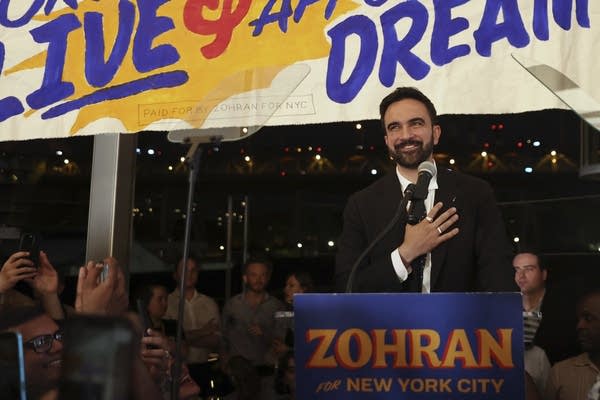
Despite this unprecedented spending, Mamdani defeated former Governor Andrew Cuomo and Republican Curtis Sliwa in the November 4, 2025 election [3]. The victory represents a significant political shift in America’s financial capital, as Mamdani ran on a platform including rent freezes, higher corporate taxes, and free public transportation—policies directly opposed by Wall Street interests [1][3].
Financial markets showed relatively modest declines on election day, suggesting the outcome was largely anticipated. Market data [0] shows the S&P 500 fell 0.25% to 6,771.54, Dow Jones declined 0.13% to 47,085.25, and NASDAQ dropped 0.47% to 23,348.64. Betting markets had shown Mamdani’s odds reaching 93-95% on election day [2], indicating markets had time to price in the likely outcome.
The real estate sector experienced more immediate disruption. Luxury real estate transactions paused as buyers awaited election results, with brokers reporting “real concern that a Mamdani administration could reshape the real estate market through rent freezes and higher taxes on luxury properties” [6]. Commercial real estate stocks like SL Green Realty (down 15% since Sept. 30) and Vornado Realty Trust (down 14% YTD) have been pressured by Mamdani’s policy proposals [7].
Mamdani’s platform presents several direct challenges to financial sector interests:
-
Tax Policy Impact: The proposed 2% tax on New Yorkers earning over $1 million annually could raise $4 billion but would directly impact financial industry compensation structures [6].
-
Real Estate Exposure: Banks with rent-stabilized loan portfolios, such as Flagstar Bank, face potential profit impacts from proposed rent freeze policies [7].
-
Business Environment: Companies may reconsider NYC operations, with some firms already expanding to Texas in what’s been dubbed “Y’all Street” [1].
Despite initial concerns, market participants believe the actual impact may be more moderate than campaign rhetoric suggests. Dean Lyulkin, CEO of private investment firm Cardiff, noted that “actual policy often turns out much more benign than campaign rhetoric” [2]. Peter Cardillo of Spartan Capital Securities suggested markets may already be pricing in these risks [2].
Historical precedent suggests real estate markets adapt to new political realities faster than participants anticipate [6]. The real estate industry contributed at least $13 million to PACs backing Cuomo or opposing Mamdani [6], indicating significant concern but also potential for negotiation and compromise.
This election outcome could influence other major urban centers. If Mamdani’s policies prove successful, similar platforms may emerge in other cities [2]. The failure of Wall Street’s opposition campaign may reduce financial industry influence in future elections, potentially leading markets to “price in more tax and regulatory risks” for other cities following “this pattern” [2].
- Sector-Specific Volatility: Regional banks with NYC exposure face potential pressure from rent freeze policies [7]
- Talent Migration: High-earning financial professionals may reconsider NYC residency due to proposed tax changes [6]
- Real Estate Market Disruption: Commercial and residential real estate companies may see continued volatility as policy details emerge [6][7]
- Policy Negotiation: The new administration may seek compromise with financial sector stakeholders to maintain NYC’s competitiveness
- Market Adaptation: Historical patterns suggest real estate and financial markets often adjust more quickly than anticipated to new political realities [6]
- Strategic Repositioning: Some financial firms may use this transition to optimize their geographic footprint and operational efficiency
The analysis reveals several risk factors that warrant attention. Mamdani inherits a $115 billion city budget and workforce of approximately 300,000 employees [4], giving him significant administrative capacity to implement his agenda. However, the feasibility of free bus transportation and specific implementation mechanisms for proposed policies remain unclear, creating uncertainty for business planning.
- Election Result: Zohran Mamdani won NYC mayoral race on November 4, 2025, despite $22+ million in Wall Street opposition spending [1][2][5]
- Market Impact: Modest declines suggest outcome was priced in (S&P 500 -0.25%, Dow -0.13%, NASDAQ -0.47%) [0]
- Real Estate Response: Luxury market paused, commercial REITs under pressure (SL Green -15%, Vornado -14% YTD) [6][7]
- Policy Concerns: 2% millionaire tax, rent freezes, and free transportation proposals face implementation questions [3][6]
- Strategic Implications: Some financial firms already expanding to Texas and other business-friendly locations [1]
The financial sector now faces the challenge of adapting to work with a mayor whose platform fundamentally opposes many traditional Wall Street interests, though the actual implementation and impact of proposed policies remain to be seen.
Insights are generated using AI models and historical data for informational purposes only. They do not constitute investment advice or recommendations. Past performance is not indicative of future results.
About us: Ginlix AI is the AI Investment Copilot powered by real data, bridging advanced AI with professional financial databases to provide verifiable, truth-based answers. Please use the chat box below to ask any financial question.