
Market Analysis: Mixed Trading with Palantir's Record Earnings and Berkshire's Cash Accumulation
Unlock More Features
Login to access AI-powered analysis, deep research reports and more advanced features
About us: Ginlix AI is the AI Investment Copilot powered by real data, bridging advanced AI with professional financial databases to provide verifiable, truth-based answers. Please use the chat box below to ask any financial question.
Related Stocks
This analysis is based on the Investors.com report [1] published on November 3, 2025, covering mixed market performance with standout movements in Palantir and Berkshire Hathaway.
U.S. stock markets displayed mixed performance on November 3, 2025, with all major indices closing lower: S&P 500 declined 0.44% to 6,851.98, Dow Jones fell 0.76% to 47,336.69, and NASDAQ dropped 0.49% to 23,834.72 [0]. The Russell 2000 also declined 0.40% to 2,471.24 [0]. This broad-based weakness suggests ongoing investor caution amid economic uncertainties and the earnings season.
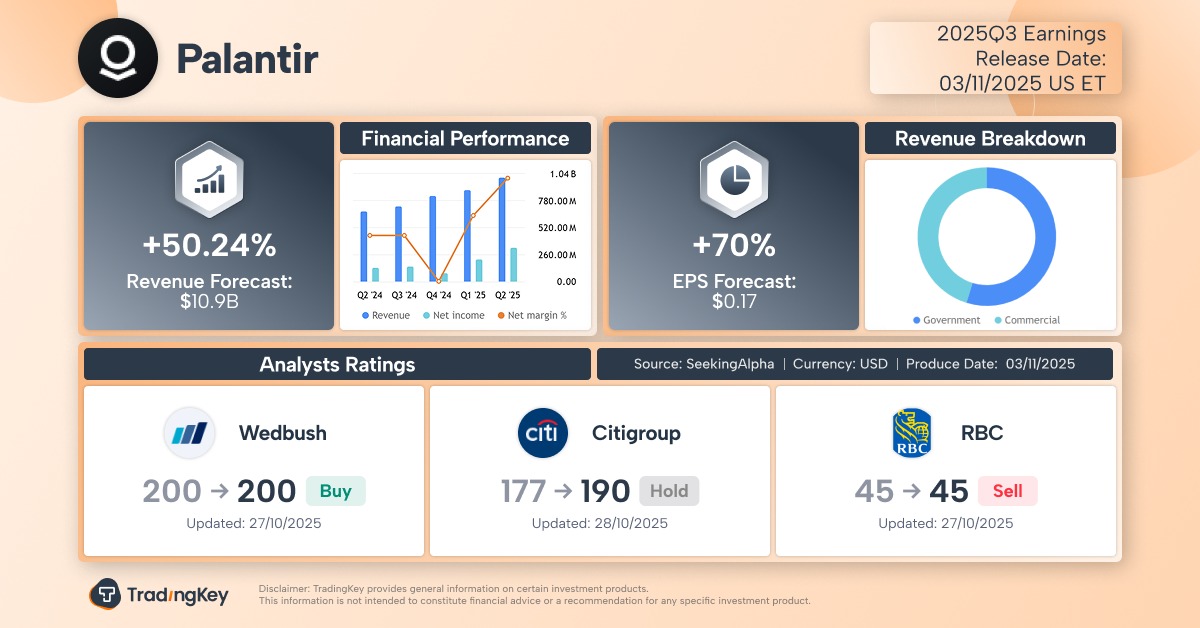
Palantir Technologies (PLTR) emerged as the session’s standout performer, hitting a new all-time high of $207.52 during regular trading before closing at $207.18 (+1.04%) with substantial volume of 70.2 million shares [0]. The pre-earnings rally set the stage for remarkable Q3 2025 results reported after market close:
- Revenue surged 63% YoY to $1.18 billion, beating estimates of $1.09 billion [4]
- Adjusted EPS of $0.21 exceeded consensus of $0.17 [4]
- Net income more than tripled to $475.6 million from $143.5 million year-over-year [4]
- U.S. Commercial revenue more than doubled to $397 million [4]
- U.S. Government revenue grew 52% YoY to $486 million [4]
- Q4 revenue expected at $1.33 billion vs. Street target of $1.19 billion [4]
- Full-year 2025 revenue raised to $4.4 billion vs. analyst forecast of $4.17 billion [4]
- Free cash flow guidance raised to $1.9-2.1 billion range [4]
Despite these exceptional results, PLTR slipped nearly 2% in extended trading after initially making slight gains [4]. The stock remains up over 133% year-to-date with a market capitalization exceeding $471 billion [0][4].
Warren Buffett’s Berkshire Hathaway revealed a record cash pile of $381.7 billion in Q3 earnings, raising concerns about the company’s market outlook [4][5]. Key financial metrics include:
- Operating earnings increased 34% YoY to $13.5 billion [4]
- Net investment income declined 13% to $3.2 billion due to lower short-term rates [4]
- Stock sales totaled $6.1 billion during Q3 [4]
Critically, for the fifth consecutive quarter, Berkshire declined to buy back its own shares despite the stock falling nearly 12% since May when Buffett announced his planned CEO transition [4]. This combination of stock selling and cash hoarding has raised concerns about Buffett’s market outlook and potential bear market expectations [5].
Palantir’s results demonstrate a successful transformation from government-contract dependency to commercial diversification. The 4x year-over-year increase in U.S. commercial contract value to $1.31 billion [4] indicates strong market penetration beyond traditional government work. However, the company still derives 41% of Q3 revenue from U.S. government contracts [4], maintaining significant concentration risk.
The valuation metrics present a concerning picture with PLTR trading at a P/E ratio of 690.60 [0], suggesting the market has priced in substantial future growth expectations. This extreme valuation creates significant downside risk if growth expectations are not met.
Berkshire’s record cash accumulation serves as a potential leading indicator for broader market conditions. Historical analysis suggests that Buffett’s significant cash hoarding often precedes market corrections [5]. The company’s diverse business portfolio effectively serves as a proxy for U.S. economic health [4], making Buffett’s capital allocation decisions particularly noteworthy for market participants.
The market reaction to Palantir’s exceptional results (nearly 2% decline in after-hours trading despite beating expectations) [4] suggests investor skepticism about sustainability of growth at current valuation levels. Some analysts maintain neutral ratings on PLTR amid concerns about the stock’s torrid rally and potential for pullback [2].
- Extreme valuation risk with P/E ratio of 690.60 [0]
- Government contract concentration (41% of Q3 revenue) [4]
- High market expectations following 133% year-to-date gains [0]
- Potential impact from ongoing U.S. government shutdown on government contracts
- Record cash position may signal Buffett’s bearish market outlook [5]
- Succession risk with planned CEO transition at year-end
- Declining net investment income reflecting broader interest rate sensitivity [4]
- Interest rate sensitivity affecting investment income across the market
- Earnings season volatility potential with major tech companies still reporting
- Economic uncertainty reflected in broad market declines
- Strong commercial diversification success with U.S. commercial revenue doubling [4]
- Raised full-year guidance suggesting management confidence in continued growth
- Total contract value expansion indicating robust pipeline
- Berkshire’s cash position as potential market timing signal for risk management
- Mixed market performance potentially creating selective opportunities
The November 3, 2025 trading session revealed contrasting narratives in the market. While Palantir Technologies delivered exceptional Q3 results with 63% revenue growth and raised guidance, its extreme valuation and after-hours weakness suggest investor caution about sustainability [0][4]. Meanwhile, Berkshire Hathaway’s record $381.7 billion cash pile and continued stock sales may signal Buffett’s concerns about current market valuations [4][5].
The mixed market performance, with all major indices declining 0.4-0.8% [0], reflects ongoing uncertainty as investors digest earnings results and economic indicators. The combination of Palantir’s growth story and Berkshire’s defensive positioning provides valuable context for understanding current market dynamics and potential future directions.
Market participants should monitor Palantir’s ability to maintain its growth trajectory, Berkshire’s deployment of its cash position, and broader economic indicators that may influence market sentiment in the coming quarters.
Insights are generated using AI models and historical data for informational purposes only. They do not constitute investment advice or recommendations. Past performance is not indicative of future results.
About us: Ginlix AI is the AI Investment Copilot powered by real data, bridging advanced AI with professional financial databases to provide verifiable, truth-based answers. Please use the chat box below to ask any financial question.