
Fed Rate Cut Analysis: ProShares Nasdaq-100 High Income ETF Investment Case
Unlock More Features
Login to access AI-powered analysis, deep research reports and more advanced features
About us: Ginlix AI is the AI Investment Copilot powered by real data, bridging advanced AI with professional financial databases to provide verifiable, truth-based answers. Please use the chat box below to ask any financial question.
Related Stocks
This analysis is based on the Benzinga report [1] published on November 3, 2025, examining how the Federal Reserve’s recent monetary policy shift impacts the investment case for ProShares Nasdaq-100 High Income ETF (NASDAQ: IQQQ).
The Federal Reserve’s decision to reduce its benchmark interest rate by 25 basis points to 3.75%-4.00% on October 29, 2025, marked the second rate cut this year [1]. The policy move was not unanimous, with Governor Stephen I. Miran advocating for a deeper 50-basis-point cut and Kansas City Fed President Jeffrey R. Schmid opposing any reduction [1]. More significantly, the Fed announced it would halt quantitative tightening, ending the runoff of its security holdings starting December 1, 2025 [1][2][3].
This dual policy action creates a favorable environment for income-generating strategies. The rate cut reduces Treasury yields, making alternative income sources more attractive, while the cessation of quantitative tightening potentially stabilizes market conditions and reduces volatility uncertainty [0].
IQQQ has demonstrated strong performance in the current environment:
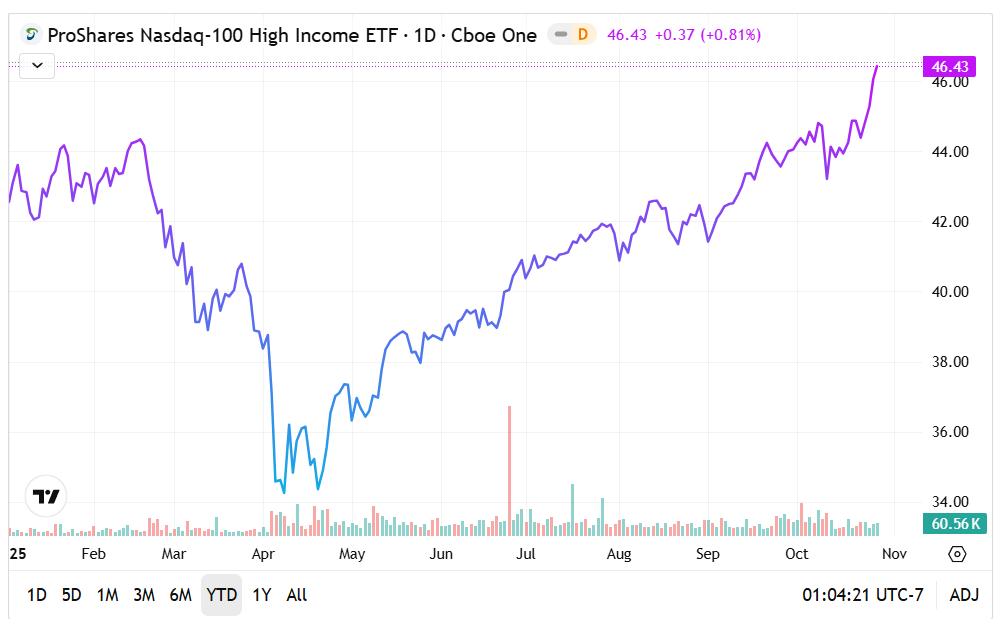
- Current price: $46.39 (+0.23% intraday) [0]
- Year-to-date performance: +8.33% [0]
- Since inception (March 18, 2024): +16.07% [4]
The ETF’s unique daily covered-call strategy distinguishes it from traditional monthly covered-call funds. Using total return swap agreements with institutional counterparties, IQQQ writes options every trading day rather than monthly, allowing more efficient volatility harvesting and frequent upside exposure reopening [1]. This approach has successfully captured 83% of Nasdaq-100’s total returns while generating substantial income [4].
IQQQ’s 10.63% 12-month distribution rate (as of September 30, 2025) significantly outperforms traditional income benchmarks [4]:
- S&P 500 dividend yield: 1.36%
- REITs: 3.93%
- High Dividend Stocks: 2.42%
- Traditional covered call ETFs (Cboe NASDAQ-100 BuyWrite V2): 8.68% [4]
In a declining rate environment, this yield differential becomes increasingly compelling for income investors seeking alternatives to fixed-income securities [0].
The Fed’s policy shift aligns perfectly with IQQQ’s value proposition. As Treasury yields decline following rate cuts, the ETF’s 10.63% distribution rate becomes more attractive relative to fixed-income alternatives [1][4]. The NASDAQ Composite’s outperformance (+4.88% over 30 days) compared to other major indices further supports IQQQ’s technology-heavy focus [0].
IQQQ’s daily options writing mechanism provides several advantages over traditional monthly covered-call strategies:
- More efficient volatility capture in changing market conditions
- Frequent upside exposure reopening during market rallies
- Potentially higher income generation through continuous option premium collection [1]
Trading patterns indicate growing investor interest in IQQQ:
- 30-day average volume: 66,173 shares (significantly above October 2024 levels) [0]
- Current trading above all key moving averages (20-day: $44.97, 50-day: $43.86, 200-day: $41.03) [0]
- Market capitalization: $275.82M [0]
This suggests increasing recognition of the strategy’s value in the current monetary policy environment [1].
- 12-month distribution rate: 10.63% [4]
- Total return capture: 83% of Nasdaq-100 returns [4]
- Year-to-date performance: +8.33% [0]
- Since inception return: +16.07% [4]
- Daily options writing vs. traditional monthly approach [1]
- Total return swap structure with institutional counterparties [1]
- Monthly distribution frequency [4]
- Focus on Nasdaq-100 technology-heavy growth stocks [1]
- Fed funds rate: 3.75%-4.00% (after 25-basis point cut) [1]
- Quantitative tightening halt: December 1, 2025 [1][2][3]
- NASDAQ outperformance: +4.88% over 30 days [0]
- Current trading above key moving averages [0]
- Distribution rate stability and composition (income vs. return of capital)
- Volume trends and trading patterns
- Relative performance versus Nasdaq-100 and competing income ETFs
- Fed policy signals and Treasury yield movements [0][1]
The analysis reveals that IQQQ offers a compelling risk-adjusted return profile in the current monetary policy environment, though investors should monitor the strategy’s performance through various market cycles and be aware of the inherent risks in options-based income generation [1].
Insights are generated using AI models and historical data for informational purposes only. They do not constitute investment advice or recommendations. Past performance is not indicative of future results.
About us: Ginlix AI is the AI Investment Copilot powered by real data, bridging advanced AI with professional financial databases to provide verifiable, truth-based answers. Please use the chat box below to ask any financial question.