
S&P 500 November Seasonality Analysis: Historical Strength Meets Market Concentration Risk
Unlock More Features
Login to access AI-powered analysis, deep research reports and more advanced features
About us: Ginlix AI is the AI Investment Copilot powered by real data, bridging advanced AI with professional financial databases to provide verifiable, truth-based answers. Please use the chat box below to ask any financial question.
Related Stocks
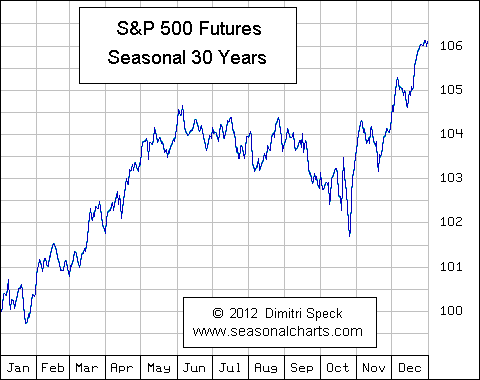
This analysis is based on the Finbold article [1] published on November 2, 2025, which highlights the S&P 500’s historical November strength. The index is currently trading at 6,840.20, near its 52-week high of 6,920.34, with year-to-date gains of 16% [0][1]. The convergence of strong seasonal patterns with current market positioning creates a complex scenario for market participants.
The article’s claims about November strength are well-supported by historical data. TrendSpider data spanning five decades shows November has delivered a 73% win rate with average returns exceeding 2% [1]. Recent performance validates this pattern: November 2024 saw the S&P 500 rise from approximately 5,929.92 to 6,032.38 (+1.73%), while November 2023 delivered gains from 4,460.06 to 4,567.80 (+2.42%) [2]. The index has gained 2.79% over the past 30 trading days, moving from 6,654.28 to 6,840.20 [0], aligning with historical seasonal expectations.
Current market conditions reveal significant structural divergence from historical norms. While the index shows positive momentum, sector performance is notably mixed:
- Energy sector: Leading with +2.81% gains
- Real Estate: Strong performance at +1.77%
- Financial Services: Positive at +1.38%
- Technology sector: Underperforming at -1.74%
- Utilities: Weakest at -2.00% [0]
This divergence is particularly concerning given that AI-linked technology giants have been driving disproportionate gains. The market’s narrow leadership is defined by companies tied to artificial intelligence infrastructure [1], creating concentration risk that differs from broader market participation typically seen in sustainable rallies.
The most significant insight is the market’s heavy reliance on AI-linked giants like Nvidia (NVDA), currently trading at $202.49 with a $4.93 trillion market cap and an elevated P/E ratio of 57.85 [0]. This concentration creates vulnerability to sector-specific setbacks. The article warns that “historically, strong year-end rallies are more sustainable when participation widens across sectors” and notes that “lagging areas, such as small-cap equities, may need to join the advance to avoid a pullback led by current leaders” [1].
Corporate earnings resilience provides support, with companies exceeding profit expectations at higher-than-average rates and strong margins remaining above five-year trends for six consecutive quarters [1]. However, elevated valuations in the AI sector raise questions about sustainability. The technology sector’s underperformance (-1.74%) while the index remains positive suggests underlying weakness that could spread [0].
While the 73% November win rate is compelling, it’s crucial to understand that seasonal patterns are probabilistic, not deterministic. The 27% failure rate represents meaningful risk, particularly given current market conditions that differ from historical averages. Current valuations and sector concentration create a different risk profile than the historical period from which the 73% success rate is derived.
-
Concentration Risk: The market’s heavy reliance on AI giants makes it vulnerable to sector-specific setbacks. If AI enthusiasm moderates, the narrow leadership could trigger significant pullbacks [1].
-
Seasonal Pattern Failure: While historical data shows strong performance, the 27% failure rate represents meaningful risk, particularly given current elevated valuations.
-
Sector Divergence: Technology’s underperformance (-1.74%) while the index remains positive suggests underlying weakness that could spread to broader market [0].
-
Sector Rotation: Current divergence may create opportunities in underperforming sectors if market participation broadens.
-
Seasonal Momentum: If historical patterns hold and market participation widens, the 73% success rate suggests potential for continued gains.
-
Earnings Quality: Strong corporate earnings exceeding expectations could provide fundamental support beyond seasonal factors [1].
- Market breadth indicators: Track whether gains broaden beyond AI and technology sectors
- Small-cap relative performance: Monitor Russell 2000 vs. S&P 500 for signs of widening participation
- Volatility measures: Monitor VIX for early warning signs of increased risk aversion
- Earnings season progression: Watch for Q3 2025 earnings quality and forward guidance
The S&P 500 enters November 2025 with strong historical seasonality advantages but faces significant structural challenges. The index is trading near 52-week highs at 6,840.20, supported by AI-linked giants and corporate earnings resilience [0][1]. However, sector performance divergence and concentration risk create vulnerability. Technology’s underperformance (-1.74%) while energy leads (+2.81%) suggests underlying market stress [0]. The historical 73% November win rate with average returns exceeding 2% provides context, but current market conditions differ from historical averages [1][2]. Market participants should monitor breadth indicators, small-cap performance, and volatility measures to assess whether gains can broaden beyond the current narrow leadership to sustain any seasonal rally.
Insights are generated using AI models and historical data for informational purposes only. They do not constitute investment advice or recommendations. Past performance is not indicative of future results.
About us: Ginlix AI is the AI Investment Copilot powered by real data, bridging advanced AI with professional financial databases to provide verifiable, truth-based answers. Please use the chat box below to ask any financial question.