
Taoping Inc. Restores Nasdaq Compliance: Critical Analysis of Financial Recovery Prospects
Unlock More Features
Login to access AI-powered analysis, deep research reports and more advanced features
About us: Ginlix AI is the AI Investment Copilot powered by real data, bridging advanced AI with professional financial databases to provide verifiable, truth-based answers. Please use the chat box below to ask any financial question.
Related Stocks
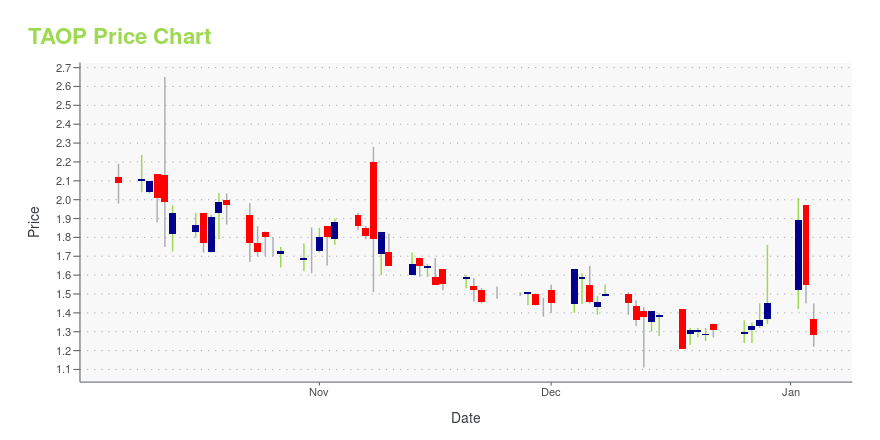
Taoping Inc. (NASDAQ: TAOP) has successfully regained compliance with Nasdaq’s minimum bid price requirement, providing short-term stability by eliminating immediate delisting risk. The company received notification on June 13, 2025, confirming compliance with Listing Rule 5550(a)(2), which mandates a minimum bid price of $1.00 per share. While this regulatory achievement is positive, Taoping continues to face severe fundamental challenges including significant financial distress, declining revenue, and extreme stock volatility. The company currently trades at $2.11 per share with a market capitalization of only $4.11 million, representing an extremely small-cap, high-risk investment opportunity.
The restoration of Nasdaq compliance represents a critical milestone for Taoping, removing the immediate threat of delisting that would have severely impacted shareholder value and market access. The company’s current bid price of $2.11 provides a comfortable buffer above the $1.00 minimum requirement, though continued maintenance above this threshold for 10 consecutive business days remains essential for permanent compliance resolution.
- Forward P/E ratio of 1.92 suggests potential undervaluation relative to earnings expectations
- Price-to-sales ratio of 0.112 indicates low valuation compared to revenue generation
- Gross profit of $7.77 million demonstrates some operational capability despite overall losses
- Moderate debt-to-equity ratio of 0.61 indicates manageable leverage levels
- Negative EPS of -$8.67 reflects significant operational losses
- Profit margin of -4.96% indicates unprofitable business operations
- Quarterly revenue decline of 24.3% year-over-year shows deteriorating business fundamentals
- Operating margin of -7.98% confirms operational inefficiencies
- Return on equity of -12.7% demonstrates poor capital utilization
Taoping operates in the Software Infrastructure sector, focusing on China’s cloud platform and IoT solutions market. The company’s 68.3% year-to-date stock decline, from a 52-week high of $25.50 to current levels around $2.11, reflects severe market skepticism about its business prospects and financial sustainability.
The regulatory compliance achievement occurs alongside deteriorating fundamental metrics, creating a complex investment scenario where short-term stability contrasts with long-term viability concerns. The company’s niche focus on China’s digital transformation market provides growth potential, but execution challenges and financial distress undermine this strategic positioning.
As a Chinese company listed on U.S. markets, Taoping faces additional regulatory scrutiny and geopolitical risks that compound its fundamental business challenges. The extremely small market capitalization of $4.11 million limits institutional investor participation and creates liquidity concerns, potentially exacerbating volatility during market stress periods.
The combination of negative profit margins, declining revenue growth, and operational losses raises serious questions about the company’s long-term business model viability. While the gross margin of 21.2% indicates some pricing power, the inability to translate this into operational profitability suggests structural issues in cost management or market positioning.
- Financial Distress Risk (HIGH): Negative earnings and declining revenue trend indicate potential solvency concerns
- Compliance Maintenance Risk (MEDIUM): Must maintain $1.00 bid price for 10 consecutive business days to ensure permanent compliance
- Market Volatility Risk (HIGH): 68.3% YTD decline demonstrates extreme price sensitivity and investor uncertainty
- Liquidity Risk (HIGH): $4.1M market cap suggests limited trading volume and potential price manipulation
- Regulatory Risk (MEDIUM): Ongoing scrutiny of Chinese companies in U.S. markets could impact future operations
- Business Sustainability Risk (HIGH): Negative operating margins raise questions about long-term viability
- Turnaround Potential: Low valuation metrics suggest potential for significant upside if operational improvements occur
- Market Position: Niche focus on China’s IoT and digital transformation markets provides growth opportunities
- Analyst Expectations: $7.00 target price implies 232% upside potential from current levels
- Compliance Stability: Elimination of delisting risk provides foundation for business stabilization efforts
This investment opportunity is suitable only for investors with:
- High risk tolerance and speculative investment capacity
- Ability to withstand potential total loss of investment
- Understanding of small-cap, international market risks
- Capacity for intensive monitoring and active management
- Limit exposure to maximum 1-2% of total portfolio value
- Consider as satellite position rather than core holding
- Implement strict stop-loss protocols due to volatility concerns
- Quarterly revenue trends and profitability metrics
- Maintenance of Nasdaq compliance status
- Any strategic business initiatives or partnership announcements
- Regulatory developments affecting Chinese U.S.-listed companies
- Cash burn rate and liquidity position
While Taoping’s restoration of Nasdaq compliance provides immediate regulatory stability and eliminates delisting risk, the company’s fundamental financial health remains deeply concerning. The combination of negative earnings, declining revenue, and extreme market volatility creates a high-risk investment scenario that should be approached with extreme caution. Only investors with speculative capacity and high risk tolerance should consider exposure, with strict position sizing and intensive monitoring requirements. The compliance achievement represents a necessary but insufficient condition for investment consideration, with fundamental business performance improvements essential for long-term viability.
Insights are generated using AI models and historical data for informational purposes only. They do not constitute investment advice or recommendations. Past performance is not indicative of future results.
About us: Ginlix AI is the AI Investment Copilot powered by real data, bridging advanced AI with professional financial databases to provide verifiable, truth-based answers. Please use the chat box below to ask any financial question.