
AI Job Disruption Analysis: WSJ Report on AI Employment Impact and Market Response
Unlock More Features
Login to access AI-powered analysis, deep research reports and more advanced features
About us: Ginlix AI is the AI Investment Copilot powered by real data, bridging advanced AI with professional financial databases to provide verifiable, truth-based answers. Please use the chat box below to ask any financial question.
Related Stocks
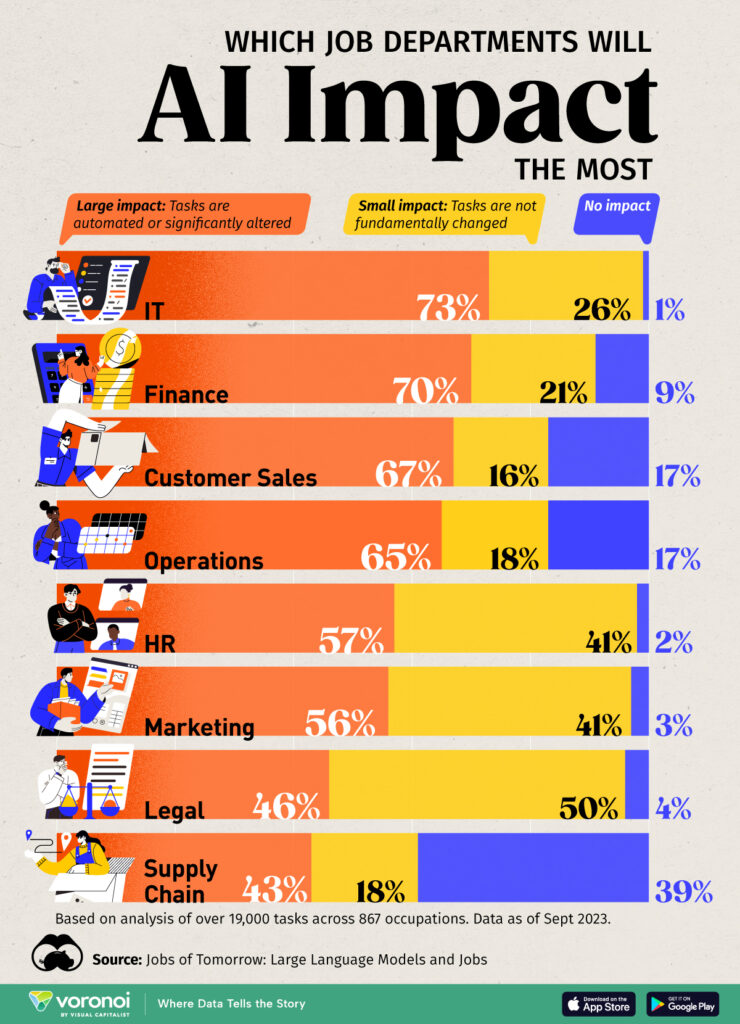
This analysis is based on the Wall Street Journal technology newsletter [1] published on November 2, 2025, titled “AI Really is Coming For the Jobs,” which examines artificial intelligence’s growing impact on white-collar employment. The report emerges amid significant corporate restructuring driven by AI implementation, creating a complex market dynamic where workforce reductions coincide with substantial technology investments.
The WSJ newsletter covers multiple AI-related topics including home robots, small AI models, Tim Cook’s “$4 trillion dance,” and Palantir’s recruitment strategies, suggesting a comprehensive examination of AI’s multifaceted impact on the technology sector and employment landscape [1].
The timing of this report coincides with notable market movements that reveal investor sentiment toward AI-driven workforce changes:
- Technology Sector Decline: The Technology sector underperformed with a -1.74% decline, reflecting investor concern about AI disruption’s impact on traditional tech business models [0]
- Amazon’s Contrasting Performance: Despite announcing 14,000 corporate job cuts attributed to AI, Amazon shares surged 9.58% to $244.22 on November 1, indicating market approval of AI-driven efficiency strategies [0]
- Broader Market Context: Major indices showed mixed performance, with NASDAQ down 0.91% and S&P 500 down 0.50% on October 31, suggesting selective investor response to AI-related news [0]
Amazon exemplifies the paradox of simultaneous AI infrastructure expansion and workforce reduction:
The data reveals a fundamental restructuring of white-collar employment that extends beyond isolated corporate decisions:
- Scale of Disruption: U.S. employers announced 946,000 job cuts in 2025 YTD, the highest since 2020, with over 17,000 explicitly attributed to AI and another 20,000 tied to automation [4]
- Tech Sector Impact: Technology firms alone have shed 108,000 jobs in 2025, suggesting the sector is both driving and experiencing AI disruption [4]
- Skills Transformation: The elimination of corporate roles indicates AI is replacing specific job functions while potentially creating new roles requiring different skill sets
Investors are demonstrating sophisticated differentiation between AI beneficiaries and traditional tech companies:
- Sector Performance Variation: Technology’s -1.74% performance contrasts with Communication Services (+1.15%) and Energy (+2.81%), indicating selective investment based on AI positioning [0]
- Company-Specific Response: Amazon’s 9.58% stock surge following layoffs suggests investors reward companies successfully implementing AI automation [0]
- Valuation Premium: Companies demonstrating clear AI ROI, like Amazon’s $10 billion projected incremental sales from Rufus, receive market premium valuations [5]
The evidence suggests a fundamental shift in corporate strategy toward AI-driven efficiency:
- AI ROI Metrics: Track whether companies’ massive AI investments translate to sustainable profitability improvements and competitive advantages
- Skills Transition Progress: Monitor the emergence of new job categories and required skill sets in AI-augmented workplaces
- Regulatory Response: Watch for potential policy responses to AI-driven job displacement that could affect implementation strategies
- Productivity Correlation: Measure whether AI investments correlate with national productivity growth and economic expansion
The Wall Street Journal’s report on AI job disruption captures a pivotal moment in corporate transformation where artificial intelligence is fundamentally reshaping employment structures. The evidence suggests this represents a structural shift rather than a temporary trend, with profound implications for career planning, investment strategies, and economic policy.
Amazon’s case demonstrates the complex dynamics at play: massive AI investment ($125 billion capex), workforce reduction (14,000 corporate cuts), and strong market approval (9.58% stock surge) can coexist when AI implementation delivers measurable business results [0][3][4].
The broader context of 946,000 YTD job cuts across U.S. employers, with 17,000+ attributed to AI, indicates this transformation extends beyond individual companies to affect the entire employment landscape [4]. Investors are differentiating between AI beneficiaries and traditional tech companies, creating new investment paradigms based on AI positioning and implementation success.
For stakeholders, the key consideration is not whether AI will disrupt employment—that is already occurring—but rather how to navigate the transition effectively. Companies successfully implementing AI automation while managing workforce transitions appear positioned for competitive advantage, while those lagging in adoption may face increasing pressure from both markets and competitors.
Insights are generated using AI models and historical data for informational purposes only. They do not constitute investment advice or recommendations. Past performance is not indicative of future results.
About us: Ginlix AI is the AI Investment Copilot powered by real data, bridging advanced AI with professional financial databases to provide verifiable, truth-based answers. Please use the chat box below to ask any financial question.