
Market Analysis: Fast Money Traders' Weekly Takeaways and AI Sector Volatility
Unlock More Features
Login to access AI-powered analysis, deep research reports and more advanced features
About us: Ginlix AI is the AI Investment Copilot powered by real data, bridging advanced AI with professional financial databases to provide verifiable, truth-based answers. Please use the chat box below to ask any financial question.
Related Stocks
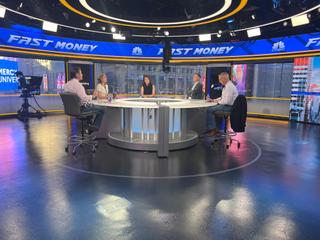
This analysis is based on the CNBC Fast Money segment [1] aired on November 14, 2025, where professional traders discussed their perspectives on the week’s market action. The discussion occurred during a period of significant market volatility, particularly in the technology sector, with notable concerns about AI trade sustainability and elevated valuations. The week concluded with mixed performance across major indices, featuring strong sector rotation patterns and recovery dynamics that suggest underlying market resilience despite surface-level concerns.
The week ending November 14, 2025, presented a complex market landscape with divergent performance across major indices [0]:
- S&P 500: Modest weekly gain of 0.1%, closing at 6,734.11 with a strong Friday rally of +0.93%
- Dow Jones Industrial Average: Outperformed with 0.3% weekly gain, settling at 47,147.48 despite a slight Friday decline of -0.16%
- Nasdaq Composite: Underperformed with 0.5% weekly decline but showed strong Friday recovery to 22,900.59 (+1.58%)
- Russell 2000: Demonstrated resilience with a notable 1.23% gain on Friday
The intraday volatility patterns were particularly significant, with the Nasdaq and S&P 500 recovering from substantial Thursday lows (down 1.9% and 1.4% respectively) to end the week on a positive note [1]. This recovery pattern suggests robust underlying market support despite persistent concerns about technology valuations.
The technology sector experienced heightened volatility driven by growing concerns about AI investment sustainability and valuation levels [1]. Oracle Corporation (ORCL) became a focal point of these concerns, spooking investors regarding AI infrastructure spending and debt financing requirements. However, ORCL demonstrated remarkable resilience, recovering strongly to close at $222.85 (+2.43%) on Friday [0], though still significantly below its 52-week high of $345.72.
Despite valuation concerns, the AI infrastructure investment narrative continued to advance, with major announcements including:
- $100 billion OpenAI data center investment (September announcement)
- Strategic partnerships in AI processors and 6G technology development [1]
NVIDIA Corporation (NVDA), as the AI chip leader, showed particular resilience, closing at $190.17 (+1.77%) with a market capitalization of $4.63 trillion [0]. The company’s upcoming earnings are positioned as crucial catalysts for broader AI sector sentiment.
November 14 sector performance revealed clear rotation dynamics [0]:
- Energy: +3.12% (strongest performer)
- Utilities: +2.16%
- Technology: +2.04% (recovering from weekly weakness)
- Financial Services: +1.41%
- Consumer Cyclical: +1.02%
- Communication Services: -2.22% (weakest performer)
This rotation toward traditional sectors (energy, utilities) and away from high-growth technology may indicate broader market repositioning, potentially driven by valuation concerns and changing risk appetites.
The most significant insight from the week’s action is the market’s demonstrated resilience despite substantial intraday volatility and sector-specific concerns. The ability of major indices to recover from Thursday’s lows suggests underlying support levels and investor confidence in long-term growth prospects, particularly in technology and AI-related investments.
A critical insight emerges from the juxtaposition of massive AI infrastructure investments against growing valuation concerns. While prominent voices including Bill Gates, Michael Burry, and Jim Chanos have raised questions about AI investment sustainability [1], the flow of capital into AI infrastructure continues unabated. This creates a complex dynamic where short-term valuation pressures coexist with long-term investment commitments.
The Fast Money traders’ discussion likely focused on institutional positioning strategies, though specific commentary was not accessible from the video content [1]. The sector rotation patterns suggest institutional investors may be rebalancing portfolios, reducing exposure to high-valuation technology stocks while increasing allocations to more traditional sectors offering better value propositions.
-
NVIDIA Earnings Impact: NVDA’s upcoming results will be crucial for AI sector sentiment and could trigger significant market movements [1].
-
Federal Reserve Policy Influence: Interest rate policy changes could disproportionately impact high-growth technology valuations.
-
Geopolitical Supply Chain Risks: Trade policy changes around technology components and AI infrastructure could affect costs and availability.
-
Inflation Data Transparency: Government shutdown delays in inflation reporting create uncertainty about actual economic conditions and their impact on monetary policy.
The week of November 14, 2025, was characterized by significant market volatility with mixed performance across major indices. The S&P 500 gained 0.1% while the Nasdaq declined 0.5%, though both showed strong Friday recovery patterns [0]. Technology sector volatility centered on AI valuation concerns, particularly affecting Oracle, while NVIDIA demonstrated resilience [0][1]. Sector rotation favored energy (+3.12%) and utilities (+2.16%) over communication services (-2.22%) [0]. The market showed underlying strength despite surface-level concerns, with the ability to recover from substantial intraday declines suggesting robust support levels. Critical factors for ongoing market assessment include NVIDIA’s upcoming earnings, Federal Reserve policy decisions, and the sustainability of AI infrastructure investments [1].
Insights are generated using AI models and historical data for informational purposes only. They do not constitute investment advice or recommendations. Past performance is not indicative of future results.
About us: Ginlix AI is the AI Investment Copilot powered by real data, bridging advanced AI with professional financial databases to provide verifiable, truth-based answers. Please use the chat box below to ask any financial question.