Integrated Analysis
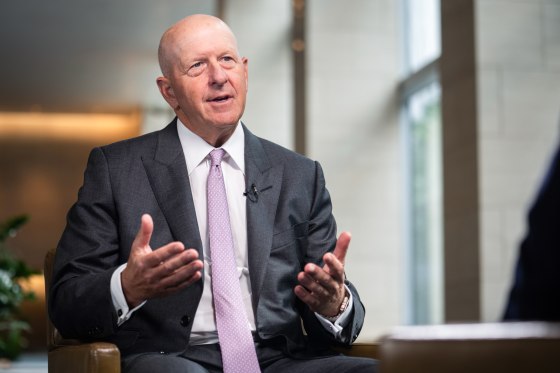
This analysis is based on Goldman Sachs CEO David Solomon’s recent remarks at the Economic Club of Washington on October 30, 2025, where he predicted a major wave of AI-driven productivity gains [1][2]. Solomon emphasized that CEOs across industries are actively pursuing AI to automate processes and boost productivity, with AI integration expected to increase business investment capacity over the next three to five years [1][2]. His views align with sentiments from Microsoft’s Satya Nadella and Nvidia’s Jensen Huang, suggesting potential upside for AI-exposed companies like Goldman Sachs (GS), Microsoft (MSFT), and Nvidia (NVDA) [1].
Current Market Performance Context:
The technology sector is currently underperforming with a -0.51% decline [0], creating a complex backdrop for Solomon’s optimistic AI projections. Individual stock performance shows mixed results: GS at $825.06 (-1.66%), MSFT at $510.57 (-0.11%), and NVDA at $186.02 (-4.01%) [0]. This divergence suggests market participants are selectively pricing AI potential amid broader volatility concerns.
Financial Fundamentals Assessment:
Microsoft demonstrates exceptional positioning with a $3.80T market cap, 35.71% net margins, and strong BUY consensus (82.1% analysts) targeting $640 (+25.3% upside) [0]. Nvidia maintains AI dominance with a $4.53T market cap, extraordinary 52.41% net margins, and 88.3% revenue from Data Center operations [0]. Goldman Sachs shows solid fundamentals with $258.84B market cap and 12.60% net margins, though trading below analyst consensus targets [0].
Key Insights
Investment Scale and Selectivity:
Solomon’s projection of $350 billion in combined AI infrastructure spending from 6-7 large companies this year [2] represents a massive capital deployment. However, his caution that “there will be winners and losers” and that “a lot of capital being deployed will not produce adequate returns” [2] suggests significant investment dispersion risk.
Historical Parallel and Volatility:
Drawing comparisons to the late 1990s tech boom where Nasdaq rose from 1,300 to over 5,000 before experiencing “adjustments and drawdowns” [2], Solomon implicitly warns of potential volatility despite the positive trend. This historical context suggests that while the AI thesis may be sound, the path could be volatile with intermediate corrections.
Implementation Pace Challenges:
The rapid AI adoption pace Solomon describes as “quicker” than previous technological shifts creates both opportunity and risk [1]. This accelerated timeline could lead to implementation challenges, workforce disruptions, and potential delays in realizing projected productivity gains.
Valuation Premiums vs. Growth Potential:
Current valuations reflect significant AI expectations - NVDA at 53.00x P/E and MSFT at 36.37x P/E [0] - suggesting substantial growth is already priced in. Goldman Sachs trades more reasonably at 16.75x P/E [0], potentially offering better risk-adjusted exposure to AI productivity gains through financial services transformation.
Risks & Opportunities
Major Risk Factors
Valuation Risk:
Premium valuations across AI beneficiaries create vulnerability to corrections. Any disappointment in AI adoption rates or productivity gains could trigger significant downside, particularly for high-multiple stocks [0].
Implementation Risk:
Solomon acknowledged that rapid AI adoption creates “volatility or an unsettled transition around certain job functions” [1]. This disruption could delay productivity realization and create unexpected operational challenges.
Capital Allocation Risk:
The warning that some AI investments “won’t produce any returns at all” [2] suggests potential for significant write-offs. Investors face the challenge of identifying which AI investments will generate sustainable returns versus speculative ventures.
Concentration Risk:
Heavy reliance on a few large tech companies for AI infrastructure creates systemic risk. Any slowdown at major players could impact the entire AI investment thesis and related market valuations.
Opportunity Windows
Productivity Gains:
Successful AI implementation could drive meaningful margin expansion and operational efficiency across industries, creating sustainable competitive advantages for early adopters with effective strategies.
Infrastructure Demand:
The projected $350 billion in AI spending [2] creates significant opportunities for companies providing essential AI infrastructure, particularly in cloud services, semiconductors, and data center operations.
Financial Services Transformation:
Goldman Sachs and other financial institutions could benefit from AI-driven productivity improvements in trading, risk management, and customer service, potentially leading to margin expansion and new revenue streams.
Selective Investment Opportunities:
Solomon’s emphasis on “winners and losers” [2] suggests opportunities for investors who can identify companies with clear AI monetization strategies and strong execution capabilities.
Key Information Summary
CEO Consensus on AI Potential:
Industry leaders including Solomon, Nadella, and Huang share optimism about AI-driven productivity gains, suggesting broad-based corporate commitment to AI integration [1][2].
Market Positioning:
Microsoft and Nvidia demonstrate strong fundamentals and analyst support for AI exposure, while Goldman Sachs offers financial services AI potential at more reasonable valuations [0].
Investment Timeline:
Solomon’s 3-5 year projection for meaningful AI productivity gains [1][2] provides a medium-term investment horizon, though near-term volatility appears likely.
Spending Magnitude:
The $350 billion projected AI infrastructure investment [2] represents significant capital commitment that could drive growth for well-positioned companies.
Selective Success:
Solomon’s caution about “winners and losers” [2] emphasizes the importance of company-specific analysis rather than broad sector exposure to AI trends.
Current Market Dynamics:
Technology sector underperformance (-0.51%) [0] amid AI optimism suggests market participants are differentiating between AI beneficiaries and general tech exposure.
Risk Management:
The historical parallel to 1990s tech boom [2] suggests investors should prepare for potential volatility while maintaining exposure to long-term AI trends.