
AI Investment Risk Analysis: Ned Davis Research Warns of Potential 2026 Market Correction
Unlock More Features
Login to access AI-powered analysis, deep research reports and more advanced features
About us: Ginlix AI is the AI Investment Copilot powered by real data, bridging advanced AI with professional financial databases to provide verifiable, truth-based answers. Please use the chat box below to ask any financial question.
Related Stocks
This analysis is based on the Seeking Alpha article [1] published on November 1, 2025, which reported on Ned Davis Research’s warning about AI investments potentially backfiring in 2026.
The market has demonstrated robust performance across major indices over the past 60 days [0], with the NASDAQ Composite leading gains at +11.30%, followed by Russell 2000 (+11.54%), Dow Jones (+7.95%), and S&P 500 (+7.63%). However, emerging sector divergence is evident, with Technology declining -1.74% while Energy (+2.81%) and Financial Services (+1.38%) showed strength [0].
NVIDIA, the bellwether AI stock, exemplifies the current AI investment enthusiasm with a market cap of $4.93 trillion and elevated P/E ratio of 57.69 [0]. Recent developments include CEO Jensen Huang’s $1 billion stock sale and announcement of major AI infrastructure partnerships, including a Samsung-Nvidia AI megafactory powered by 50,000 GPUs [3].
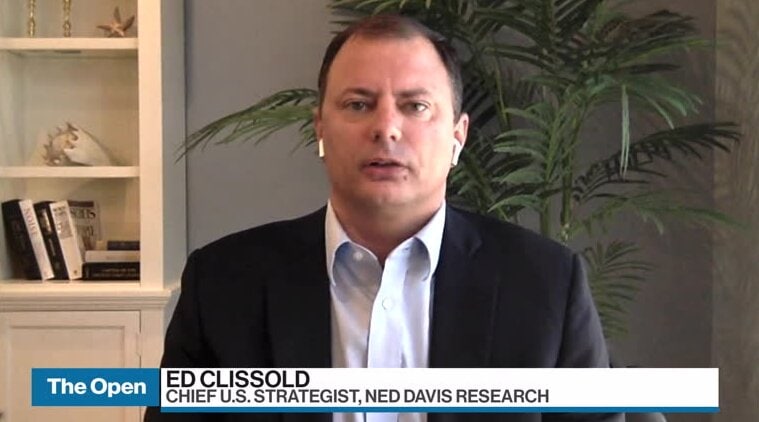
Ed Clissold, Chief US Strategist at Ned Davis Research, characterizes the current AI investment surge as a “classic” capital expenditure cycle that historically “end[s] poorly with a bear market, in some cases a recession” [2]. The analysis draws compelling parallels to the late 1990s market environment, suggesting the AI rally may continue through 2025 but face significant headwinds in 2026.
Despite the warning, Clissold acknowledges that current market breadth remains healthy, with most stocks above their 50-day and 200-day moving averages and positive trends across smaller groups within sectors [2]. This indicates broader market support beyond mega-cap AI stocks.
There’s a notable disconnect between Clissold’s cautious outlook and current market momentum. While recent earnings from major tech companies and continued AI infrastructure investments suggest the cycle may have further room to run [3], historical patterns suggest such cycles typically end with corrections.
The 2000-2002 bear market provides valuable context: the Russell 2000 Value Index only declined 5% while the S&P 500 fell nearly 50% [2]. This suggests potential rotation opportunities away from AI-heavy mega-cap stocks toward value and small-cap segments during a potential correction.
Unlike previous bubble cycles, today’s mega-cap tech companies possess substantial cash reserves that could extend the current AI investment cycle longer than historical precedents [2]. This factor may delay but not necessarily prevent the eventual correction.
The analysis reveals several concerning factors that support Clissold’s warning:
- Elevated Valuations: NVIDIA’s P/E ratio of 57.69 suggests stretched valuations across AI stocks [0]
- Capital Intensity: Massive AI infrastructure spending by major tech companies may not yield proportional returns
- Market Concentration: Heavy reliance on mega-cap tech stocks for market gains creates vulnerability
Decision-makers should track several critical indicators:
- AI capital expenditure trendsand ROI metrics from major tech companies
- Sector rotation patternsaway from technology toward other sectors
- Corporate earnings guidancespecifically related to AI investment returns
- Interest rate environmentand its impact on growth stock valuations
Clissold suggests diversification opportunities, noting that “there’s always a bull market somewhere” and highlighting gold as a potential hedge [2]. Historical data indicates value and small-cap stocks may provide protection during tech corrections, as evidenced by the Russell 2000 Value Index’s relative outperformance during 2000-2002.
The current AI-driven market rally demonstrates strong momentum through 2025, but historical capex cycle patterns suggest elevated risk of a correction in 2026. While mega-cap tech companies’ strong cash positions may extend this cycle beyond typical durations, the fundamental dynamics of capital-intensive investment cycles remain concerning. Market participants should monitor AI investment returns, sector rotation patterns, and valuation metrics while considering diversification strategies that include value and small-cap segments as potential hedges against AI-heavy portfolio concentration [0, 1, 2, 3].
Insights are generated using AI models and historical data for informational purposes only. They do not constitute investment advice or recommendations. Past performance is not indicative of future results.
About us: Ginlix AI is the AI Investment Copilot powered by real data, bridging advanced AI with professional financial databases to provide verifiable, truth-based answers. Please use the chat box below to ask any financial question.