Integrated Analysis
Qualcomm’s Strategic Market Entry
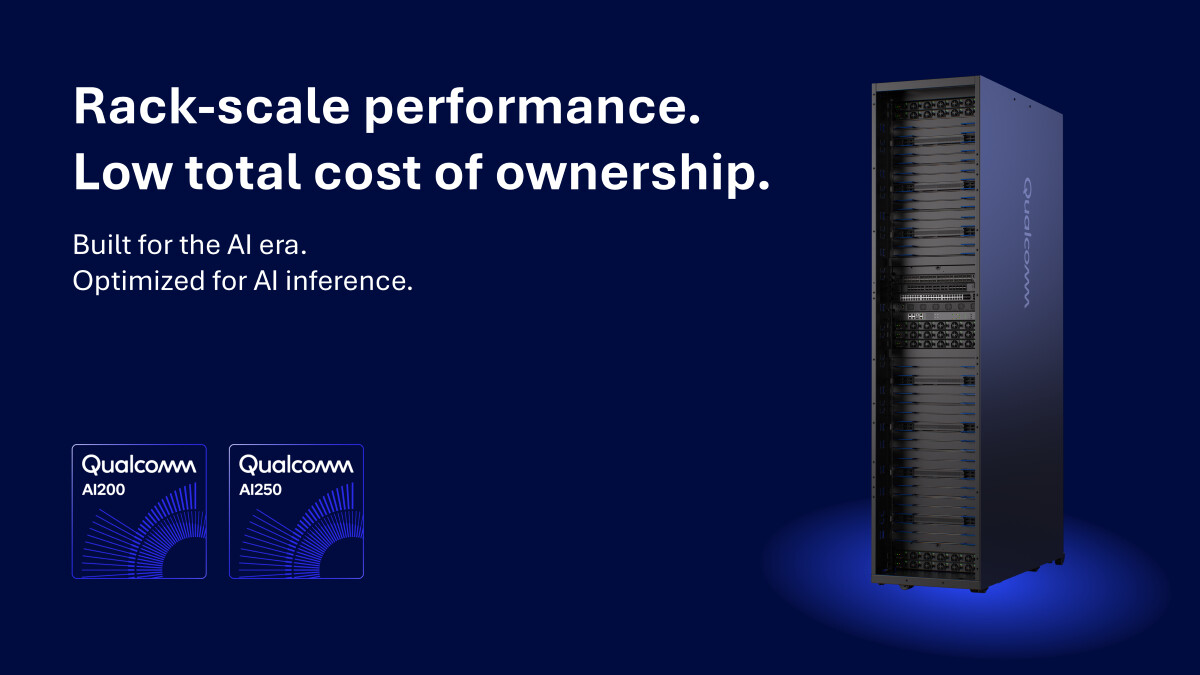
Qualcomm’s announcement of AI200 (2026) and AI250 (2027) inference accelerators represents a significant strategic pivot into the data center AI chip market [2][4]. This move targets the rapidly growing AI inference market, projected to expand from $106.15 billion in 2025 to $254.98 billion by 2030 (19.2% CAGR) [9]. The company leverages its established Hexagon NPU technology, refined through mobile applications, to address specific enterprise pain points in AI infrastructure deployment [2][4].
The technical specifications reveal Qualcomm’s differentiated approach: 768GB LPDDR memory per card, liquid cooling, and rack-scale deployment targeting [2][4]. The AI250’s near-memory computing architecture promises 10x higher effective bandwidth with reduced power consumption, directly addressing operational cost concerns that drive enterprise adoption decisions [2][4]. This inference-focused strategy mirrors successful custom chip approaches, prioritizing total cost of ownership (TCO) over raw training performance [4][5].
Competitive Landscape Analysis
The market entry confronts Nvidia’s dominant position in data center AI chips, with estimates suggesting 80-92% market share and projected $49 billion AI revenue in 2025 [12][13]. AMD maintains a smaller but growing presence with $5.6 billion projected AI chip revenue, though facing pressure from Nvidia’s Blackwell architecture ramp [12]. The competitive dynamics favor ASICs for inference efficiency, with projections indicating 37% deployment share for specialized chips in 2025 [12].
Qualcomm’s advantages include mobile-optimized efficiency expertise, established cloud provider relationships, and potential cost advantages through LPDDR versus expensive HBM memory [2][4]. However, significant barriers exist in Nvidia’s entrenched CUDA ecosystem, AMD’s established data center presence, and Qualcomm’s limited track record in enterprise computing [12][13].
Financial and Market Implications
Market Share Projections
Based on current market dynamics and Qualcomm’s positioning, conservative estimates suggest 3-5% market share by 2027, potentially expanding to 8-12% by 2030 contingent on successful execution. This projection assumes timely product launches, competitive performance, and adoption by at least 2-3 major cloud providers.
Margin Structure Analysis
Qualcomm’s current financial metrics show strong profitability with 26.77% net margins and 27.79% operating margins [0]. Data center AI chips likely present different margin dynamics:
- Initial gross margins projected at 30-35% versus Nvidia’s 70%+ GPU margins
- Operating margins expected at 15-20% in early years, improving to 25%+ at scale
- Higher R&D investment requirements (15-20% of revenue) initially
The inference focus should enable better margins than training chips through lower manufacturing complexity and LPDDR memory advantages, while leveraging existing mobile IP investments [2][4].
Key Insights
Cross-Domain Strategic Implications
Supply Chain Ripple Effects
: Qualcomm’s entry amplifies demand across the semiconductor ecosystem. TSMC benefits from increased advanced node requirements regardless of market share outcomes, while ASML sees continued EUV lithography demand. Memory equipment providers gain from AI chip memory capacity expansion, and AI-specific IP providers experience increased demand [0][15].
Market Validation Signal
: The move validates inference as distinct from training workloads, creating specialized market segments. Qualcomm’s annual product cadence suggests serious commitment to data center market penetration, potentially accelerating the shift from general-purpose GPUs to specialized inference solutions [3][4].
Competitive Response Dynamics
: Established players face strategic dilemmas - maintain premium pricing versus respond to new competitive pressures. Nvidia may need to segment its portfolio more explicitly between training and inference workloads, while AMD must defend its growing data center presence against new entrants [12][13].
Technology Trend Implications
Architecture Evolution
: Near-memory computing in AI250 represents a significant architectural shift addressing memory bandwidth constraints that limit current AI deployments. This approach could influence broader industry design patterns, particularly as model sizes continue expanding [2][4].
Software Ecosystem Importance
: Qualcomm’s emphasis on rich software compatibility with leading AI frameworks highlights the critical role of developer experience in adoption decisions. The success of hardware initiatives increasingly depends on software ecosystem maturity and integration ease [3][4].
Regulatory Impact Considerations
: Export controls on high-end AI chips to China create market fragmentation opportunities. Qualcomm’s inference-focused approach may navigate regulatory constraints more effectively than training-optimized alternatives [12].
Risks & Opportunities
Critical Risk Factors
Execution Risk
: New product category entry requires significant R&D investment ($2-3 billion annually) with uncertain returns. Technical challenges in scaling from mobile to data center applications could delay timelines or impact performance [2][4].
Competitive Response Risk
: Established players may respond aggressively through pricing, ecosystem enhancements, or accelerated product roadmaps. Nvidia’s CUDA ecosystem advantages create high switching costs that could limit adoption despite technical advantages [12][13].
Market Timing Risk
: The 2026-2027 product timeline faces potential market evolution uncertainties. Rapid technological advances could render current specifications less competitive by launch date [2][4].
Margin Pressure Risk
: Aggressive competitive dynamics could compress margins below projections, particularly if pricing becomes more value-based than technology-differentiated [0][12].
Strategic Opportunity Windows
First-Mover Inference Advantage
: Early entry into specialized inference market could establish ecosystem advantages before larger competitors fully segment their portfolios. The TCO focus aligns with enterprise deployment priorities as AI models mature [4][5].
Cloud Provider Partnerships
: Established relationships through mobile chips provide pathways to early adoption. Securing 2-3 major cloud provider commitments could create momentum for broader market acceptance [3][4].
Supply Chain Positioning
: Early engagement with foundry and equipment providers ensures capacity access in constrained advanced node environments. This advantage becomes increasingly valuable as AI chip demand accelerates [0][15].
Software Ecosystem Development
: Investment in developer tools and framework integration could create sticky adoption barriers. Early ecosystem establishment compounds advantages over time [3][4].
Key Information Summary
Market Context and Timing
The announcement occurs during accelerated AI infrastructure spending, with major cloud providers expected to invest $260 billion in 2025 [10]. The broader AI infrastructure market projects $6.7 trillion spending by 2030, with $5.2 trillion allocated to AI compute specifically [9][10][11]. This timing provides favorable market conditions for new entrants addressing specific deployment challenges.
Investment Implications
Qualcomm (QCOM)
: Current valuation at P/E 17.06x appears reasonable given growth potential, with analyst consensus target of $192.50 suggesting 6.4% upside [0]. The strategic move addresses potential Apple modem revenue erosion while creating new growth vectors. Long-term positioning improves as AI inference demand accelerates, though near-term revenue impact remains limited until 2026 product launches [7][8].
Competitive Impact
: Nvidia (NVDA) at $4.93T market cap and P/E 57.69x reflects dominant positioning but may face inference segment margin pressure as competition increases [0][12]. AMD’s high P/E of 152.45x suggests elevated growth expectations vulnerable to competitive pressures [0].
Supply Chain Beneficiaries
: TSMC, ASML, and equipment providers benefit from increased demand regardless of individual market share outcomes. The AI chip expansion creates structural demand increases for advanced manufacturing capabilities [0][15].
Critical Information Gaps
Missing Performance Validation
: Independent benchmarks comparing AI200/AI250 against Nvidia/AMD solutions remain unavailable, making performance claims difficult to verify [2][4][12].
Pricing and Commercial Terms
: No announced pricing structure or commercial terms prevents accurate TCO analysis and market penetration assessment [2][4].
Customer Commitments
: Absence of announced design wins or customer partnerships creates uncertainty about initial adoption trajectory [3][4].
Manufacturing Partnerships
: Undisclosed foundry relationships limit assessment of capacity access and manufacturing risk [2][4].
Software Ecosystem Details
: Specific AI framework compatibility and developer tool capabilities require further clarification for adoption evaluation [3][4].
Future monitoring should focus on Q4 2025 earnings for data center investment guidance, early 2026 customer announcements, mid-2026 performance benchmarks, and late 2026 commercial availability metrics.