
In-depth Research Report on iFLYTEK's B2A2C New Marketing Paradigm and SuperAgent Framework
Unlock More Features
Login to access AI-powered analysis, deep research reports and more advanced features
About us: Ginlix AI is the AI Investment Copilot powered by real data, bridging advanced AI with professional financial databases to provide verifiable, truth-based answers. Please use the chat box below to ask any financial question.
Related Stocks
Based on the latest collected information and data analysis, I will compile an in-depth analysis report on iFLYTEK’s B2A2C new marketing paradigm and its SuperAgent framework.
On January 15, 2026, iFLYTEK held the 2026 iFLYTEK AIMC Global Intelligent Marketing Ecosystem Summit in Shenzhen, where iFLYTEK AI Marketing (AIMarX) officially launched the Marketing SuperAgent application framework and released a marketing agent platform built on this framework[1][2]. The summit brought together iFLYTEK ecosystem partners, conducted in-depth dialogues with global partners through parallel sub-forums, and fully showcased the new intelligent marketing ecosystem via an ecological exhibition zone[1].
The summit revolved around the core concept of ‘swarm intelligence’, aiming to drive marketing from ‘experience-driven’ to ‘intelligence-driven’ and promote the marketing industry’s upgrade from single-point optimization to systemic intelligent transformation[2]. In his opening speech, Yu Jidong, Senior Vice President of iFLYTEK and President of the Consumer Business Group, pointed out that AI has evolved from a ‘function’ to the ‘underlying architecture’ of products, and the public’s evaluation of products is also feedback on their AI capabilities[1][2].
The core challenges facing the current marketing industry are mainly reflected in the following aspects:
| Challenge Dimension | Specific Performance |
|---|---|
Data Silos |
Marketing data is scattered across multiple fragmented touchpoints, restricted by privacy regulations, and needs to support real-time decision-making[2] |
Globalization Complexity |
Diverse market hierarchies, significant cultural differences, and highly dispersed touchpoints make manual efforts insufficient[2] |
Limitations of Single Agent |
Single-function agents are difficult to meet the needs of complex marketing scenarios, lacking comprehensive problem-solving capabilities with industry insights[2] |
Invalid Value Measurement |
Traditional collaboration models have severe barriers, and traditional metrics like click-through rate and conversion rate are difficult to measure long-term trust between brands and consumers[2] |
Ronen Mense, President and Managing Director of AppsFlyer Asia Pacific, pointed out at the summit that AI’s position in the marketing industry is shifting from an optional efficiency-aiding tool to a foundational support that deeply empowers core business processes, while the disunity and even fragmentation in data and system dimensions constitute the core bottleneck restricting the full release of AI value[1][2].
B2A2C (Brand to Agent to Consumer) is a new marketing relationship paradigm proposed by iFLYTEK, officially put forward by Li Ping, President of iFLYTEK AI Marketing Business Group. The core evolution logic of this paradigm is as follows:
- Brands face consumers directly
- Relies on manual experience and static labels
- Marketing decisions are based on historical data and experience judgments
- Dominated by one-way communication with limited interactivity
- AI agents serve as intelligent bridges between brands and consumers
- Achieves a fundamental shift from ‘experience-driven’ to ‘intelligence-driven’
- Multi-agent collaboration enables full-domain data integration
- Dynamic and real-time personalized marketing reach

The core concept of the B2A2C paradigm is ‘swarm intelligence’, which includes the following key elements:
- Multi-agent Collaboration: Breaks down barriers between traditional marketing departments, creates cross-functional collaborative workflows, enables optimizers, creative teams, etc., to have a unified work perspective, and breaks the siloed state of data analysis, content creation, and media placement[2]
- Ecosystem-level Reconstruction: Uses AI as the underlying architecture rather than a single function to achieve ecosystem-level reconstruction, promotes the rebuilding of a value measurement system, shifting from being limited to traditional metrics like click-through rate and conversion rate to measuring long-term trust and value connections between brands and consumers[2]
- Autonomous Evolution Capability: Builds an autonomously evolving super marketing hub, driven by full-domain data and with multi-modal perception as its tentacles, to enable continuous learning and optimization of agents
The proposal of the B2A2C paradigm has the following strategic significance:
- Paradigm Innovation: Promotes the fundamental upgrade of the marketing industry from single-point optimization to systemic intelligent transformation
- Value Remodeling: Redefines the relationship between brands and consumers, shifting from transactional relationships to value symbiotic relationships
- Efficiency Leap: Achieves an order-of-magnitude improvement in marketing efficiency through agent collaboration
- Global Adaptation: Provides replicable and scalable intelligent solutions for brand global marketing
iFLYTEK’s Marketing SuperAgent application framework is built on the iFLYTEK Spark Large Model, with two core capabilities of ‘Intelligent User Reach’ and ‘Intelligent Creative Production’ as its foundation[1][2].
| Core Capability | Function Description | Application Scenario |
|---|---|---|
Intelligent User Reach |
Deeply understands user needs and achieves precise audience targeting | Focuses on scale and efficiency in the early A-I stage |
Intelligent Creative Production |
Generates multi-modal content and supports personalized creative output | Focuses in-depth and continuous operation in the late P-L stage |
iFLYTEK has planned a two-stage evolution path for SuperAgent:
- Has achieved end-to-end closed-loop delivery in the programmatic advertising field
- Completes the entire process from strategy formulation, audience targeting, delivery review to customer retention within a single scenario
- Achieves intelligent upgrading of local scenarios
- Enhances SuperAgent’s global deduction and autonomous collaboration capabilities
- Deeply understands the business logic behind KPIs
- Independently formulates full-domain marketing strategies
- Achieves dynamic game and collaborative optimization among agents
- Completely breaks through marketing scenario boundaries
Delivery Strategy SuperAgent addresses the differentiated needs of each link in the AIPL (Awareness-Interest-Purchase-Loyalty) chain, helping brands achieve dynamic adaptation and global optimization:
- A-I Stage (Awareness-Interest): Focuses on scale and efficiency, achieving rapid user reach through intelligent delivery
- P-L Stage (Purchase-Loyalty): Focuses on in-depth and continuous operation, optimizing the entire lifecycle value of users
- Precise Connection: By precisely connecting scenarios, users and content, and focusing on vertical scenarios, it drives growth from users to sales for brands[1][2]
During the summit, Wang Dong, Deputy General Manager of Media Intelligence at CSM Media Research Co., Ltd., Xu Weichong, Vice President of Performance Marketing and E-commerce at Dentsu China, Zhong Kun, Vice President of iFLYTEK and General Manager of Reading and Writing Technology, Shi Yilong, Media Director of UPPAbaby China, and Wang Yunxia, Vice President of iFLYTEK AI Marketing Business Group, jointly announced the official establishment of the “iFLYTEK GEO Strategic Cooperation Alliance”[1].
The alliance aims to deeply bind the implementation logic of SuperAgent through more collaborative ecological resource integration and more precise technical capability empowerment, covering four core sectors: overseas advertising, influencer marketing, brand full-domain marketing, and programmatic advertising[1][2].
According to the latest market data, the Chinese general AI application market has formed a clear competitive landscape in 2025[3][4]:
| Ranking | Product | Monthly Active Users | Background |
|---|---|---|---|
| 1 | ByteDance Doubao | 172 million | ByteDance |
| 2 | DeepSeek | 145 million | DeepSeek |
| 3 | Tencent Yuanbao | 32.86 million | Tencent |
| 4 | Baidu Qianwen/Wenxiaoyan | - | Baidu |
In terms of user scale distribution, the market shows a 6:3:1 structure, with Doubao accounting for 60%, DeepSeek 30%, and the remaining products sharing 10%[3].
- Doubao AI: Leverages the unlimited traffic exposure of TikTok (Douyin), with both software and hardware products being promoted and implemented
- On the ToB side, it continues to expand its influence in the MaaS (Model as a Service) field through Volcano Engine with its vertical category and cost-effective advantages
- 2025 capital expenditure plan reaches 150 billion yuan, a year-on-year increase of 88%[4]
- Qianwen APP (formerly Tongyi) launched in November 2025, with monthly active users exceeding 30 million in 23 days, achieving nearly 10-fold user growth
- Alibaba Cloud’s AI-related product revenue has maintained triple-digit year-on-year growth for nine consecutive quarters[4]
- Will invest 380 billion yuan in the next three years to build cloud and AI hardware infrastructure[4]
- Yuanbao has been connected to dozens of internal core applications such as WeChat, Tencent Meeting, and Tencent Video
- Marketing service revenue increased by 21% year-on-year in Q3 2025, with AI-driven advertising platform improvements being a key factor[4]
- 2025 capital expenditure is expected to reach 100 billion yuan[4]
- AI-native marketing service revenue increased by 262% year-on-year to 2.8 billion yuan in Q3 2025, accounting for 18% of core advertising revenue[4]
- Cumulative AI investment has exceeded 100 billion yuan since March 2023[4]
Facing competitive pressure from internet giants, iFLYTEK has adopted a differentiated positioning strategy in the AI marketing field:
| Dimension | iFLYTEK’s Strategy | Competitive Advantage |
|---|---|---|
Technical Route |
Focuses on the B2A2C paradigm, emphasizing swarm intelligence | Vertically deepens marketing scenarios, avoiding general-purpose competition |
Large Model Foundation |
Built on the iFLYTEK Spark Large Model | Leading advantages in Chinese speech and semantic technology |
Ecosystem Construction |
GEO Strategic Cooperation Alliance | Professional marketing ecosystem partner network |
Scenario Focus |
Vertical scenarios such as programmatic advertising and overseas marketing | Solution capabilities deeply cultivated in specific scenarios |
According to the latest financial data, the core financial indicators of iFLYTEK (002230.SZ) are as follows[5][6]:
| Indicator | Value | Industry Comparison |
|---|---|---|
Market Capitalization |
147.267 billion yuan | - |
Price-to-Earnings Ratio (P/E) |
175.89x | Relatively high |
Price-to-Book Ratio (P/B) |
8.27x | Above medium |
Return on Equity (ROE) |
4.70% | Relatively low |
Net Profit Margin |
3.29% | Relatively low |
Current Ratio |
1.48 | Stable |
Beta Coefficient |
0.8 | Relatively resilient to declines |
iFLYTEK’s stock price has performed strongly recently[5][6]:
| Period | Price Change |
|---|---|
| 5-Day | +10.78% |
| 1-Month | +29.13% |
| 3-Month | +24.07% |
| 6-Month | +33.82% |
| 1-Year | +32.90% |
| YTD | +18.31% |
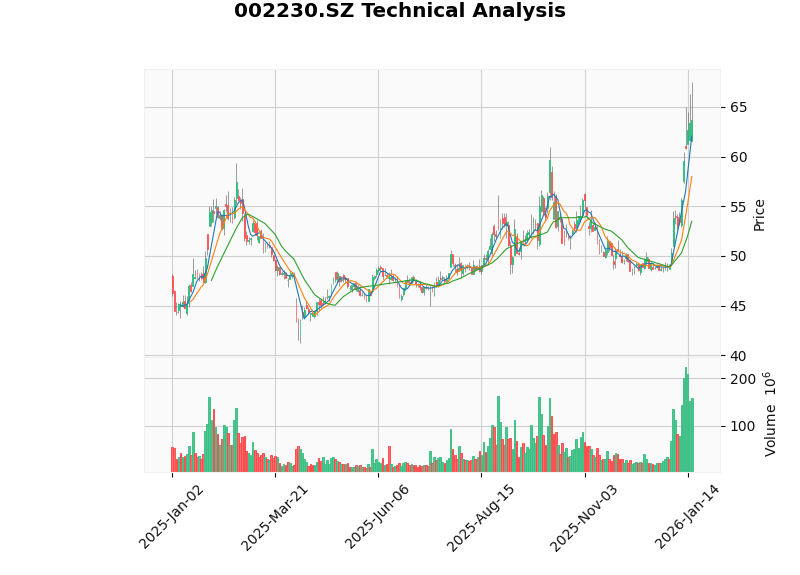
According to technical analysis results[6]:
| Indicator | Value | Signal Interpretation |
|---|---|---|
MACD |
No Crossover | Neutral bullish |
KDJ |
K:79.9, D:80.8, J:78.0 | Short-term overbought risk |
RSI (14) |
- | In the overbought zone |
Trend Judgment |
Sideways consolidation | No clear direction |
Support Level |
$53.48 | - |
Resistance Level |
$64.93 | - |
The latest quarterly financial data shows[5]:
-
Q3 2025 (2025-10-21):
- EPS: $0.07 (expected $0.09), 16.84% below expectations
- Revenue: $6.08 billion (expected $6.62 billion), 8.16% below expectations
-
Profit Trend:
- Q2 FY2025: Loss of $0.02
- Q4 FY2024: Profit of $0.39
- Q1 FY2025: Loss of $0.08
The company’s current profitability is highly volatile, and it is still in the strategic investment period.
- Global marketing complexity is increasing exponentially, and brands have strong demand for intelligent marketing solutions
- Data silos are a widespread problem, and SuperAgent provides systematic solutions
- Global brands need replicable intelligent marketing infrastructure
- The iFLYTEK Spark Large Model continues to iterate and upgrade
- Leading advantages in Chinese speech and semantic technology
- The Star Agent platform accelerates the large-scale application and implementation of agents
- The GEO Strategic Cooperation Alliance integrates multi-party resources
- Covers four core sectors: overseas advertising, influencer marketing, brand full-domain marketing, and programmatic advertising
- Global layout adapts to the needs of brand going global
- The capital expenditure scale of internet giants far exceeds that of iFLYTEK (ByteDance’s 160 billion yuan, Alibaba’s 380 billion yuan for reference)
- The general AI application market has been dominated by Doubao, DeepSeek, etc.
- Faces competition from professional AI marketing companies in vertical fields
- The payment model for AI marketing solutions remains to be verified
- Enterprise customers have long decision-making cycles, making implementation difficult
- The redefinition of ROI measurement standards requires market education
- Large model technology is evolving rapidly, leading to uncertainty in technical routes
- The capability boundary of agents continues to expand, requiring maintenance of technological leadership
- Data security and privacy compliance requirements are becoming increasingly stringent
- The B2A2C paradigm is forward-looking and conforms to the development trend of AI marketing
- The SuperAgent framework adopts differentiated positioning, avoiding direct competition with giants
- The summit and ecological cooperation demonstrate a positive attitude towards market expansion
- The strong stock price performance reflects the market’s recognition of the company’s AI strategy
- High valuation (175x P/E) requires sustained high growth to support it
- Profitability volatility indicates that commercialization is still in the exploration stage
- Facing competition from giants, there is an obvious resource gap
- The B2A2C paradigm is innovative: The B2A2C marketing paradigm proposed by iFLYTEK represents an important evolution direction in the AI marketing field, driving marketing from experience-driven to intelligence-driven through swarm intelligence, and has certain industry-leading significance[1][2].
- The SuperAgent framework has differentiated advantages: The SuperAgent framework focuses on vertical scenarios, emphasizes multi-agent collaboration and ecological reconstruction, and is targeted at solving industry pain points such as data silos and fragmented touchpoints[2].
- Growth engine potential remains to be verified: Although the strategic direction is correct, whether SuperAgent can become a new growth engine for the company still needs to be observed through commercial implementation effects and changes in the market competitive landscape.
- Competitive pressure cannot be ignored: Facing the hundreds-of-billion-yuan investments in AI by giants like ByteDance, Alibaba, and Tencent, iFLYTEK needs to continue to deeply cultivate its differentiated path and build competitive barriers[3][4].
- SuperAgent Phase 1.0 continues to be implemented in fields such as programmatic advertising
- The GEO Strategic Cooperation Alliance expands its ecological partner network
- Pay attention to the revenue contribution of AI marketing business in the Q1 financial report
- SuperAgent Phase 2.0 achieves global deduction and autonomous collaboration capabilities
- The B2A2C paradigm forms a word-of-mouth effect among brand customers
- Evaluate whether external strategic investment needs to be introduced to accelerate development
- The AI marketing industry pattern gradually stabilizes
- Suppliers with ecosystem-level capabilities form oligopolistic competition
- iFLYTEK needs to clarify its position in the industrial chain
- Uncertainty in AI technology iteration
- Risk of intensified market competition
- Commercialization process falling short of expectations
- Macroeconomic fluctuations affecting the prosperity of the advertising industry
[1] Sina Finance - “2026 iFLYTEK AIMC Launches Today! ‘SuperAgent’ Revitalizes the Win-Win Global Marketing Ecosystem” (https://finance.sina.com.cn/tech/roll/2026-01-16/doc-inhhncxc5657517.shtml)
[2] 36Kr - “iFLYTEK Launches SuperAgent Application Framework, Driving the Evolution of Marketing Relationships to B2A2C” (https://eu.36kr.com/zh/p/3642948995862405)
[3] OFweek - “Fierce Competition in AI Internet: 2026 ByteDance, Alibaba, Tencent Three-Party Battle is Coming!” (https://m.ofweek.com/ai/2026-01/ART-201700-8420-30678811.html)
[4] 21st Century Business Herald - “Tencent, Alibaba, ByteDance, Baidu, etc. Invest Hundreds of Billions in AI” (https://www.bianews.com/news/details?id=228584)
[5] Jinling API - iFLYTEK Company Profile and Real-time Quotation Data
[6] Jinling API - iFLYTEK Technical Analysis Data
Report Generation Time: January 18, 2026
Data Sources: Jinling API Financial Database, Public Market Information
Insights are generated using AI models and historical data for informational purposes only. They do not constitute investment advice or recommendations. Past performance is not indicative of future results.
About us: Ginlix AI is the AI Investment Copilot powered by real data, bridging advanced AI with professional financial databases to provide verifiable, truth-based answers. Please use the chat box below to ask any financial question.