
Strategic Impact Analysis of the Battery Supply Collaboration Between Ford and BYD
Unlock More Features
Login to access AI-powered analysis, deep research reports and more advanced features
About us: Ginlix AI is the AI Investment Copilot powered by real data, bridging advanced AI with professional financial databases to provide verifiable, truth-based answers. Please use the chat box below to ask any financial question.
Related Stocks
I have now collected sufficient information, so let me conduct a systematic and comprehensive analysis for you.
According to the latest reports, Ford Motor is in discussions with BYD regarding battery supply collaboration, planning to supply batteries for hybrid vehicles at Ford’s overseas plants [1][2][3]. As of now, the two parties are still discussing the collaboration model and have not reached a final agreement. One of the main proposals is for Ford to import batteries from BYD to its production bases outside the United States [1][2][4].
This collaboration negotiation comes at a critical juncture of Ford’s strategic transformation. In December 2025, Ford announced that in response to declining demand for electric vehicles, it would adjust its strategic focus from concentrating on electric vehicle production to hybrid models, and recorded approximately $19.5 billion in expenses related to its electric vehicle business [1][4]. The company aims to make sales of hybrid vehicles, plug-in hybrid vehicles, and pure electric vehicles account for approximately half of its global total sales by 2030 [1][3].
Meanwhile, BYD, a leading automaker in global electric vehicle sales, is actively advancing its overseas expansion strategy. In full-year 2025, BYD’s total sales of new energy vehicles reached 4.6024 million units, a year-on-year increase of 7.73%, and it topped the global annual pure electric vehicle sales ranking for the first time [5]. The company has achieved significant breakthroughs in markets such as Europe, Southeast Asia, and Latin America, with overseas sales increasing by approximately 150% year-on-year [6][7].
Ford’s current core challenge lies in the reconstruction of its battery supply system. Following the termination of its cooperation agreements with LG Energy Solutions and SK On [2], Ford needs to find new battery suppliers to support its hybrid vehicle strategic transformation. BYD, with its technological accumulation and cost advantages in hybrid vehicle batteries, has become an ideal potential partner.
Ford’s hybrid vehicle sales in the fourth quarter of 2025 increased by 18% year-on-year to 55,000 units [3], showing strong market demand for hybrid models. CEO Jim Farley pointed out at the 2025 Detroit Auto Show that the F-150 Hybrid version has demonstrated market appeal, and the company hopes to extend this successful experience to more models [3].
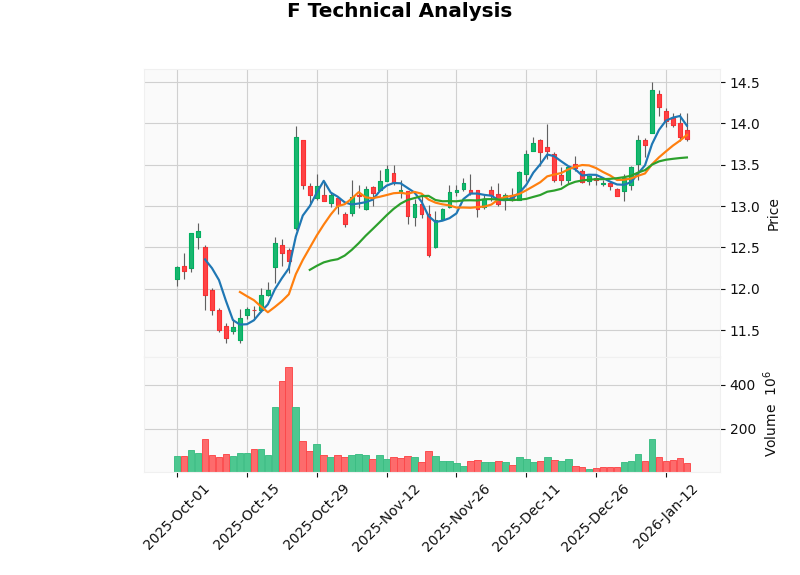
From a technical analysis perspective, Ford’s stock price is currently in a sideways consolidation phase, with a price range of $13.59-$13.95, and the MACD indicator shows upward momentum [8]. The current Beta coefficient is 1.63, indicating that its stock price volatility is higher than the overall market level [8].
Collaboration with BYD will help Ford diversify its battery supply sources. Currently, Ford’s battery plant under construction in Marshall, Michigan, plans to adopt technology from CATL [1][3]. This discussion with BYD indicates that Ford is adopting a “multi-supplier” strategy to reduce the risk of dependence on a single supplier and ensure bargaining power in key technology areas.
From a financial perspective, Ford’s current market capitalization is $54.03 billion, with a price-earnings ratio of 11.68 times and a price-to-book ratio of 1.16 times [9], placing it at a relatively low valuation level. If the collaboration with BYD is finalized, it will bring Ford more cost-competitive battery supply, which is expected to improve the profit margin of its automotive business. Ford’s latest quarterly financial report shows that revenue exceeded expectations by 7.41%, and earnings per share exceeded expectations by 27.15% [9].
However, this collaboration faces significant political resistance. White House Trade Advisor Peter Navarro publicly questioned that Ford’s move may support the supply chain of Chinese competitors and make itself more vulnerable to supply chain constraints [5]. Republican lawmakers have previously launched investigations into Ford’s collaboration with CATL [1][3], showing the vigilance of US political circles towards Chinese battery companies entering the US supply chain.
Therefore, Ford may tend to limit the scope of collaboration to markets outside the United States to avoid political risks and protect its domestic business.
If the collaboration is finalized, it will be an important overseas breakthrough for BYD’s battery business. Although BYD has experience in producing commercial vehicle batteries at its bus manufacturing plant in California [1][3], it has not yet produced passenger vehicle batteries in the US. Collaboration with Ford will significantly enhance BYD’s position in the global automotive supply chain and open up a larger market space for its battery business.
BYD’s current market capitalization reaches $865.5 billion, with a price-earnings ratio of 22.84 times and a price-to-book ratio of 3.98 times [10], which is significantly higher than Ford’s valuation. In the third quarter of 2025, its revenue reached $19.498 billion [10], with a net profit margin of 4.56% [10], showing a sound financial situation. Bernstein Research estimates that BYD’s battery shipments reached 286 GWh in 2025, a year-on-year increase of 47% [3].
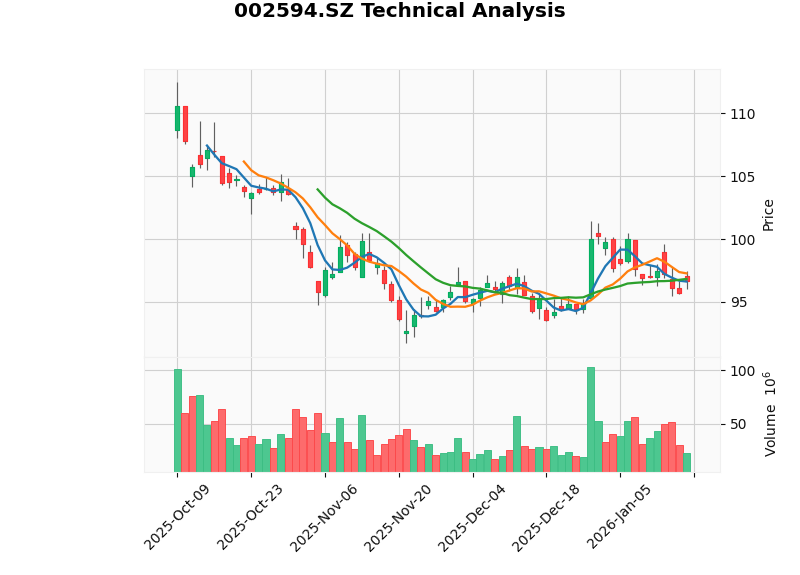
From a technical perspective, BYD’s stock price is also in a sideways consolidation phase, with a price range of RMB 95.73-RMB 97.63 [11]. The KDJ indicator shows an oversold opportunity [11], and the Beta coefficient is only 0.42 [11], indicating that its stock price volatility is low and its correlation with the international market is relatively small.
BYD is accelerating its overseas capacity layout to address tariff barriers and shorten the supply chain. In 2025, BYD made progress in its plants in Hungary (Europe), new plants in Southeast Asia, and production capacity in Latin America [6][7]. The company’s overseas sales target for 2026 is 1.6 million units [6], and collaboration with Ford will directly support the achievement of this target.
BYD’s global expansion strategy shows that it is transforming from “China-first” to “global layout”. Its overseas deliveries exceeded 1 million units in 2025 [6], marking that it has the ability to compete with established automakers in major global markets. By supplying batteries to international automakers such as Ford, BYD can further diversify the risk of dependence on the Chinese market.
BYD’s Blade Battery technology is renowned for its high safety, long service life, and low cost, and has been widely used in the company’s own models and some external customers. Establishing a supply relationship with a global top-tier automaker like Ford will be a strong endorsement of its battery technology competitiveness, which will help attract more international customers.
From a financial analysis perspective, BYD exhibits characteristics of conservative accounting policies, with free cash flow reaching RMB 36.094 billion [12], and a debt risk rating of “Medium Risk” [12], showing a healthy financial situation.
The global automotive industry is undergoing a reassessment of electrification paths. According to the International Energy Agency (IEA) report, global sales of pure internal combustion engine vehicles have declined by 30% since their peak in 2017 [13], but the growth momentum of electric vehicles (including pure electric and plug-in hybrid vehicles) is undergoing structural changes.
The hybrid vehicle market is ushering in a growth inflection point. Mordor Intelligence predicts that plug-in hybrid models will achieve battery cost parity by 2027 [14], which will significantly enhance the market competitiveness of hybrid vehicles. Toyota has announced that starting from the 2026 RAV4, its core models will adopt a hybrid-dedicated platform [14]; Ford has committed to extending its hybrid vehicle product line into the 2030s [14].
The global hybrid vehicle market size is expected to grow from $155.2 billion in 2020 to $303.5 billion in 2028, with a compound annual growth rate of 9.0% [15]. This growth trend creates huge market opportunities for battery suppliers such as BYD.
Global electric vehicle registrations increased by 20% in 2025, but growth is expected to slow in 2026 [16]. Slowing growth in the Chinese market, relaxed global electrification targets, and the expiration of US electric vehicle tax incentives [16] have collectively led to a slowdown in industry growth.
Against this background, traditional automakers such as Ford have chosen a “diversified technical path” strategy, using hybrid vehicles as a bridge from fuel vehicles to pure electric vehicles. This can not only meet current emission regulation requirements but also retain flexibility for future technological evolution.
The global automotive supply chain is undergoing profound regional reconstruction. Tariff barriers and trade restrictions between China and the United States are prompting automakers to re-examine their supply chain layouts. BYD has achieved “localized production” by building a plant in Hungary [6][7] to avoid high tariffs in the European market; similarly, if the collaboration with Ford is implemented, it will also adopt a “China production, overseas assembly” model.
This supply chain reconstruction trend has a profound impact on the global automotive industry pattern:
- Changes in cost structure: Localized production increases capital expenditure but can reduce logistics costs and tariff burdens
- Restrictions on technology transfer: Countries are increasingly strict with cross-border transfer restrictions on key technologies
- Decentralized capacity layout: Automakers and battery suppliers need to establish production capacity in multiple regions
The uncertainty of Sino-US trade relations is the biggest risk facing this collaboration. High tariffs, policy restrictions, and political resistance imposed by the United States on Chinese electric vehicles and battery products may make it difficult for the collaboration to proceed smoothly or expand to a larger scope.
The incoming US administration has threatened to impose additional tariffs on Chinese imported goods, and there is significant uncertainty in future policy trends. Ford needs to strike a balance between strategic interests and political risks.
Automotive batteries need to meet strict technical specifications and safety standards. Although BYD’s battery technology is mature, integration with Ford’s existing models requires a lot of engineering development and verification work. In addition, different battery management systems, charging interfaces, and thermal management solutions may all become technical barriers to collaboration.
BYD is currently one of the world’s largest electric vehicle manufacturers, with huge internal demand for batteries. Supplying batteries to external customers such as Ford may conflict with BYD’s own model production plans. How to balance internal and external demands will be a key challenge in collaboration management.
If the battery supply collaboration negotiations between Ford and BYD are successfully finalized, they will have the following strategic impacts on both parties:
- Obtain a cost-competitive hybrid vehicle battery supply source
- Support its strategic adjustment towards hybrid vehicle transition
- Achieve diversification of battery supply and reduce supply chain risks
- Face significant domestic political resistance in the United States, which may force the collaboration to be limited to overseas markets
- Achieve an overseas breakthrough in battery business and enhance its global supply chain position
- Obtain endorsement from a top international automaker and enhance technological competitiveness
- Diversify risks of dependence on the Chinese market and expand new revenue sources
- Against the background of geopolitical tensions, need to prudently manage international collaboration risks
| Scenario | Probability | Impact on Both Parties |
|---|---|---|
| Reach comprehensive collaboration (including US market) | Low | Both parties will gain significant strategic benefits, but face strong political resistance |
| Reach collaboration for overseas markets | Medium-High | Both parties will obtain limited but substantial collaboration benefits, with controllable political risks |
| Negotiations fail to reach an agreement | Medium | Both parties maintain the status quo; Ford continues to seek other suppliers, while BYD promotes independent overseas expansion |
From an investment perspective, Ford’s current valuation is at a relatively low level (price-earnings ratio of 11.68 times). With the advancement of its hybrid vehicle strategy and improvement in cost control, its stock price has upside potential. Although BYD’s valuation is relatively high, its overseas expansion and battery business growth provide it with long-term growth momentum.
[1] GuruFocus - “Ford (F) and BYD Discuss Potential Battery Supply Partnership” (2026-01-15) https://www.gurufocus.com/news/4113740/ford-f-and-byd-discuss-potential-battery-supply-partnership
[2] Stocktwits - “Ford Contemplates Deal With Chinese Rival BYD As It Seeks To Scale Hybrids” (2026-01-15) https://stocktwits.com/news-articles/markets/equity/ford-contemplating-deal-with-chinese-rival-byd-as-it-seeks-to-scale-hybrids-report
[3] Seeking Alpha - “Ford exploring hybrid battery partnership with China’s BYD” (2026-01-15) https://seekingalpha.com/news/4539609-ford-exploring-hybrid-battery-partnership-with-chinas-byd
[4] Sina Finance - “Electric Vehicle Market Cools; Ford Motor Discusses Hybrid Vehicle Battery Collaboration with BYD” (2026-01-16) https://finance.sina.com.cn/stock/usstock/c/2026-01-16/doc-inhhmhtf7371187.shtml
[5] News18a Auto News - “Foreign Media: Ford Discusses Hybrid Vehicle Battery Collaboration with BYD” (2026-01-16) http://www.news18a.com/news/storys_224720.html
[6] Motorwatt - “Top Electric Vehicle Seller: BYD Overtakes Tesla in Global Sales” https://motorwatt.com/ev-blog/trends/top-electric-vehicle-seller
[7] Nasdaq - “2025 Was a Turning Point for BYD. Here’s What Investors Must Know” https://www.nasdaq.com/articles/2025-was-turning-point-byd-heres-what-investors-must-know
[8] Jinling AI Technical Analysis Data [0]
[9] Jinling AI Company Profile Data - Ford Motor (F) [0]
[10] Jinling AI Company Profile Data - BYD (002594.SZ) [0]
[11] Jinling AI Technical Analysis Data - BYD [0]
[12] Jinling AI Financial Analysis Data [0]
[13] EV Magazine - “IEA: What Comes Next for EVs in the Automotive Landscape?” (2026-01-15) https://evmagazine.com/news/iea-what-comes-next-for-evs-in-the-automotive-landscape
[14] Mordor Intelligence - “Hybrid Vehicle Market Size, Share & Industry Growth” https://www.mordorintelligence.com/industry-reports/hybrid-vehicle-market
[15] GreyViews - “Global Hybrid Vehicle Market CAGR” https://greyviews.com/storage/file_manager/gallery/Global-Hybrid-Vehicle-Market-CAGR.png
[16] Reuters - “Global EV sales growth likely to slow after 20% jump in rocky 2025” (2026-01-14) https://www.reuters.com/sustainability/climate-energy/global-ev-sales-growth-likely-slow-after-20-jump-rocky-2025-research-firm-says
Insights are generated using AI models and historical data for informational purposes only. They do not constitute investment advice or recommendations. Past performance is not indicative of future results.
About us: Ginlix AI is the AI Investment Copilot powered by real data, bridging advanced AI with professional financial databases to provide verifiable, truth-based answers. Please use the chat box below to ask any financial question.