
Apple's AI Strategy Adopts Google Gemini: Strategic Reinvention of Its Ecosystem Moat
Unlock More Features
Login to access AI-powered analysis, deep research reports and more advanced features
About us: Ginlix AI is the AI Investment Copilot powered by real data, bridging advanced AI with professional financial databases to provide verifiable, truth-based answers. Please use the chat box below to ask any financial question.
Related Stocks
Apple is facing unprecedented challenges in the generative AI competition. According to the latest reports, the parameter scale of Apple’s in-house large model is approximately 150 billion parameters, while the Gemini model provided by Google to Apple has a parameter scale of approximately 1.2 trillion parameters, representing a significant capability gap [1]. More critically, Apple’s in-house trillion-parameter model will not mature until around 2027 at the earliest, a timeline that means Apple will continue to lag behind competitors in AI capabilities.
The predicament of Apple’s AI team is not only reflected in technology, but also in severe talent drain. Since 2024, dozens of core AI team members have left for companies such as Meta, OpenAI, and xAI [1]. The cautious, privacy-first strategy of Apple’s former AI chief John Giannandrea reportedly frustrated management, as it caused Apple to fall behind faster-moving competitors in the AI race [2].
The Apple Intelligence features showcased by Apple at WWDC 2024 were supposed to be rolled out gradually during the iOS 18 update cycle, but multiple core capabilities have been successively delayed, with the earliest release date pushed back to spring 2026 [1]. This delay reflects the systematic challenges Apple faces in the AI field.
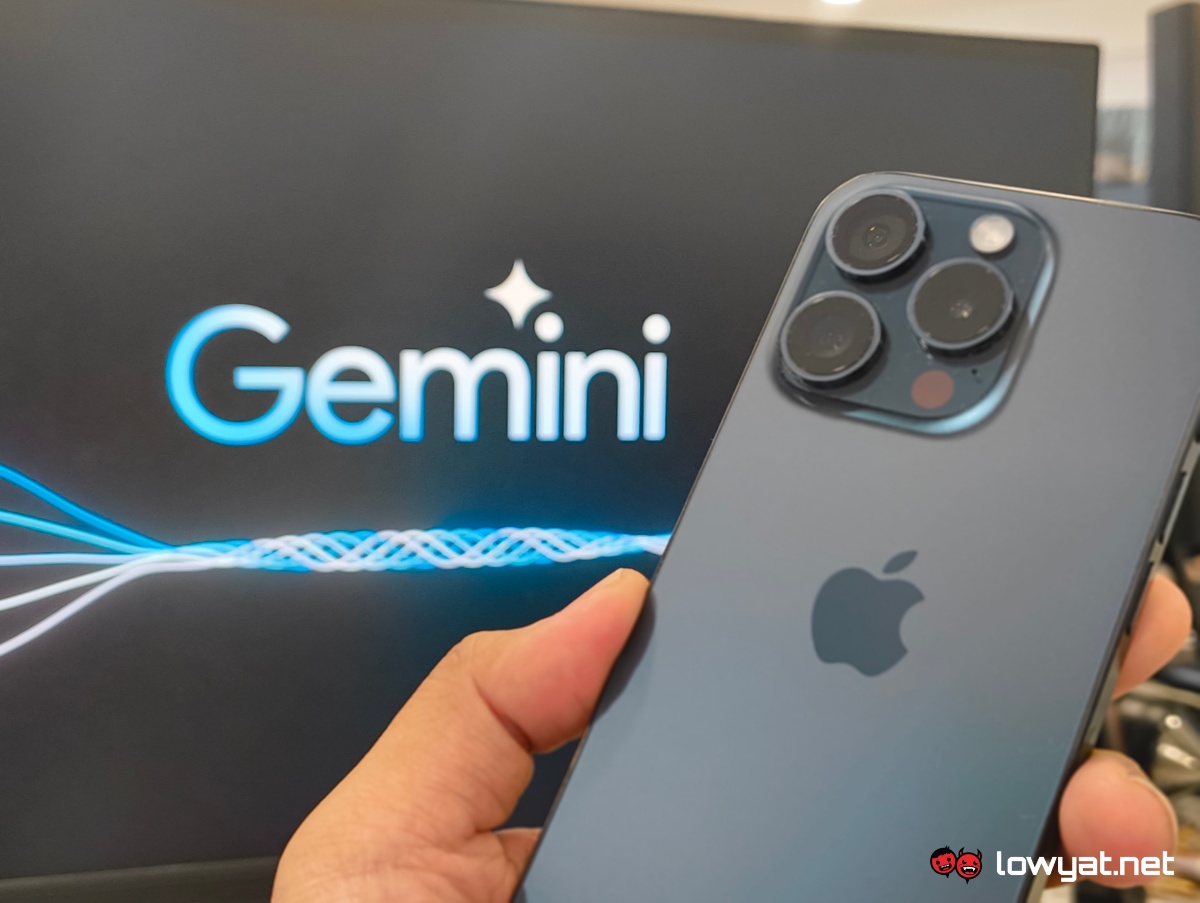
On January 12, 2026, Apple and Google officially announced a multi-year partnership. According to the joint statement, Apple’s future foundational AI models will be built on Google’s Gemini and its cloud technologies, and will be used to power multiple Apple Intelligence features including the new personalized Siri [3][4]. Apple emphasized in the statement: “After careful evaluation, we believe Google’s AI technology provides the most capable foundation for Apple’s foundational models” [4].
JPMorgan subsequently released a research report, maintaining its “Overweight” rating on Apple (AAPL), stating that the multi-year partnership with Google, a subsidiary of Alphabet, will help Apple accelerate its AI development. It is estimated that Apple may pay approximately $1 billion annually for access to Google’s Gemini large language model [5].
The most notable feature of this partnership is the white-label integration strategy adopted by Apple. Unlike the current ChatGPT integration model (clearly marked as supported by OpenAI), Gemini’s enhanced capabilities will run invisibly in the background, and the prototype version of personalized Siri will not display any Google or Gemini branding [6][7].
According to reports from The Information, Apple is independently fine-tuning Google’s Gemini model to ensure that Siri’s voice, personality, and response style meet Apple’s internal standards [6]. This design ensures that the experience users perceive is entirely Apple-native, thus avoiding the dilution of Apple’s ecosystem recognition by third-party AI brands.
Apple has retained significant control in this partnership, which is crucial to its ecosystem moat:
- Model Fine-Tuning Rights: Apple can independently fine-tune Gemini’s responses to align with Apple’s preferred tone, style, privacy standards, and safety guidelines [6][7]
- Model Adjustment Request Rights: Apple can directly request Google to make broader specific adjustments to the model
- User Experience Leadership: Apple has full control over the presentation of the user interface, ensuring that AI-enhanced features are seamlessly integrated into the Apple ecosystem experience
Based on current information, the upgraded Siri is expected to be rolled out in phases starting in spring 2026 (possibly alongside iOS 26.4) [6][7]:
- Phase 1: Core conversation improvement features go live
- Subsequent Phases: Features such as remembering past interactions, proactive suggestions based on calendar and location data, and deeper app integration
More advanced features may be officially announced at the WWDC developer conference in June 2026.
Apple has long regarded privacy protection as a core brand value and a key pillar of ecosystem differentiation. However, this strategy creates an inherent tension in the AI field: the most powerful AI models typically require large-scale cloud processing and massive data training, which conflicts with Apple’s privacy-first principle.
The dilemmas facing Apple are:
- On-Device Limitations: Pure on-device processing cannot support the operation of large models at the GPT-4 level
- Cloud Risks: Traditional cloud processing may lead to exposure of user data to third parties
- Competitive Pressure: Competitors (such as Google Assistant, Microsoft Copilot) are rapidly iterating their AI capabilities
To resolve this contradiction, Apple has launched the Private Cloud Compute (PCC) architecture as the core technical support for its privacy protection [8]. According to the technical documentation from WWDC 2025, the core features of PCC include:
| Feature | Description |
|---|---|
Zero Trust Architecture |
The cloud infrastructure adopts a zero-trust security model to prevent unauthorized access |
Device-First Priority |
All AI processing is completed on-device first, with cloud resources only invoked when necessary |
Data Isolation |
User data is completely isolated from cloud services; third-party AI models cannot directly access it |
End-to-End Encryption |
Data is fully encrypted during transmission |
For this partnership with Google, Apple has clearly committed that user conversation data with Siri will not be shared with Google [9]. All processing will be completed entirely on-device or within Apple’s Private Cloud Compute infrastructure, a model that prevents Google from accessing any user data [6][7][9].
This privacy protection mechanism is the key difference between Apple’s AI integration solution and others:
- Contrasts with ChatGPT integration (clearly marked with optional data sharing)
- Contrasts with Samsung Galaxy AI’s direct use of Google technology (perceived by users as Google services)
- Maintains Apple’s brand image as a “privacy protection leader”
-
Resolving Siri’s Capability Shortcomings: By introducing Gemini’s advanced capabilities, upgrade Siri’s conversational Q&A, emotional support, and complex query processing capabilities [6][7]
-
Maintaining User Stickiness: Prevent users from switching to competitors (such as Samsung Galaxy AI, Google Pixel, etc.) due to insufficient AI experience
-
Preserving Brand Consistency: The unbranded background operation mode ensures that users still view the upgraded Siri as an Apple-native experience
- Users may perceive that Apple “admits” its own AI capabilities are insufficient
- Dependence on external technology suppliers may arouse concerns among some users
Apple’s partnership with Google provides a strategic buffer period, enabling it to:
| Strategic Objective | Implementation Path |
|---|---|
Rapid Deployment of AI Features |
Leverage Gemini’s mature capabilities to accelerate Siri upgrades |
Advance In-House Model Development |
Continue developing the trillion-parameter model (expected to mature in 2027) |
Build Infrastructure |
Improve Private Cloud Compute and AI chip capabilities |
Talent Development |
Rebuild the AI R&D team and technical reserves |
This strategy is similar to Apple’s transition from Google Maps to its own Maps [10]. Apple can gradually replace the model with its in-house version in the background without changing the front-end user experience.
- Technology Dependence Risk: Long-term reliance on external AI suppliers may weaken Apple’s independent innovation capabilities
- Declining Bargaining Power: As the partnership deepens, Apple may lose bargaining power over AI suppliers
- Diminished Differentiation: If other manufacturers also adopt similar AI integration models, Apple’s AI experience differentiation advantage may weaken
- Hybrid AI Architecture Advantage: Through the hybrid architecture of on-device AI (Apple Silicon) + cloud AI (Gemini), Apple may create a unique user experience
- Strengthening Developer Ecosystem: The opening of the Foundation Models framework provides third-party developers with new AI capabilities [8]
- Privacy Differentiation: In the AI era, privacy protection may become a more important differentiating factor
Apple’s partnership with Google marks an important shift in the AI competitive landscape:
- Checks and Balances on OpenAI: Apple previously integrated ChatGPT as an auxiliary feature for Siri, and the partnership with Google forms a check on OpenAI [1]
- Google’s Strategic Victory: Reuters described this partnership as a “major victory” for Google, whose technology will enter a market with more than 2 billion active devices [1]
- Industry Demonstration Effect: This “competitor collaboration” model may trigger more cross-ecosystem AI partnerships
After the news was announced, the market responded positively:
- Shares of Alphabet, Google’s parent company, closed up more than 1%, hitting a new all-time high for three consecutive days, with market capitalization exceeding $4 trillion for the first time [1]
- Apple’s stock reversed seven consecutive days of decline with two consecutive gains, rising slightly [1]
- JPMorgan maintained its “Overweight” rating on Apple [5]
From a technical analysis perspective, Apple’s stock (at $257.21 as of January 14, 2026) exhibits the following characteristics [0]:
- Trend Judgment: Sideways consolidation, no clear trend direction
- Key Price Levels: Support level at $255.02, resistance level at $267.97
- Technical Signals: KDJ and RSI are in the oversold territory, suggesting potential rebound opportunities
- Beta Coefficient: 1.09, slightly higher than market volatility
- Clear AI Strategy: The partnership with Google indicates that Apple has clarified its AI development path
- Maintained Privacy Advantage: The PCC architecture ensures user data security, alleviating privacy concerns
- Reinforced Ecosystem Moat: Upgraded AI capabilities maintain user stickiness
- Reasonable Valuation: The current P/E ratio (34.35x) has certain appeal relative to growth expectations [0]
- Execution Risk: Uncertainty remains whether AI features can be launched as planned
- Partnership Dependence Risk: Reliance on Google’s AI technology may bring long-term strategic risks
- Talent Drain Risk: Continuous loss of core AI talent may affect the development of in-house capabilities
- Regulatory Risk: Antitrust agencies may focus on the deep cooperation between Apple and Google
Apple’s AI partnership with Google is a pragmatic strategic choice. While its in-house capabilities are insufficient, Apple leverages external forces to accelerate AI deployment, while maintaining its core competitive advantages through innovative privacy protection mechanisms. This “leverage external resources, maintain independent control” strategy is expected to enhance Apple’s AI competitiveness in the short term, but in the long run, Apple still needs to increase in-house investment to ensure ecosystem independence.
[1] Huxiu - “Apple and Google’s ‘Century Collaboration’ Has Musk on Edge” (https://www.huxiu.com/article/4826023.html)
[2] Tech Between Lines - “2026: The Year Apple’s Strategy Faces Its Reckoning” (https://www.techbetweenthelines.com/2026-the-year-apples-strategy-faces-its-reckoning/)
[3] IT Home - “Apple Officially Announces Partnership with Google Gemini” (https://finance.sina.com.cn/tech/digi/2026-01-13/doc-inhhcaec9455087.shtml)
[4] Yahoo Finance - “Siri’s Backend Changed? Apple’s AI Strategy U-Turns to Google Gemini” (https://hk.finance.yahoo.com/news/siri背後換人-蘋果ai策略大轉彎找上google-gemini-173004947.html)
[5] Yahoo Finance - “JPMorgan: Apple (AAPL.US) Partners with Google Gemini to Accelerate AI Upgrade” (https://hk.finance.yahoo.com/news/大行-摩通-蘋果-aapl-us-021637747.html)
[6] MacDailyNews - “Apple said to fine-tune Google’s Gemini for un-branded Siri integration” (https://macdailynews.com/2026/01/14/apple-said-to-fine-tune-googles-gemini-for-un-branded-siri-integration/)
[7] Android Headlines - “Apple Fine-Tuning Gemini-Powered Siri to Erase the Google AI Feel” (https://www.androidheadlines.com/2026/01/apple-siri-unbranded-fine-tuning-gemini-integration-details.html)
[8] Tencent Cloud Developer Community - “Analysis of Apple WWDC 2025 Technology Trends” (https://cloud.tencent.com/developer/article/2531469)
[9] Storyboard18 - “Apple assures Siri users their data stays private even as Google Gemini powers new AI features” (https://www.storyboard18.com/digital/apple-assures-siri-users-their-data-stays-private-even-as-google-gemini-powers-new-ai-features-87507.htm)
[10] Huxiu - “When I Saw Apple and Google’s Major Joint Announcement, I Was Writing Code with Gemini” (https://www.huxiu.com/article/4825935.html)
[0] Jinling API Market Data
Insights are generated using AI models and historical data for informational purposes only. They do not constitute investment advice or recommendations. Past performance is not indicative of future results.
About us: Ginlix AI is the AI Investment Copilot powered by real data, bridging advanced AI with professional financial databases to provide verifiable, truth-based answers. Please use the chat box below to ask any financial question.