
In-Depth Analysis of He Fu Noodle's Central Kitchen Model and Pre-Made Dishes Controversy
Unlock More Features
Login to access AI-powered analysis, deep research reports and more advanced features
About us: Ginlix AI is the AI Investment Copilot powered by real data, bridging advanced AI with professional financial databases to provide verifiable, truth-based answers. Please use the chat box below to ask any financial question.
Related Stocks
Based on the latest information I have collected, I will systematically analyze the relationship between He Fu Noodle’s central kitchen model and the pre-made dishes controversy from three dimensions:
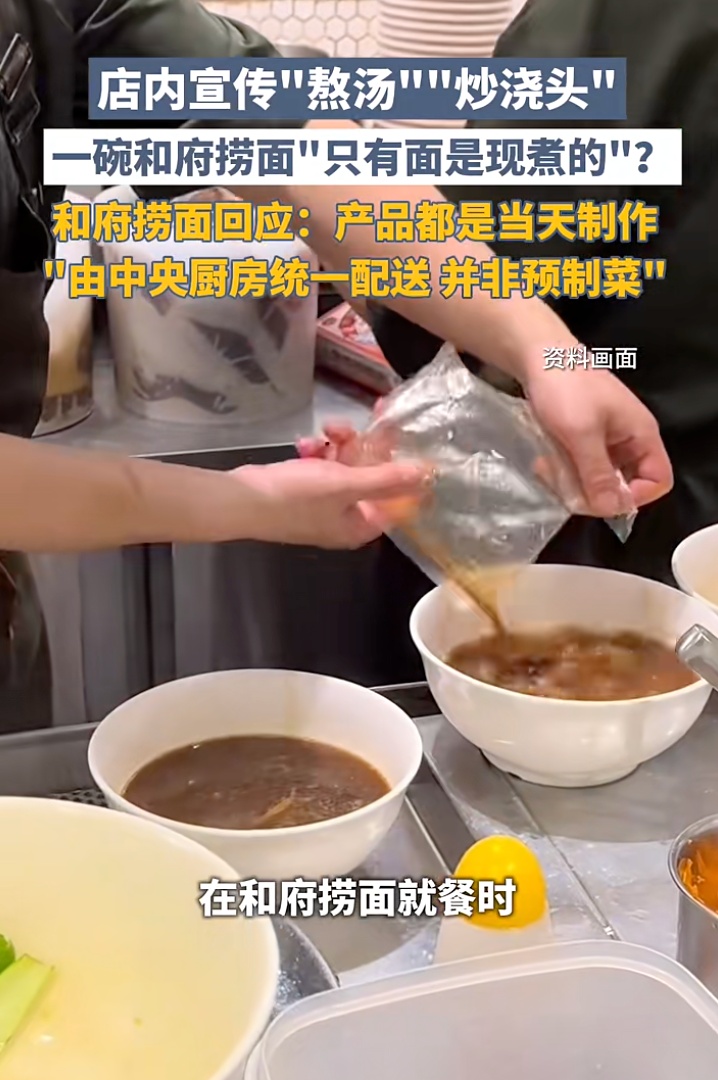
In early January 2026, the topic “He Fu Noodle only cooks the noodles fresh” topped Weibo’s hot search list. The incident originated from multiple consumers reporting that they saw a large number of pre-packaged ingredient bags in the back kitchen of He Fu Noodle stores. Among the noodle dishes with a unit price of 30 to 40 yuan,
According to a field visit by a reporter from Shandong Business Daily to a store in Jinan:
Staff place cooked noodles into a bowl, then open sealed soup packets and vacuum-sealed topping packets for assembly……From opening, heating to assembly and serving, pre-packaged ingredients are used throughout the process[2].
According to the
Pre-packaged dishes made from one or more edible agricultural products and their products, processed through industrial pre-treatment (such as mixing, marinating, stir-frying, frying, roasting, boiling, steaming, etc.),
which are edible only after heating or cooking[3].
He Fu Noodle’s customer service responded: “The dishes are produced by the central kitchen and then distributed to each store,
From a legal perspective, He Fu Noodle does indeed
| Item | Actual Situation | Consumer Expectation |
|---|---|---|
| Price | 30-40 yuan/bowl | Premium positioning |
| Noodles | Freshly cooked | Freshly cooked |
| Soup base | Distributed from central kitchen in pre-packaged bags | Freshly simmered on-site |
| Toppings | Heated from pre-packaged bags | Made on-site |
Jiang Han, senior researcher at the Pangu Think Tank, pointed out:
“The pricing of catering is essentially a comprehensive reflection of brand, scenario, and operating costs. He Fu Noodle has established a premium image with the concept of ‘study + health-preserving noodles’, but when consumers discover that only the noodles are freshly cooked, while the soup bases and toppings are all pre-made packages, a
serious breakdown between value perception and actual productoccurs. When consumers pay a premium for ‘freshly made’ and ‘health-preserving’ features, they are essentially buying the ‘non-industrial’ handcrafted feel and trust.”[5]
Although the central kitchen model is not classified as pre-made dishes under the law, the
- Currently, there are no relevant laws or regulations at the national level mandating the labeling of pre-made dishes in the catering industry
- Jiangsu Province has taken the lead in legislating to require the explicit disclosure of pre-made dishes in catering, but this has not been popularized at the national level
- Consumers generally report that it is difficult to know whether the dishes they consume are pre-made dishes[5]
| Aspect | Description |
|---|---|
Standardization |
Unified recipes and processes ensure consistent taste across different stores |
Large-scale expansion |
Supports rapid expansion, with He Fu Noodle planning to open over 2,000 stores by 2026[5] |
Quality control |
Centralized production facilitates supervision, enabling full-chain traceability from “farm to table”[6] |
Efficiency |
Reduces store operating costs and labor costs |
| Aspect | Description |
|---|---|
Transparency |
Industrial operations in the back kitchen conflict with consumers’ expectation of “freshly made” |
Trust crisis |
The sensory impact of a back kitchen full of plastic bags conflicts with the brand’s premium positioning |
Price sensitivity |
85.2% of consumers can accept a price of no more than 30 yuan, while nearly half of He Fu Noodle’s products are priced between 30-40 yuan[5] |
The application of pre-made dishes in the catering industry is already a common phenomenon, but
“Central kitchens and pre-made technologies are an inevitable trend in the modernization of the catering industry.”[6]
| Strategy | Implementation Status |
|---|---|
Proactive transparency |
Founder Li Xuelin once stated that “we will achieve transparency of our own central kitchen”[7] |
Price adjustment |
Launched a strategic adjustment in mid-2024, reducing the price of core products by 30%[5] |
New product positioning |
Launched “He Fu Master Noodles” with the core concept of “freshly simmered daily”[5] |
- Pay attention to the match between price and value: The central kitchen model is not equivalent to low quality; the key is to see whether the ingredient quality and price are reasonable
- Understand your own needs: If you pursue a freshly made experience, you can choose stores or sub-brands that emphasize “on-site production” (such as Alan’s Beef Noodles, which emphasizes “handmade on-site”)
- Perceptual gap: Consumers pay a premium for “freshly made” and “health-preserving” features, but receive industrialized products
- Trust crisis: The visual impact of a back kitchen filled with plastic bags conflicts with the brand’s premium positioning
- Lack of right to know: Consumers find it difficult to learn the actual production method of the product in advance
[1] The Paper - 《“Only the noodles are freshly cooked”? He Fu Noodle responds to “pre-made dishes” controversy》
https://m.thepaper.cn/newsDetail_forward_32345429
[2] Jiemian News - 《Tencent, Juewei Food-invested He Fu Noodle: How to Respond to the “Pre-Made Dishes” Storm?》
https://m.jiemian.com/article/13861102.html
[3] CCTV.com - 《What Exactly Are Pre-Made Dishes? 6 Departments Once Issued a Clear Definition》
https://news.cctv.com/2025/09/14/ARTI8vDjikqnSQjTXXy16myT250914.shtml
[4] Sina Finance - 《He Fu Noodle responds to pre-made dishes allegation: Products are uniformly produced by central kitchen, not within the scope of pre-made dishes》
https://finance.sina.cn/2026-01-07/detail-inhfnemx2245943.d.html
[5] 21st Century Business Herald - 《After proactively cutting prices by 30%, the 7-billion-yuan He Fu Noodle is again mired in pre-made dishes controversy》
https://www.21jingji.com/article/20260109/herald/3b75b4f99bdc6d1e1ba25b134d3f7a91.html
[6] Legal Daily - 《Multiple Departments Accelerate the Formulation of National Standards for Pre-Made Dishes》
http://epaper.legaldaily.com.cn/fzrb/content/20250926/Articel06002GN.htm
[7] Xinhua News - 《He Fu Noodle’s “only noodles are freshly cooked” tops hot searches; founder once stated “we make food with the same attitude as making milk powder”》
http://www.news.cn/food/20260109/6b09fb467b97495495482460ad2ec2a7/c.html
Insights are generated using AI models and historical data for informational purposes only. They do not constitute investment advice or recommendations. Past performance is not indicative of future results.
About us: Ginlix AI is the AI Investment Copilot powered by real data, bridging advanced AI with professional financial databases to provide verifiable, truth-based answers. Please use the chat box below to ask any financial question.