
Analysis of the Impact of the U.S.-Taiwan Trade Agreement on TSMC's U.S. Capacity Expansion and the Global Semiconductor Supply Chain
Unlock More Features
Login to access AI-powered analysis, deep research reports and more advanced features
About us: Ginlix AI is the AI Investment Copilot powered by real data, bridging advanced AI with professional financial databases to provide verifiable, truth-based answers. Please use the chat box below to ask any financial question.
Related Stocks
Based on the data and analysis I have collected, I now present a systematic and comprehensive research report.
According to authoritative media reports such as The New York Times, the Trump administration is close to reaching a bilateral trade agreement with the Taiwan region, which is expected to be officially announced in January 2026. The core clauses of the agreement include [1][2]:
- Taiwan’s export tariffs to the U.S. will be reduced from the current 20% to 15%, matching the treatment of allies such as Japan and South Korea
- This will make Taiwan’s exported goods more competitive in the U.S. market, especially electronic components and tech products
- As a core part of the agreement, TSMC commits to building at least 5advanced wafer fabs in Arizona
- This will bring the total number of TSMC’s wafer fabs in Arizona to approximately 10
- Together with the previous $65 billion investment commitment, the total investment scale will expand to $165 billion[2][3]
The conclusion of this agreement has profound strategic background:
- Supply Chain Security Considerations:The U.S. continues to promote “friendshoring” of the semiconductor supply chain to reduce dependence on a single region [4]
- CHIPS Act Drive:The U.S. government provides $52 billion in subsidies through the CHIPS and Science Act to attract the return of advanced manufacturing [5]
- AI Boom Drive:The explosive growth of the artificial intelligence industry has led to a surge in demand for advanced chips, requiring urgent capacity expansion [6]
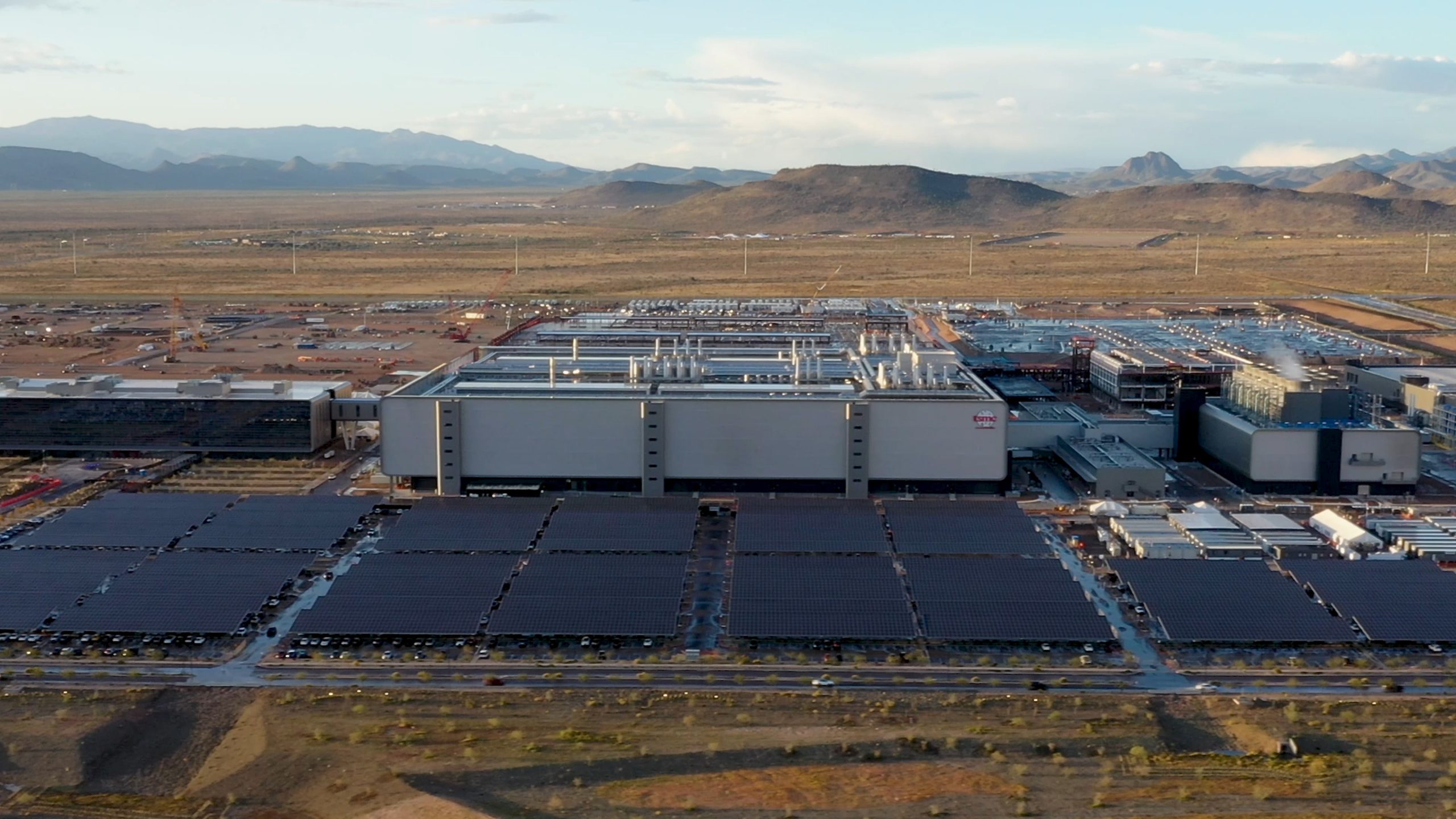
TSMC’s Arizona project is its largest overseas investment in history, with specific progress as follows [3][7][8]:
| Wafer Fab | Process Node | Start Time | Mass Production Time | Monthly Capacity |
|---|---|---|---|---|
| Fab 1 | 4nm | 2024 | End of 2024 | 15K wafers |
| Fab 2 | 3nm | Q3 2026 | 2027 | 25K wafers |
| Fab 3 | 2nm | 2025 | 2028 | 30K wafers |
| Fab 4 | 2nm | 2026 | 2029 | 30K wafers |
| Fab 5 | A14 | 2027 | 2030 | 35K wafers |
| Fab 6 | A14 | 2027 | 2030 | 35K wafers |
- Fab 1 began mass production at the end of 2024, with a yield rate of 92%, 4 percentage points higher than that of Taiwan’s local production lines [9]
- The mass production time of Fab 2 has been advanced from the previous 2028 to 2027, a full year earlier [8]
- U.S. Secretary of Commerce Lutnick revealed that TSMC may further increase investment [2]
Advanced packaging is a key bottleneck in the current industrial chain, with significant existing challenges:
- Current Status:AI chips manufactured in Arizona, especially GPUs requiring CoWoS advanced packaging, still need to be shipped back to Taiwan for back-end packaging and testing [9]
- Plan:Two advanced packaging factories, AP1 and AP2, are scheduled to break ground in 2026 and start mass production in 2028 [7]
- Capacity Target:TSMC plans to increase CoWoS monthly capacity to 125,000 wafers by the end of 2026 [6]
| Time Node | Investment Amount | New Capacity |
|---|---|---|
| 2020 Initial Plan | $12 billion | 1 wafer fab |
| April 2024 | $65 billion | 3 wafer fabs |
| March 2025 | $165 billion | +5 wafer fabs + 2 packaging factories + 1 R&D center |
| Rumor (Dec 2025) | $300 billion | 12 wafer fabs (to be confirmed) [10] |
As of January 12, 2026, TSMC (TSM) has strong market performance [12]:
| Indicator | Value |
|---|---|
| Stock Price | $328.53 |
| Market Capitalization | $1.70 trillion |
| Price-to-Earnings (P/E) | 27.62x |
| Price-to-Book (P/B) | 8.77x |
| 52-Week Gain | +63.14% |
TSMC demonstrates excellent financial quality [12][13]:
| Financial Indicator | Value | Industry Position |
|---|---|---|
| Net Profit Margin | 43.70% | World-leading |
| Gross Profit Margin | ~53% | Highest in the semiconductor foundry industry |
| Return on Equity (ROE) | 34.52% | Excellent |
| Current Ratio | 2.69 | Financially Sound |
| Debt Risk | Low | Conservative Financial Management |
- Q3 2025 Earnings Report:EPS of $2.92, exceeding expectations by 12.74%; revenue of $32.42 billion, exceeding expectations by 1.09% [12]
- 2026 Outlook:IDC predicts that TSMC’s revenue growth rate will reach 25%-30% in 2026, and the AI server accelerator market is expected to grow by 78% [6]
- Capacity Ramp-Up:The 2nm process began mass production in Q4 2025, and monthly capacity is expected to reach 100,000 wafers by the end of 2026 [6]
The U.S.-Taiwan Trade Agreement will accelerate the geographic redistribution of global semiconductor capacity:
| Year | Taiwan Share | U.S. Share | Other Regions |
|---|---|---|---|
| 2024 | 85% | 5% | 10% |
| 2026 | 75% | 15% | 10% |
| 2028 | 60% | 25% | 15% |
| 2030 | 50% | 35% | 15% |
- Taiwan’s absolute dominance in advanced manufacturing processes will gradually weaken
- The U.S. will achieve strategic autonomy in advanced manufacturing processes
- Japan and Europe will also become important supplementary capacity bases
EY’s 2026 Geostrategic Outlook Report points out that the global supply chain is undergoing a fundamental restructuring [4]:
- Friendshoring:Governments prioritize supply chain resilience, security, and domestic capacity over efficiency and openness
- Diversified Layout:12%-14% of Apple’s iPhone production capacity has been transferred to India [4]
- Regionalization Trend:The process of manufacturing returning to North America and Europe is accelerating
Despite the accelerated globalization of front-end manufacturing capacity, advanced packaging remains a weak link in the industrial chain:
- CoWoS Capacity:Global capacity is severely insufficient, and delivery times have been extended to 2026 [14]
- Geographical Concentration:Advanced packaging capacity is still highly concentrated in Taiwan
- Ecosystem Construction:Packaging factories such as Amkor are investing in the U.S., but full mass production will still take several years
Supply chain restructuring brings inevitable cost increases:
- Operating Costs:Building factories in new regions faces challenges such as talent training and supply chain supporting facilities
- Construction Efficiency:TSMC’s Arizona project was delayed due to labor issues [5]
- Ecosystem:Semiconductor manufacturing requires a complete ecosystem of equipment, materials, and talents
| Impact Dimension | Before the Agreement | After the Agreement | Change Analysis |
|---|---|---|---|
| Tariff Cost | 20% tax rate | 15% tax rate | 25% savings in tariff expenses |
| Investment Incentives | Existing subsidies | Potential additional incentives | Reduced financing costs |
| Supply Chain Stability | Single-node risk | Diversified layout | Reduced geopolitical risk exposure |
| Market Access | Trade friction risk | Stable trade environment | Enhanced predictability |
- Improve supply chain resilience and reduce single-point failure risks
- Promote the layout of advanced manufacturing in the U.S. and allied countries
- Promote the healthy development of the global semiconductor industry
- Increased risk of industrial chain fragmentation
- Systemic increase in cost structure
- Intensified competition for technical talents
- Sustained strong demand for advanced manufacturing processes driven by the AI wave
- Clear capacity expansion plan, leading position is stable
- Healthy financial status and excellent profitability
- Policy support combined with geopolitical risk diversification
- Higher-than-expected costs of overseas factory construction
- Persistent bottlenecks in advanced packaging capacity
- Still high geopolitical uncertainty
- Catching-up pressure from competitors (Intel, Samsung)
| Segment | Benefit Logic | Focus Targets |
|---|---|---|
| Equipment Manufacturers | Capacity expansion drives equipment demand | ASML, LAM, AMAT |
| Material Manufacturers | Growing demand for advanced process materials | Tokyo Ohka Kogyo, Shin-Etsu |
| Packaging and Testing | Advanced packaging capacity expansion | Amkor, ASE |
| End Customers | Chip supply assurance | NVIDIA, AMD, Apple |
The conclusion of the U.S.-Taiwan Trade Agreement will reshape the global semiconductor industry pattern from multiple dimensions:
-
For TSMC:Tariff reductions and investment incentives will significantly improve profit prospects. The $165 billion U.S. investment plan makes the company the largest foreign direct investment case in the world, while effectively diversifying geopolitical risks.
-
For the U.S.:By 2030, the U.S. share of advanced manufacturing capacity is expected to rise from 5% to 35%, basically achieving self-sufficiency in AI chip supply and greatly enhancing technological autonomy.
-
For the Global Supply Chain:The “friendshoring” trend of the industrial chain is accelerating, and Taiwan’s share in advanced manufacturing processes will drop from 85% to 50%, but it will remain the world’s most important advanced chip production base.
-
Long-Term Outlook:Despite short-term challenges of rising costs and integration, the regionalization and diversification of the supply chain will enhance overall resilience, laying a foundation for the sustainable development of the global technology industry.
[1] The New York Times - “Trump Administration Nears Deal With Taiwan” (https://www.nytimes.com/2026/01/12/business/economy/trump-taiwan-deal.html)
[2] U.S. News - “TSMC Q4 Profit Poised to Soar 27% as AI Demand Drives Growth” (https://money.usnews.com/investing/news/articles/2026-01-11/tsmc-q4-profit-poised-to-soar-27-as-ai-demand-drives-growth)
[3] DigiTimes - “TSMC reportedly set to build 12 Arizona fabs” (https://www.digitimes.com/news/a20260106PD217/tsmc-arizona-market-germany-2026.html)
[4] Livemint - “What is friendshoring? Why Ernst & Young says it will reshape global supply chains in 2026” (https://www.livemint.com/economy/what-is-friendshoring-why-ey-says-it-will-reshape-global-supply-chains-in-2026-11766553135520.html)
[5] Wikipedia - “CHIPS and Science Act” (https://en.wikipedia.org/wiki/CHIPS_and_Science_Act)
[6] Sina Finance - “Full Release of 3nm Process Capacity, TSMC’s Q4 2025 Profit Expected to Surge 27%” (https://t.cj.sina.com.cn/articles/view/1826017320/6cd6d02802001iyuc)
[7] LinkedIn - “TSMC’s Arizona Expansion: A Front-End Powerhouse with Packaging Gap” (https://www.linkedin.com/posts/jean-lucca-aleskovich-0036_fab21-cowos-tsmc-activity-7414017035321556992-GzaT)
[8] TechPowerUp - “TSMC Targets 2027 for 3 nm Production at Second Arizona Fab” (https://www.techpowerup.com/344214/tsmc-targets-2027-for-3-nm-production-at-second-arizona-fab)
[9] Semiconductor Industry Analysis - LinkedIn Professional Article (https://www.linkedin.com/feed/update/urn:li:activity:7414017035321556992)
[10] IT Home - “Report: TSMC’s Arizona 3nm Fab Mass Production Time Advanced to 2027” (https://www.ithome.com/)
[11] Sohu - “TSMC Adds $100 Billion in Investment Because It Violated DEI Clauses!” (https://m.sohu.com/a/975072057_128469)
[12] Jinling AI - Company Profile and Real-Time Market Data
[13] Jinling AI - Financial Statement Analysis
[14] DBS - “Technology 2026 outlook” (https://www.dbs.com/insightsdirect/api/s3/dbs-buffer/article_attachment/20260108/07-24-24_Reg tech 2026 outlook 090126.pdf)
Insights are generated using AI models and historical data for informational purposes only. They do not constitute investment advice or recommendations. Past performance is not indicative of future results.
About us: Ginlix AI is the AI Investment Copilot powered by real data, bridging advanced AI with professional financial databases to provide verifiable, truth-based answers. Please use the chat box below to ask any financial question.