
Energy Sector Analysis: Venezuela Supply Risks Overblown Amid WTI Pressure on U.S. Shale
Unlock More Features
Login to access AI-powered analysis, deep research reports and more advanced features
About us: Ginlix AI is the AI Investment Copilot powered by real data, bridging advanced AI with professional financial databases to provide verifiable, truth-based answers. Please use the chat box below to ask any financial question.
Related Stocks
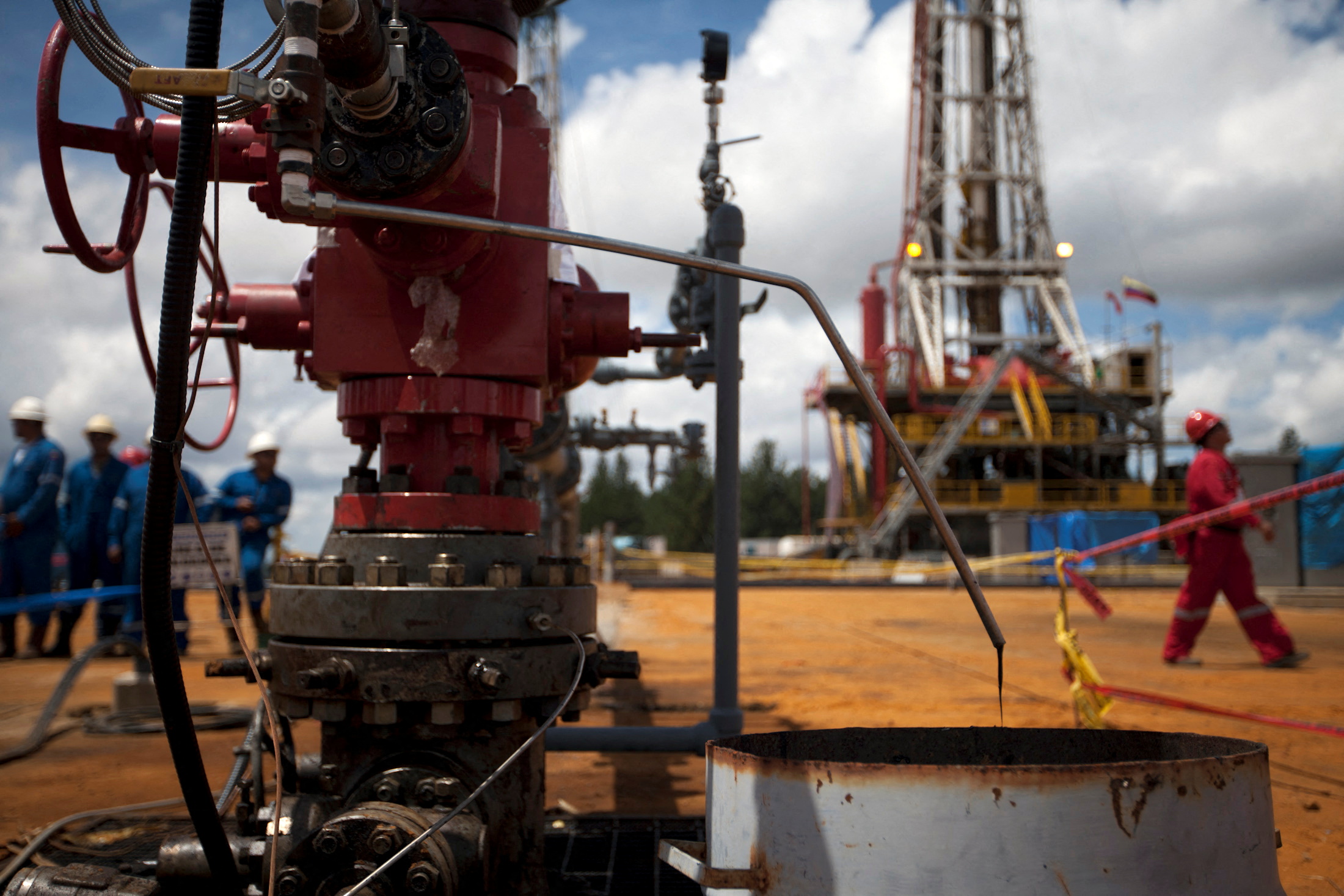
The Seeking Alpha thesis that Venezuela supply fears are overblown is strongly supported by comprehensive market analysis. Current Venezuelan production stands at approximately 800,000 barrels per day, representing less than 1% of global oil output [4]. Despite holding the world’s largest proven reserves at approximately 303 billion barrels, the country’s infrastructure has deteriorated significantly from historical production levels approaching 3.2 million barrels per day [4]. TD Securities analysis confirms that “any supply changes from Venezuela would require massive, slow capital expenditure, making quick shifts unlikely to materialize” [5]. This assessment is reinforced by ExxonMobil CEO Darren Woods, who explicitly characterized Venezuela as “uninvestable” without “significant changes” to legal frameworks, commercial constructs, and hydrocarbon laws during a January 9, 2026 White House meeting with President Trump [2][3]. Woods stated the company would only send a technical team to assess operations without making concrete investment commitments despite Trump’s $100 billion investment pitch [3].
The author’s concern about WTI below $60/barrel pressuring U.S. shale is validated by multiple industry data sources. The Dallas Fed Energy Survey found that U.S. shale operators are planning 2026 capital expenditures based on WTI at $59/barrel, with executives hoping for $62/barrel while recognizing the challenging current price environment [6]. Some operators report that “lower oil prices are making many of our firm’s wells noneconomic,” while one executive warned drilling “will cease in 2026” if conditions don’t improve [6]. Kpler analysis indicates U.S. supply remains resilient in the near term but warns that a sustained $50/barrel scenario could cause rig counts to fall to approximately 300 (from current levels around 320), potentially slashing U.S. crude supply by 700,000 barrels per day by the fourth quarter of 2026 [7]. The low-price environment creates divergent outcomes among U.S. producers, with large exploration and production companies (producing more than 10,000 barrels per day) better positioned to absorb lower prices through efficiency gains and scale, while smaller producers face existential pressure [8].
OPEC+ continues to actively manage market balance through coordinated production policies. The alliance has maintained production targets unchanged through the first quarter of 2026 for eight core producers including Saudi Arabia, Russia, UAE, Kazakhstan, Kuwait, Iraq, Algeria, and Oman [9]. However, compensation cuts are tripling as key producers implement output reductions totaling 829,000 barrels per day by June 2026, up from previous pledges, with the UAE cutting 55,000 barrels per day and Kazakhstan cutting 669,000 barrels per day [10]. This highlights the tension between maintaining market share and supporting prices, with the alliance attempting to balance competing objectives amid expectations of a 2026 supply surplus.
The fundamental supply-demand backdrop remains challenging for oil prices despite the bullish long-term thesis. Multiple forecast sources project 2026 Brent prices ranging from $55 to $68 per barrel, with the IEA projecting global oil inventory builds could exceed 2 million barrels per day driven by strong production growth from the U.S., Brazil, Guyana, and Canada overwhelming relatively weak demand growth [4]. Oxford Economics projects supply will exceed demand by 0.5 to 3.5 million barrels per day, creating persistent oversupply pressure [4]. However, the Seeking Alpha thesis argues that OPEC and non-OPEC supply are potentially peaking, which could support eventual price recovery as supply growth slows over time.
The competitive dynamics around Venezuela have become more complex following the January 9, 2026 White House meeting between Trump and major oil executives. ExxonMobil’s explicit characterization of Venezuela as “uninvestable” represents the most significant barrier to rapid supply increases, as the company’s massive scale and technical capabilities would be essential for meaningful production expansion [3]. Chevron is taking a more cautious approach, with Vice Chairman Mark Nelson stating the company is “committed” to Venezuela and may increase production by approximately 50% over 18-24 months, though this reflects existing partnership operations with PDVSA rather than new investments [3]. ConocoPhillips remains particularly cautious given it is still owed nearly $9 billion after losing assets during previous nationalization [2]. This divergence in corporate responses suggests that even if political conditions improve, major capital investments will require years of legal framework development before meaningful production increases can occur.
Technical analysis indicates energy markets remain in a consolidation phase with lower highs and lower lows since June 2025, suggesting the bearish trend remains intact despite Venezuela-related volatility [12]. WTI support zones are identified at $55-56/barrel, with resistance levels at $60.3-62.0/barrel for WTI and $63.8-64.8/barrel for Brent [12]. This technical backdrop reinforces the near-term challenges facing energy investors while potentially setting the stage for longer-term value accumulation if prices stabilize at current levels and supply discipline eventually emerges.
While upstream operations face significant pressure from low oil prices, downstream refining operations demonstrate more constructive dynamics. High refinery utilization rates are expected to continue through 2026, with “very high diesel crack spreads” in Europe and the United States likely to persist [11]. Gasoline margins are also supported as refiners balance output between different product streams [11]. This creates a more favorable environment for integrated oil companies that can capture value across the supply chain, potentially offsetting some of the weakness in upstream operations.
The analysis reveals several risk factors warranting attention. The 2026 oversupply expected to persist, with estimates ranging from 0.5 to 3.5 million barrels per day surplus, creates persistent downward pressure on prices [4]. U.S. shale operators face existential pressure at current price levels, with capital expenditure planning based on $59/barrel scenarios indicating the challenging economics facing the industry [6]. The technical trend remains bearish with lower highs and lower lows since mid-2025, suggesting selling pressure may continue in the near term [12]. Additionally, the geopolitical uncertainty surrounding Venezuela creates potential for sudden policy shifts that could impact market dynamics.
Despite near-term challenges, several opportunity windows exist for patient capital. Global inventories are not elevated despite current prices, suggesting underlying demand remains solid [1]. OPEC and non-OPEC supply may be peaking, which could eventually support price recovery as supply growth slows [1]. The massive capital requirements for Venezuelan production increases create a natural barrier that limits near-term supply additions, potentially supporting longer-term price recovery. Strong diesel and gasoline margins are supporting refining earnings, providing a buffer for integrated companies [11]. For investors with longer time horizons, the current price environment may represent a value opportunity if the Seeking Alpha thesis of eventual supply discipline proves correct.
The near-term opportunity for energy equities appears to be time-sensitive in the context of quarterly or annual performance expectations, as the sector faces persistent headwinds from oversupply and low prices. However, for longer-term investors, the current price environment may represent an extended accumulation period. The technical trend suggests continued volatility in the near term, while the capital intensity of potential supply additions from Venezuela means that any meaningful supply response would require years rather than months to materialize.
The analysis integrates multiple dimensions of the energy sector outlook, presenting a nuanced view of the opportunities and challenges facing investors. Venezuela’s current production of approximately 800,000 barrels per day represents a minimal portion of global supply, and the massive capital requirements and multi-year timelines needed to meaningfully increase production create natural barriers that support the thesis that supply fears are overblown [4][5]. Major integrated oil companies including ExxonMobil have characterized Venezuela as “uninvestable” without significant legal framework changes, reinforcing the view that rapid supply increases are unlikely [2][3].
However, near-term challenges are substantial. WTI trading below $60/barrel is pressuring U.S. shale operators who are planning 2026 capital expenditures based on $59/barrel scenarios, with some operators reporting that current prices make many wells uneconomic [6]. The 2026 supply surplus expected to persist, with inventory builds potentially exceeding 2 million barrels per day, creates persistent downward pressure on prices [4]. OPEC+ is actively managing oversupply through production adjustments, with compensation cuts tripling to 829,000 barrels per day by June 2026 [10].
The technical trend remains bearish with support at $55-56/barrel and resistance at $60.3-62.0/barrel for WTI, suggesting continued volatility in the near term [12]. Energy was the worst-performing sector on January 11, 2026, declining -1.59%, reflecting the market’s assessment of near-term challenges [0]. For downstream operations, refining margins remain resilient with high diesel crack spreads expected to persist through 2026 [11].
The opportunity exists for patient capital, but timing the energy sector recovery remains challenging given the oversupply dynamics and persistent bearish technical trend. Investors should consider their time horizons and risk tolerance when evaluating the contrarian bullish thesis presented in the Seeking Alpha analysis.
Insights are generated using AI models and historical data for informational purposes only. They do not constitute investment advice or recommendations. Past performance is not indicative of future results.
About us: Ginlix AI is the AI Investment Copilot powered by real data, bridging advanced AI with professional financial databases to provide verifiable, truth-based answers. Please use the chat box below to ask any financial question.