
In-Depth Analysis of Investment Prospects for Circular Economy and AI Intelligent Sorting Technology
Unlock More Features
Login to access AI-powered analysis, deep research reports and more advanced features
About us: Ginlix AI is the AI Investment Copilot powered by real data, bridging advanced AI with professional financial databases to provide verifiable, truth-based answers. Please use the chat box below to ask any financial question.
Based on the data and market information I have collected, I now provide you with a systematic and comprehensive investment analysis.
According to authoritative industry research data,
From a global perspective,
The Chinese government attaches great importance to the development of the circular economy and has issued a series of supportive policies:
| Policy Document | Core Objective |
|---|---|
| “14th Five-Year Plan for Circular Economy Development” | Reach RMB 5 trillion in output value of resource recycling industry by 2025 |
| “Opinions on Accelerating the Construction of a Waste Recycling System” | Reach 450 million tons of renewable resource utilization by 2025 |
| “Action Plan for Comprehensive Solid Waste Management” | Build a full-chain comprehensive solid waste management system |
| Waste Classification Policy | National domestic waste classification coverage rate exceeds 98% |
The policy framework, from tax incentives, financial subsidies to industry access standards, has built a full-chain support system, creating a good institutional environment for the application and promotion of intelligent sorting equipment [1].
AI intelligent sorting technology is going through a critical point from laboratory to large-scale application. According to industry data:
- Significant Cost-Effectiveness: The application of AI sorting systems reduces recycling costs by 40% and improves sorting accuracy to over 95% [1]
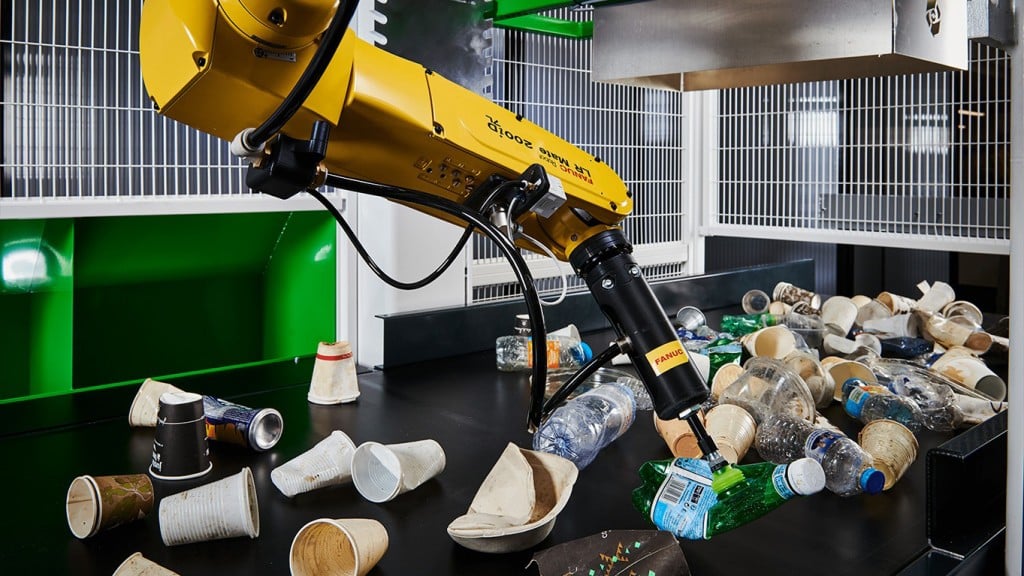
- Strong Recognition Capability: AI-driven recycling robots can accurately identify and classifyover 2,000 types of waste[1]
- Wide Application Scenarios: Covers multiple categories such as waste steel, waste plastic, waste paper, waste electrical and electronic products, and end-of-life vehicles
Guangzhou Nine-Claw Intelligence, as a representative enterprise in the industry, integrates AI vision, hyperspectral, near-infrared and other technical routes through its multi-modal intelligent sorting technology, providing integrated hardware and software solutions, which represents the cutting-edge direction of industry technology development [4].
| Technology Direction | Application Effect | Investment Value |
|---|---|---|
| AI Visual Recognition | Accurately classifies over 2,000 types of waste | High accuracy brings high recycling value |
| Hyperspectral Imaging | Material recognition accuracy reaches 98% | Improves sorting efficiency and purity |
| Near-Infrared Spectroscopy | Plastic sorting accuracy exceeds 95% | Value excavation of low-value recyclables |
| Robot Automation | Replaces manual labor, reduces operating costs | Significant scale economic effects |
In the international market, Zenrobotics launched its fourth-generation waste sorting robot, Zenrobotics 4.0, in February 2024, with upgraded AI functions that significantly improve sorting efficiency [3]. Domestic enterprises such as Guangzhou Nine-Claw Intelligence are gradually narrowing the gap with international leading enterprises through independent technological innovation, and showing competitive advantages in localized services.
From 2024 to 2025, investment and financing activities in the circular economy field are frequent:
- Henan Circular Economy Group: Completed a nearly RMB 1 billion acquisition of multiple electronic waste recycling enterprises under GEM
- Hebai Group: Cross-border entered the renewable resource field and established a RMB 20 million joint venture company
- Ingka Group: Acquired a stake in Shanghai Ruimo Environmental Protection, a Chinese plastic recycling enterprise
- Wankai New Materialsand France’s Carbios jointly invested in a 50,000-ton waste bio-enzymatic depolymerization PET recycling project with a total investment of approximately RMB 922 million
- Yindu Lama Groupcompleted a US$20 million strategic capital increase in Zhejiang Jianxin Jiren New Materials
- Lejucompleted its B++ round of financing, exclusively invested by Kunlun Capital
- Suxin Technologycompleted several million RMB in pre-A and pre-A+ round financing
- Yuantian Biologyreceived strategic investment from Toyota Tsusho
Many local governments have established special industrial funds to support the development of circular economy and intelligent manufacturing:
| Region | Fund Name | Scale | Investment Direction |
|---|---|---|---|
| Shenzhen | Artificial Intelligence and Embodied Robot Industry Fund | RMB 10 billion | AI, embodied robots |
| Shanghai | National and Local Co-constructed Humanoid Robot Innovation Center | RMB 10 billion | Humanoid robots |
| Jiangsu | Strategic Emerging Industry Parent Fund | RMB 50 billion | Strategic emerging industries |
| Guangzhou | Guangzhou Financial Assets Investment Co., Ltd. Equity Investment Fund | RMB 10 billion | Intelligent equipment and robots |
- Founded in 2021, focusing on AI multi-modal intelligent sorting technology in the resource recycling field
- Completed tens of millions of RMB in Pre-A round financing, with investors being Baiyun Jinkong and Baiyun Jianke
- The founder once worked at Huawei, with nearly 10 years of experience in IoT and intelligent equipment R&D
- Track Alignment: Aligns with the policy orientation of the “Dual Carbon” goals and waste classification policies
- Technological Barriers: Multi-modal fusion technology forms differentiated competitive advantages
- Market Rigid Demand: Intelligent sorting equipment has become a rigid configuration in the resource recycling field
- Sustainable Growth: Market demand has long-term and structural characteristics
According to industry calculation data:
| Indicator | Traditional Manual Sorting | AI Intelligent Sorting | Improvement Range |
|---|---|---|---|
| Sorting Accuracy | 70-80% | 95%+ | +15-25% |
| Labor Cost | High | Low | -60-70% |
| Processing Efficiency | Low | High | +3-5x |
| Operating Cost | High | Low | -40% |
Taking intelligent circular packaging enterprises as an example, through the exploration of AI logistics unmanned solutions and the expansion of intelligent asset scale, enterprises show good scale economic effects and cost reduction trends [5].
| Risk Type | Risk Description | Response Strategy |
|---|---|---|
| Technological Iteration Risk | Rapid evolution of AI technology | Sustained R&D investment to maintain technological leadership |
| Market Acceptance | Verification cycle of downstream customers | Build benchmark customers and replicate successful cases |
| Policy Dependence | Changes in subsidy policies | Improve self-profitability and reduce policy dependence |
| Intensified Competition | Cross-border entry of large enterprises | Differentiated positioning and deep cultivation of segmented markets |
Based on market data and development trends, it is recommended to focus on the following segmented areas:
- Plastic Circular Sorting: Strong demand in the recycled plastic market, high technology maturity
- Electronic Waste Dismantling and Sorting: Strong policy support, high recycling value
- Construction Waste Resource Utilization: Large market scale, broad intelligent space
- Low-Value Recyclable Sorting: The recovery rate of waste glass, waste textiles, etc. is less than 30%, with great room for improvement
- New Energy Vehicle Power Battery Recycling: A key link in the closed-loop of the new energy industry chain
| Evaluation Dimension | Key Indicators | Weight |
|---|---|---|
| Technological Barriers | Number of core patents, multi-modal technology capabilities | 25% |
| Commercialization Capability | Number of customers, repurchase rate, average customer unit price | 25% |
| Team Background | Founding team’s industry experience, R&D capabilities | 20% |
| Growth Potential | Market space, track competitiveness | 20% |
| Financial Status | Revenue growth rate, gross profit margin, cash flow | 10% |
- Policy Dividend Period: 2025 is the closing year of the “14th Five-Year Plan”, and policy support will continue to increase
- Technological Inflection Point: The maturity of AI multi-modal technology has reached the critical point of large-scale application, and the investment window has opened
- Market Outbreak Period: The annual growth rate of renewable resource recycling volume exceeds 6%, and the intelligent penetration rate is still at a low level
- Reasonable Valuation Period: Compared with other AI application fields, the valuation of intelligent sorting is relatively reasonable
| Trend | Specific Performance | Investment Implication |
|---|---|---|
Intelligent Upgrade |
AI-driven recycling robots identify over 2,000 types of waste | Technology-leading enterprises will obtain excess returns |
High-Value Recycling |
Shift from metal recycling to extraction of high-value materials such as rare earths | Open up a new market space of tens of billions of RMB |
Digital Traceability |
Blockchain technology ensures the compliance of resource sources | Reduces compliance costs, benefiting compliant enterprises |
Modular Deployment |
Flexible configuration solutions adapted to different scenarios | Reduces customer acquisition thresholds and accelerates penetration |
- Increased Market Concentration: Leading enterprises expand and strengthen through M&A and integration
- Deepened Professional Division of Labor: Segmented development of sorting technology, operation services, and channel networks in all links
- Accelerated International Layout: Leading enterprises such as China National Resources and Environment Group lay out markets in Southeast Asia and Europe
- Cross-Border Integration and Innovation: Integration of AI, environmental protection, logistics and other fields gives birth to new business models
- Optimized Subsidy Policies: Shift from universal subsidies to precise support for technological R&D
- Improved Standard System: Gradual establishment of product standards, traceability standards, and industry access standards
- Continued Tax Incentives: The value-added tax immediate refund policy for comprehensive resource utilization is expected to continue and be optimized
- Broad Market Space: China’s circular economy market scale exceeds RMB 4.6 trillion, and the penetration rate of AI intelligent sorting technology is still in the early stage, with huge growth space
- Continuous Policy Benefits: Policies such as the “Dual Carbon” goals, waste classification policies, and the “Action Plan for Comprehensive Solid Waste Management” form strong support
- Technological Inflection Point Reached: The maturity of AI multi-modal technology has reached the critical point of large-scale application, and the investment window has opened
- Rising Capital Enthusiasm: Industrial capital and government funds accelerate layout, and industry financing events occur frequently
- Technology-Driven: Intelligent sorting solution providers with independent intellectual property rights and multi-modal technology capabilities
- Scenario-Enabled: Enterprises with mature cases in high-value scenarios such as plastic recycling, electronic waste, and automobile dismantling
- Platform-Type: Platform enterprises that build integrated operation of recycling networks and sorting services
- Be alert to substitution risks brought by changes in technical routes
- Pay attention to the impact of policy subsidy withdrawal on profitability
- Attach importance to the transmission of downstream bulk commodity price fluctuations to recycling value
[1] Zhiyan Consulting - Report on the Operation Status and Development Trend of China’s Circular Economy Industry (May 2025)
[2] China Material Recycling Association - 2024 Renewable Resource Recycling Industry Data
[3] Fortune Business Insights - Digital Waste Management Solutions Market Report (December 2024)
[4] 36Kr - Report on Guangzhou Nine-Claw Intelligence’s Pre-A Round of Financing
[5] China Material Recycling Association - Top 10 Investment Cases in the Plastic Recycling Industry 2025
If you need further analysis of specific investment targets or enable in-depth research mode to obtain more detailed target data, please let us know.
Insights are generated using AI models and historical data for informational purposes only. They do not constitute investment advice or recommendations. Past performance is not indicative of future results.
About us: Ginlix AI is the AI Investment Copilot powered by real data, bridging advanced AI with professional financial databases to provide verifiable, truth-based answers. Please use the chat box below to ask any financial question.