
Analysis of Supply Chain Moat Construction in the New Tea Beverage Industry: The Competitive Advantages of Mixue Group's Leadership
Unlock More Features
Login to access AI-powered analysis, deep research reports and more advanced features
About us: Ginlix AI is the AI Investment Copilot powered by real data, bridging advanced AI with professional financial databases to provide verifiable, truth-based answers. Please use the chat box below to ask any financial question.
Related Stocks
Based on the information collected, I will provide an in-depth analysis of how Mixue Group and other brands build supply chain moats against the backdrop of the IPO boom in the new tea beverage industry.
After years of capital dormancy, the new tea beverage industry ushered in a concentrated IPO window in 2024-2025. Following Nayuki’s Tea’s successful listing on the Hong Kong Stock Exchange (HKEX) in 2021, ChaBaiDao, Guming, and Mixue Group completed their listings on the HKEX successively, while CHAGEE also launched its U.S. IPO process [1]. This wave of capitalization marks the new tea beverage industry’s official entry into the deep end of capitalized operations.
Notably, Mixue Group broke the curse of new tea beverage companies ‘breaking upon listing’. Its stock price has continued to rise since its Hong Kong listing, and as of July 7, 2025, the company’s market capitalization has exceeded HK$200 billion, earning it the title of one of the ‘Three Golden Flowers of Hong Kong Stocks’ alongside Pop Mart and Laopu Gold [2]. This performance reflects the capital market’s recognition of its business model, particularly its supply chain capabilities.
The new tea beverage industry is facing unprecedented involution challenges. As of January 15, 2025, the total number of milk tea beverage stores nationwide reached approximately 393,200, with 111,400 new stores opened and a net closure of 38,800 stores in the past year [1]. In the stock competition environment, the economies of scale are declining, and industry profits are being continuously eroded. Lai Yang, an expert committee member of the China General Chamber of Commerce, pointed out that the economies of scale in the new tea beverage industry are declining, and industry profits are being continuously eroded.
This shift has prompted corporate strategies to move from ‘scale-driven’ to ‘value-driven’, with hard indicators such as single-store profitability, product innovation cycles, and supply chain barriers becoming new benchmarks for measuring enterprise value.
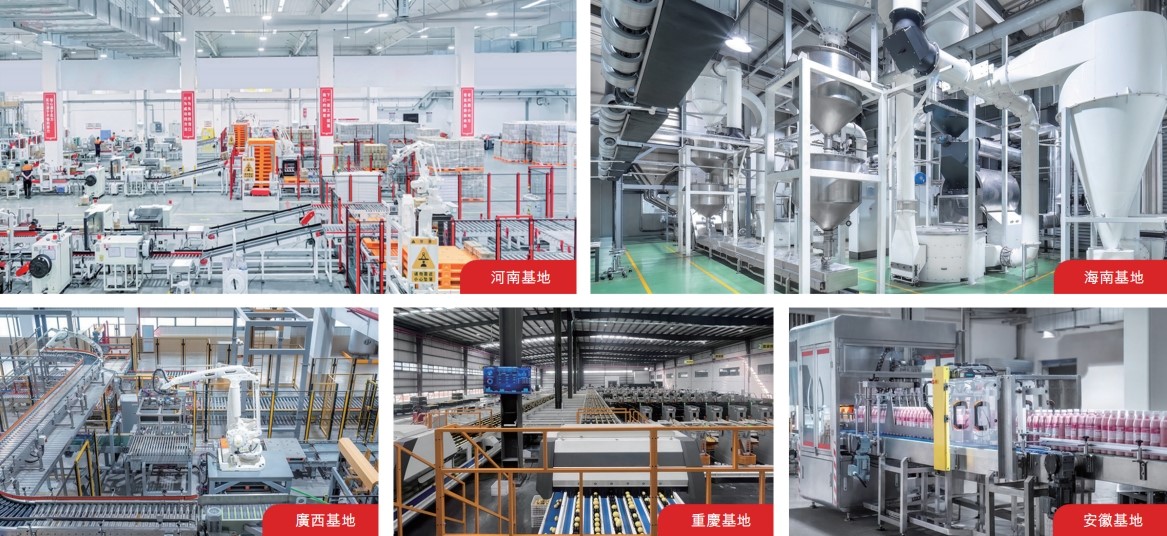
Mixue Group’s supply chain moat is first reflected in its large-scale self-owned factory system. Daka International Food Co., Ltd., located in Wenxian County, Henan Province, is its core production base, covering an area of approximately 342,000 square meters with an annual production capacity of 1.21 million tons. It provides core raw materials including sugar, milk, tea, coffee, fruits, grains, and ingredients, as well as packaging materials and equipment, to over 46,000 stores under Mixue Group [2].
| Indicator | Data |
|---|---|
| Production Base Area | 342,000 square meters |
| Annual Production Capacity | 1.21 million tons |
| Self-Production Rate of Beverage Ingredients | Over 60% |
| Self-Production Rate of Core Beverage Ingredients | 100% |
| Franchisee Procurement Concentration | 100% procured from the brand |
This deep vertical integration strategy enables Mixue Group to control product quality from the source, ensuring that every drink meets strict standards, while effectively reducing production costs through large-scale production.
Mixue Group has built a global procurement network, demonstrating significant advantages in cost control:
- Lemon Procurement Advantage: As China’s largest lemon buyer, Mixue Group has established in-depth cooperation through its wholly-owned subsidiary Xuewang Agriculture in Tongnan, Chongqing (one of the world’s three high-quality lemon producing areas), adopting an ‘order-based agriculture’ model with growers. In 2023, its lemon procurement volume reached 115,000 tons, and the procurement cost for lemons of the same type and quality was 20% lower than the industry average [3].
- Large-Scale Bargaining Power: Relying on the huge scale and order volume of over 46,000 stores, Mixue Group has gained strong bargaining power in the procurement link, achieving further compression of raw material prices.
- Global Layout: It has established procurement partnerships in fruit producing areas such as Fusui, Guangxi, Changfeng, Anhui, and Hainan, while adopting a mixed model of localized procurement and centralized distribution in overseas expansion.
Mixue Group has carried out comprehensive optimization in all links of the supply chain, demonstrating excellent cost control capabilities:
Mixue Group initially purchased finished oil jugs for storing molasses and fruit syrup, but transportation costs remained high (the jugs cannot be flattened, limiting vehicle loading capacity). The company adjusted its strategy, purchasing preforms for blow molding, and ultimately directly purchasing plastic pellets to achieve fully independent production. Through this series of adjustments, procurement costs were reduced by 49% [2].
Through the introduction of automated production equipment, Mixue Group has achieved:
- Reduced errors and contamination caused by manual operations, ensuring product quality
- Lowered warehousing costs
- Improved production efficiency and delivery stability
The robust supply chain system supports Mixue Group’s ‘high-quality, low-price’ product strategy. In 2024, the 4-yuan fresh lemon water sold over 1.1 billion cups, becoming the company’s star product [2]. Behind this extreme cost-effectiveness is the cost advantage brought by the supply chain.
Guming has built high operational efficiency through the strategy of ‘regional deep cultivation + supply chain preposition’. The company’s supply chain construction focuses on establishing warehousing and distribution networks in key regions to deliver raw materials to stores in the shortest time, ensuring product freshness [4].
In its 2024 financial report, Guming emphasized the requirement for franchisees to ‘operate in-store’, requiring partners to personally participate in frontline store management, indicating the brand’s increased emphasis on single-store operation and management.
ChaBaiDao has deeply integrated large model technologies such as DeepSeek and Tongyi Qianwen, starting from key scenarios such as store management, food safety control, and efficiency improvement, to build a ‘trinity’ intelligent management system, empowering stores in an all-round way through digital technology. Currently, relevant applications have been implemented on a large scale in over 8,000 stores nationwide [1].
ChaBaiDao also enhances its bargaining power through global procurement, self-built raw material production bases, and warehousing facilities to ensure stable raw material supply and quality control.
HEYTEA has launched a number of high-tech tea beverage equipment and applied for a number of technical patents. These equipment not only greatly reduce manual operation time, but also reduce store losses through data algorithms and control product sell-out rates [1].
In February 2025, HEYTEA issued an internal company-wide email titled ‘Not Participating in Digital Games and Scale Involution, Returning to Users and Brands’, announcing the temporary suspension of accepting applications for business partnership, indicating the company’s strategic shift from scale expansion to quality priority.
As the ‘first stock of new tea beverages’, Nayuki’s Tea faces greater cost pressure under its high-end positioning. The company revealed at its 2024 financial report performance conference that it basically suspended franchise business after May 2024 to ensure the quality of each store first [4]. This strategic adjustment reflects the re-examination of single-store profitability by high-end brands in fierce competition.
The new tea beverage industry is accelerating the introduction of various intelligent equipment, including:
- Intelligent tea dispensing machines
- Automatic peeling machines, automatic pitting machines
- Automatic lemon hammering machines
- Milk tea robots
- Fully intelligent tea beverage machines
Yin Junfeng, a researcher at the Tea Research Institute of the Chinese Academy of Agricultural Sciences, believes that intelligent equipment will be used more and more in the new tea beverage industry in the future. These equipment can not only reduce labor input, but also standardize product standards and solve problems such as hygiene [1].
The ‘trinity’ intelligent management system built by brands such as ChaBaiDao through large model technology represents the cutting-edge direction of the industry’s digital transformation. The system covers:
- Store Management: Intelligent scheduling, inventory early warning, sales forecasting
- Food Safety Control: Full-process traceability, temperature control monitoring, quality early warning
- Efficiency Improvement: Intelligent scheduling, loss control, efficiency optimization
Through digital tools, new tea beverage enterprises can achieve:
- Demand forecasting based on sales data to optimize procurement plans
- Real-time inventory management to reduce losses and stockouts
- Real-time monitoring and optimization of store operation data
As of September 30, 2024, Mixue Group has established a localized warehousing system in 4 Southeast Asian countries, with 7 self-operated warehouses covering a total area of approximately 69,000 square meters. The company plans to build a multi-functional supply chain center in Southeast Asia to optimize the distribution efficiency of ingredients to local stores [3].
In 2025, Mixue Group further expanded its overseas footprint:
- In April, its first store in Kazakhstan opened, expanding its overseas store footprint to the Central Asian market
- In August, the first store of its coffee brand ‘Lucky Coffee’ made its debut in Malaysia, officially entering the overseas market
During overseas expansion, new tea beverage brands adopt a mixed model of ‘localized procurement + centralized distribution’:
- Match local tastes and consumption habits
- Reduce cross-border logistics costs
- Ensure raw material freshness and supply stability
As the number of overseas stores increases, the global procurement scale of new tea beverage brands continues to expand, further enhancing their bargaining power in the global supply chain. This positive cycle provides a solid supply chain foundation for the brand’s international strategy.
| Component | Core Content | Representative Enterprise Practices |
|---|---|---|
| Self-Owned Factories | Independent production of core raw materials to ensure quality and cost control | Mixue Group’s Daka International Factory |
| Direct Procurement from Origin | Order-based agriculture, cooperation with planting bases | Mixue Group’s lemon procurement |
| Large-Scale Procurement | Global procurement network to obtain bargaining power | Major brands |
| Intelligent Manufacturing | Automated production to reduce labor and warehousing costs | Mixue Group’s independent production of packaging materials |
| Digital Management | AI technology empowers store and supply chain management | ChaBaiDao’s DeepSeek application |
| Cold Chain Logistics | Efficient distribution network to ensure raw material freshness | Guming’s regional warehousing preposition |
| Localized Warehousing | Overseas supply chain network construction | Mixue Group’s 7 warehouses in Southeast Asia |
Jiang Han, a senior researcher at the Pangoal Institution, stated that building a self-owned supply chain is not only a wise choice for new tea beverage brands in cost control and quality assurance, but also an effective way for them to explore diversified profit models and enhance market competitiveness [1].
Zhu Danpeng, a Chinese food industry analyst, pointed out that upstream supply chain construction has become the core of competition and a key investment focus for new tea beverage brands, which is crucial for ensuring product quality and achieving large-scale development [1].
Full-link control from source planting to terminal stores will become a standard configuration for leading brands. Mixue Group’s ‘from field to store’ model has verified the feasibility of this direction.
The in-depth application of AI technology will reshape supply chain management. From demand forecasting and inventory optimization to quality control, digital capabilities will become one of the core competitive strengths.
As the brand’s internationalization process accelerates, building a global supply chain network will become increasingly important. This is not only a cost issue, but also a reflection of market responsiveness.
The change in the valuation logic of the capital market has prompted enterprises to pay more attention to single-store profitability and supply chain efficiency, rather than simply pursuing the number of stores.
After the IPO boom in the new tea beverage industry, the construction of supply chain moats has become a core competitive element for the sustainable development of brands. Mixue Group has built an irreplicable cost advantage and quality assurance capability through a full-link system of ‘self-owned factories + global procurement + intelligent manufacturing + efficient logistics’. Its model of 100% self-production of core beverage ingredients and 100% centralized procurement by franchisees has formed a unique competitive barrier in the industry.
For investors, when evaluating the value of new tea beverage enterprises, the following supply chain indicators should be focused on:
- Self-Production Rate: The proportion of core raw materials produced in-house reflects the depth of supply chain control
- Procurement Cost Advantage: Cost difference relative to the industry average
- Warehousing and Logistics Efficiency: Distribution timeliness and loss rate
- Digitalization Level: Degree of application of intelligent tools
- Globalization Capability: Improvement level of overseas supply chain networks
Brands such as Mixue Group, Guming, and ChaBaiDao are shifting from ‘scale competition’ to ‘efficiency competition’ and ‘value competition’ through differentiated supply chain strategies. In this competition to build supply chain moats, brands that can take the lead in achieving in-depth supply chain integration and intelligent upgrading may occupy a dominant position in the industry’s competition in the next decade.
[1] Securities Times - “New Tea Beverage Industry’s ‘Red Sea Breakout’: Restructuring Development Logic Through Supply Chain, Intelligence, and Internationalization” (https://stcn.com/article/detail/1665856.html)
[2] Securities Times - “Exploring the Supply Chain Code of Mixue Group: Building Competitive Advantages from Field to Store” (https://www.stcn.com/article/detail/2449918.html)
[3] Core Information of Mixue Group’s Supply Chain System - Field Research by Securities Times
[4] Yicai Global - “Financial Report Analysis of 4 Major New Tea Beverage Enterprises: Growing Pains of Transformation Emerge, Brands Find It Harder to Make Money” (https://www.cbndata.com/information/293894)
Insights are generated using AI models and historical data for informational purposes only. They do not constitute investment advice or recommendations. Past performance is not indicative of future results.
About us: Ginlix AI is the AI Investment Copilot powered by real data, bridging advanced AI with professional financial databases to provide verifiable, truth-based answers. Please use the chat box below to ask any financial question.