
Analysis of the Impact of Embodied Intelligence Demonstrations at CES 2026 on the Investment Value of the Robot Industry Chain
Unlock More Features
Login to access AI-powered analysis, deep research reports and more advanced features
About us: Ginlix AI is the AI Investment Copilot powered by real data, bridging advanced AI with professional financial databases to provide verifiable, truth-based answers. Please use the chat box below to ask any financial question.
Related Stocks
Based on collected data and market information, I now provide you with a comprehensive investment analysis report.
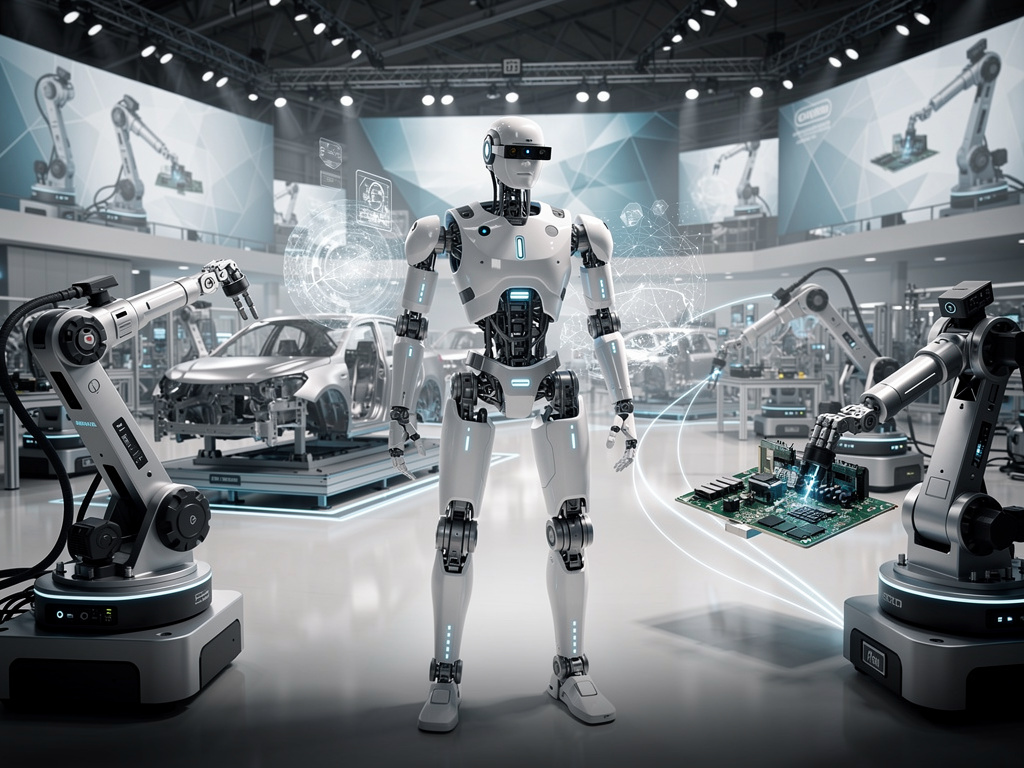
The 2026 International Consumer Electronics Show (CES) opened in Las Vegas on January 6, attracting over 4,500 exhibitors on the first day, including approximately 1,000 Chinese enterprises. The theme of this exhibition is clearly positioned as “Embodied Intelligence Applications: AI Capabilities Moving from Screens to the Physical World”, marking a historic turning point for artificial intelligence technology to move from virtual layers to real-world industrial implementation[1][2].
At the show, the new-generation Atlas humanoid robot jointly launched by Boston Dynamics and Hyundai Motor became the focus. This is the first time Boston Dynamics, after being acquired by Hyundai Motor, has launched a robot product as a group-level strategic initiative, marking the official shift of this once “stunt-focused” robotics company to a commercial mass production route. Hyundai Motor announced a plan to produce 30,000 Atlas humanoid robots annually, which will be deployed in its own U.S. factories in 2028[1][3]. This production capacity plan means that humanoid robots will truly transition from laboratory prototypes to large-scale mass production.
The new-generation Atlas exhibits several breakthrough features:
- All-Electric Drive Design: Abandons hydraulic systems and adopts a lightweight structure
- Supernatural Mobility: 56 degrees of freedom, supporting 360-degree joint rotation
- Industrial-Grade Battery Life: 4 hours of operation on a single charge, equipped with an autonomous battery swapping system
- Environmental Adaptability: IP67 waterproof rating, operating temperature range of -20℃ to 40℃
- Strength Specifications: Maximum load capacity of 50 kg, maximum reach height of 2.3 meters[2][4]
More importantly, Hyundai Motor has clarified its industrialization timeline: internal production will begin in 2026, pilot deployment for external customers will start in 2027, large-scale promotion to the global manufacturing system will be carried out in 2028, and complex assembly tasks will be achieved by 2030. This clear roadmap significantly reduces investment uncertainty[2].
The robot industry chain exhibits a “smile curve” characteristic, with core components occupying the top of the value chain. According to data from the Zhongshang Industrial Research Institute, the cost proportions of core components are as follows:
| Core Component | Cost Proportion | Technological Barrier | Localization Rate |
|---|---|---|---|
| Reducer | 35% | Highest | Approximately 35% (harmonic), 25% (RV) |
| Servo System | 25% | Relatively High | Breakthroughs achieved by Inovance Technology, etc. |
| Controller | 15% | High | Catching up continuously |
| Sensor | 10% | High | 6-axis force sensors rely on imports |
| Robot Body Structure | 10% | Medium | Relatively High |
| Others | 5% | - | - |
Upstream core components are the segment with the highest technological barriers and largest cost proportion in the industry chain, and are also the key battlefield for domestic substitution[5][6].
| Segment | 2024 | 2025E | 2026E | CAGR |
|---|---|---|---|---|
| Reducer Market Size (CNY 100 million) | 1,447 | 1,520 | 1,672 | 7.5% |
| Servo Motor Market Size (CNY 100 million) | 223 | 245 | 280 | 12.2% |
| Global Industrial Robot Market Size (CNY 100 million) | 1,016 | 1,129 | 1,263 | 11.5% |
- Harmonic Reducer: Lude Harmonic (with a market share of ~12%) has technical indicators close to international advanced levels, leading domestic substitution
- RV Reducer: Domestic enterprises such as Huandong Technology have a market share of 25%, entering the first tier
- Investment Logic: Technological breakthroughs + cost advantages + demand for domestic substitution, leading enterprises are expected to continue to benefit[5][6]
- Inovance Technology has surpassed Japanese brands in market share with its high cost-performance ratio and fast response services
- Estun has achieved controller technological breakthroughs through the acquisition of the UK’s TRIO
- Investment Logic: Dual drivers of downstream demand growth + increasing localization rate[5][6]
- Strong demand for 3D vision and force sensors
- Lidar leaders such as Hesai Technology and RoboSense are expanding from autonomous driving to robot perception systems
- 6-axis force sensors still heavily rely on imports, leaving huge space for domestic substitution[9]
- Tesla Optimus: The V3 version is expected to be released in Q1 2026, and a 1 million-unit V3 production line will be completed by the end of 2026
- Boston Dynamics Atlas: 2026 orders are fully booked, with an annual production capacity plan of 30,000 units
- Unitree Robotics: 2025 orders approached CNY 1.2 billion, shipments exceeded 10,000 units, and the company is sprinting for an IPO
- Ubtech Robotics: 2025 orders reached nearly CNY 1.4 billion, and the 1,000th Walker S2 has rolled off the production line[8][10]
Three core application scenarios:
- Industrial Manufacturing: Automobiles and parts (43.3% share), electronics and electrical appliances (19.1% share)
- Logistics and Warehousing: Rapidly growing demand for AMR/AGV mobile robots
- Commercial Services and Household: Markets for service robots and companion robots are gradually opening up[5][6]
According to statistics from Securities Times · Data Treasure, there are 31 humanoid robot concept stocks for which 5 or more institutions have unanimously predicted that net profit growth rates will exceed 20% in both 2026 and 2027. Comparing the closing price on January 6 with the institutional target price, the targets with upside potential exceeding 30% include:
| Target | Upside Potential | Core Logic |
|---|---|---|
| Zhiwei Zhineng | 43.6% | Embodied intelligence “big and small brain” controller, has received customer orders |
| iSoftStone | Over 30% | Layout of robot operating systems |
| Zhenyu Technology | Over 30% | Core component supplier |
| Leadshine Technology | Over 30% | Motion control system |
| Xiangxin Technology | Over 30% | Structural component supplier[7] |
As of the close on January 6, concept stocks with a trailing price-to-earnings ratio (PE) below 40 include:
| Target | Trailing PE Ratio | Business Highlights |
|---|---|---|
| Huaqin Technology | 24.25x | AI servers + robot business |
| Topband Corporation | Low valuation | Motor control + robots |
| Dechang Corporation | Low valuation | Motor supplier |
| Jiecang Drive | Low valuation | Linear drive[7] |
Auto parts companies have become early beneficiaries due to their underlying technologies and industrial logic being highly compatible with humanoid robots:
- Has laid out in the actuator field, with independent R&D capabilities for permanent magnet servo motors
- Has laid out products such as robot body structural components and sensors
- Revenue in the first three quarters of 2025 reached CNY 20.928 billion
- Relying on accumulated businesses such as wire-controlled brakes, it has expanded horizontally to robot electric drive actuators[8][11]
- Has entered the bionic robot electromechanical actuator segment relying on motor manufacturing, large-scale production, and cost control capabilities
- Revenue in the first three quarters of 2025 reached CNY 24.029 billion, a year-on-year increase of 16.86%
- Total market capitalization exceeded the historical high of CNY 220 billion[8][11]
- Lude Harmonic (domestic substitution for harmonic reducers)
- Inovance Technology (leader in servo systems)
- Qinchuan Machine Tool (ball screws and linear guides)
- Tuopu Group (in-depth cooperation with Tesla)
- Sanhua Intelligent Controls (actuator supplier)
- Xusheng Group (precision components)
- Zhiwei Zhineng (big and small brain controller)
- iSoftStone (operating system)
- iFlytek (AI large model)
- Hesai Technology (lidar)
- RoboSense (lidar)
- Dahua Technology/Hikvision (machine vision)[9][11]
Based on the industrial development stage, the current period is the
- Short-term (2026): Focus on component suppliers with verified mass production capabilities and sufficient orders
- Mid-term (2027-2028): Pay attention to industry chain collaboration opportunities brought by large-scale volume expansion of whole machine manufacturers
- Long-term (after 2029): Lay out enterprises with platform capabilities and scenario implementation capabilities[8][10]
| Risk Type | Specific Performance | Response Strategy |
|---|---|---|
| Technological Risk | Key technical bottlenecks such as dexterous hands and sensors | Focus on enterprises that have achieved technological breakthroughs |
| Mass Production Risk | Cost reduction falling short of expectations, yield issues | Focus on enterprises with large-scale production experience |
| Competition Risk | Intensified competition from international giants | Focus on domestic manufacturers with cost advantages |
| Valuation Risk | High valuation of the sector | Select low-valuation + high-growth targets |
| Policy Risk | Excessive capital investment in the industry | Focus on enterprises with actual order implementations[8] |
The large-scale display of embodied intelligence at CES 2026 marks the robot industry’s official transition from the “technology verification phase” to the “mass production ramp-up phase”. Hyundai Motor’s announcement of a 30,000-unit/year Atlas mass production plan, Tesla’s 1-million-unit Optimus production line plan, and order breakthroughs by domestic manufacturers such as Unitree Robotics and Ubtech Robotics collectively confirm that the inflection point for humanoid robot commercialization has arrived.
From an investment perspective,
It is recommended that investors seize the investment opportunities during the 2026 mass production ramp-up phase, focusing on laying out industry chain leaders with leading technologies, sufficient orders, and reasonable valuations.
[1] Sina Tech - “Boston Dynamics Robots Enter Factories for the First Time | On-Site at CES” (https://finance.sina.com.cn/tech/2026-01-06/doc-inhfhttf7779667.shtml)
[2] EET China - “From ‘Stunt Shows’ to ‘Mass Production’: In-Depth Interpretation of Hyundai Motor Group’s Robot Ambitions at CES 2026” (https://www.eet-china.com/mp/a465703.html)
[3] NE Time - “Boston Dynamics’ New-Generation Atlas Robot is About to ‘Work’ in Hyundai Motor Factories” (https://ne-time.cn/web/article/37563)
[4] Sina Tech - CES 2026 Exhibition Special Report
[5] Zhongshang Industrial Research Institute - “2026 China Industrial Robot Industry Chain Map and Investment Layout Analysis” (https://www.163.com/dy/article/KIDSDFR205198SOQ.html)
[6] Sina Finance - “2026 China Industrial Robot Industry Chain Map and Investment Layout Analysis” (https://cj.sina.com.cn/articles/view/7962326780/1da9776fc001017hly)
[7] Securities Times - “Humanoid Robot Industry Heats Up, Multiple Concept Stocks Favored by Institutions” (https://www.stcn.com/article/detail/3574963.html)
[8] Eastmoney - “7 Limit-Up Days! Humanoid Robot Mass Production is Imminent, Leading Companies Secure Hundred-Billion-Yuan Market Capitalization” (https://caifuhao.eastmoney.com/news/20260106204753236859290)
[9] Futu News - “In-Depth Perspective on the 2026 Robot ‘Hong Kong Listing Wave’: Complete Sorting of Investment Logic” (https://news.futunn.com/post/67117570)
[10] 36Kr - “Where is the Hottest Trend in 2026?” (https://eu.36kr.com/zh/p/3614881649738758)
[11] Red Weekly Finance - “7 Limit-Up Days! Humanoid Robot Mass Production is Imminent, Leading Companies Secure Hundred-Billion-Yuan Market Capitalization” (https://news.qq.com/rain/a/20260106A07AQN00)
Insights are generated using AI models and historical data for informational purposes only. They do not constitute investment advice or recommendations. Past performance is not indicative of future results.
About us: Ginlix AI is the AI Investment Copilot powered by real data, bridging advanced AI with professional financial databases to provide verifiable, truth-based answers. Please use the chat box below to ask any financial question.