
Analysis of Non-Food Order Structure and Unit Economic Model for Full Category Expansion of Taobao Flash Buy
Unlock More Features
Login to access AI-powered analysis, deep research reports and more advanced features
About us: Ginlix AI is the AI Investment Copilot powered by real data, bridging advanced AI with professional financial databases to provide verifiable, truth-based answers. Please use the chat box below to ask any financial question.
Related Stocks
Based on the latest information, I have conducted a systematic analysis of the non-food order structure of Taobao Flash Buy and the unit economic model for its full category expansion.
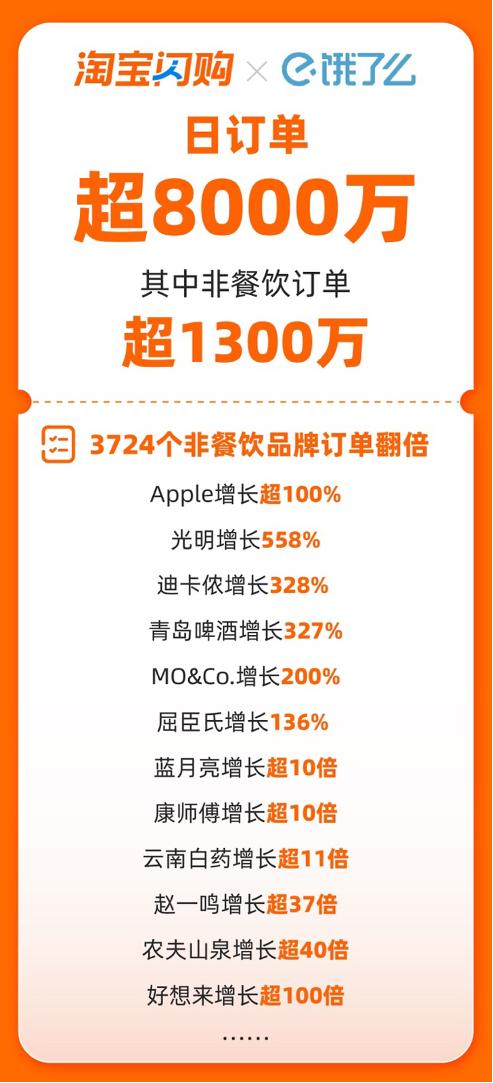
Since Taobao Flash Buy was upgraded from “Hourly Delivery” in April 2025, it has achieved leaping development. It only took 6 days after its launch for orders to exceed 10 million; by the end of May, daily orders exceeded 40 million, in June over 60 million, and the peak daily order volume reached 120 million in August, with the average daily order volume on weekdays stabilizing at 80 million [1]. This growth rate is unprecedented in the instant retail sector.
More importantly, the order structure has been continuously optimized. The latest data shows that
| Order Type | Early Proportion | Current Proportion | Impact on Unit Economics |
|---|---|---|---|
| Catering/Tea Beverages | ~80% | ~25% | Low average order value, high frequency, limited profit margin |
| Non-Food Categories | ~20% | ~75% | High average order value, strong profitability |
In terms of average order value,
Taobao Flash Buy is not merely a food delivery platform, but a “near-field touchpoint” within Alibaba’s large consumer ecosystem. Its full category expansion relies on three strategic pillars:
- Access to 400,000 brand storesto achieve online-offline integration
- For leading brands such as Huawei, vivo, and Xtep, weekly transactions have increased by over 19 times month-on-month through the “authorized flagship store genuine products + 30-minute delivery” model [3]
- Heytea was first accessed in September 2025, breaking its previous exclusive cooperation with a specific platform [1]
- Hema’s daily order volume has exceeded 2 million, with a year-on-year growth of over 70%[3]
- Tmall Supermarket has upgraded from the B2C long-distance model to “near-field flash buy + three deliveries a day”, with 5,000 key products available for delivery in as fast as 4 hours [3]
- Cainiao Supply Chain has joined to provide “hourly delivery” services, covering multiple categories such as 3C digital products
- The effect of capacity reuse is significant: the peak of the Ele.me rider network is concentrated during the “lunch and dinner peaks” for catering, and during off-peak hours, it can undertake orders for fresh produce, daily necessities, and even Xianyu same-city delivery from Flash Buy [2]
- Taobao Flash Buy has driven a 20% year-on-year growthin the daily active users of the Taobao App, increasing from 375 million in April to 437 million in September [4]
- During Double 11, the number of e-commerce orders on the main site from new users brought by Flash Buy exceeded 100 million[1]
- Flash Buy has become a high-frequency traffic entry point, increasing users’ average daily usage duration and opening frequency within the Taobao App
According to Alibaba’s latest disclosure,
- Increased proportion of high average order value orders → Higher per-order revenue
- 75% proportion of non-food orders → Gross margin level is better than that of catering orders
- Increased order density has led to a significant reduction in logistics costs
- Capacity reuse reduces per-order fulfillment costs
- Since October last year, the per-order loss of Flash Buy has been halved compared to July and August[4]
- Flash Buy brings high-frequency traffic to the Taobao main site, reducing the customer acquisition cost of the main site
- Improved user activity, new user acquisition, and churn recall efficiency enable Alibaba to reduce marketing expense investment[2]
- The average daily orders of Tmall brands’ instant retail business surged 198% month-on-month compared to September, with nearly 600 brands achieving transactions exceeding RMB 100 million [2]
From the perspective of the unit economic model,
| Dimension | Catering Orders | Non-Food Orders | UE Impact |
|---|---|---|---|
| Average Order Value | RMB 30-50 | RMB 80-200+ | +60%-300% |
| Product Profit Margin | 15-20% | 25-40% | +10-20 pct |
| Delivery Complexity | Standardized | Highly Variable | Slightly higher initial cost |
| User Repurchase Frequency | High | Medium | Decrease in marginal customer acquisition cost |
The core logic of full category expansion improving UE lies in:
- High average order value directly increases per-order gross profit: Non-food products (digital, apparel, alcohol, beauty, etc.) inherently have higher average order values and gross profit margins
- Order density dilutes fulfillment costs: Category expansion drives growth in total orders, improves delivery network efficiency, and reduces per-order fulfillment costs
- Improvement in the entire lifecycle of user value: High-frequency catering orders serve as traffic entry points, while low-frequency, high-average-order-value non-food orders act as profit engines, forming a healthy business portfolio
- Cross-selling generates synergistic benefits: The purchase conversion rate of Flash Buy users on the Taobao main site increases, leading to growth in advertising revenue and customer management revenue (CMR) [2]
Alibaba’s management has clearly stated that
- Xu Hong, Chief Financial Officer of Alibaba, stated that the third quarter of last year was the peak of investment in the Flash Buy business; as the scale stabilizes and efficiency continues to optimize, overall investment is expected to shrink significantly in the next quarter [4]
- Jiang Fan stated that the economic benefit optimization in the second phase is in line with expectations, which lays a foundation for the long-term sustainable development of the food delivery business [2]
- Erosion of Alibaba’s overall profit due to continuous high investment (the adjusted EBITA profit of the China e-commerce group fell by 76% in Q2)
- Changes in regulatory policies (In December 2025, the Ministry of Commerce issued the Guidelines for the Standardization of the Instant Retail Industry, prohibiting vicious subsidies below cost price)
- Counterattack strategies of competitors and evolution of the market structure
The structural change of Taobao Flash Buy with 75% of non-food orders
In the short term, Taobao Flash Buy is still in the strategic stage of “trading investment for market share”; however, in the medium to long term, relying on the synergistic effects of Alibaba’s ecosystem and its full category supply capacity, the improvement trend of its unit economic model has strong sustainability.
[1] China Business News - 2025 Restructured Food Delivery Landscape: An Orange Storm Sparked by Taobao Flash Buy (https://m.sohu.com/a/972982963_114986)
[2] Wumian Caijing - Ele.me “Goes Orange”, Opening a New Chapter in Service E-Commerce (https://wumiancaijing.com/NewsDetail/6460192.html)
[3] 21st Century Business Herald - Alibaba Performance Preview: Taobao Flash Buy to Maintain Heavy Investment in 2026 (https://finance.sina.com.cn/roll/2026-01-08/doc-inhfqtyt1311878.shtml)
[4] Southern Metropolis Daily - Taobao Flash Buy’s Primary Goal is Market Share Growth, Firmly Increasing Investment to Seize Absolute Market Leadership (https://finance.eastmoney.com/a/202601083612889687.html)
[5] Leidi - Alibaba’s Clear Goal: Taobao Flash Buy’s Primary Target is Market Share Growth, Increasing Investment to Strive for Absolute Leadership (https://m.sohu.com/a/973991623_430392)
Insights are generated using AI models and historical data for informational purposes only. They do not constitute investment advice or recommendations. Past performance is not indicative of future results.
About us: Ginlix AI is the AI Investment Copilot powered by real data, bridging advanced AI with professional financial databases to provide verifiable, truth-based answers. Please use the chat box below to ask any financial question.