
In-depth Analysis Report on IKEA China's Online Channel Layout and E-commerce Transformation
Unlock More Features
Login to access AI-powered analysis, deep research reports and more advanced features
About us: Ginlix AI is the AI Investment Copilot powered by real data, bridging advanced AI with professional financial databases to provide verifiable, truth-based answers. Please use the chat box below to ask any financial question.
Based on the collected information, I will conduct a systematic analysis of IKEA China’s online channel layout and e-commerce transformation strategy from multiple dimensions.
IKEA China is experiencing an unprecedented performance winter. According to financial data disclosed by Ingka Group, IKEA China’s sales in fiscal 2024 (September 2023 to August 2024) fell 7.6% year-on-year in RMB, marking the second consecutive decline following the 10.6% drop in fiscal 2023 [1][2]. From a global perspective, IKEA’s global retail sales in fiscal 2024 were approximately EUR 45.1 billion, down 5.3% year-on-year; net profit was approximately EUR 806 million, nearly halving year-on-year [1]. Notably, the share of the Chinese market in Ingka Group’s global sales also dropped from 3.6% in the previous fiscal year to 3.5% [1].
This downward trend stands in stark contrast to IKEA China’s former glory. In fiscal 2019, IKEA China’s sales peaked at RMB 15.77 billion, contributing 6% of the parent company’s revenue and ranking among the top markets, on par with the UK market [1]. At that time, IKEA ignited Chinese consumers’ enthusiasm with affordable products such as RMB 39 tables, RMB 9.9 cups and vases, as well as the Nordic modern minimalist lifestyle concept, becoming a “phenomenon-level” presence in the home furnishing market. However, the consecutive declines since then mark the stall of this growth engine.
The decline in IKEA China’s performance is not an isolated incident, but the result of multiple intertwined factors. According to data released by the China Building Materials Circulation Association, the cumulative sales of national scale building materials and home furnishing stores in 2024 reached RMB 1.17 trillion, down 4.62% year-on-year [1], putting pressure on the entire industry. Meanwhile, the 2025 China Home Furnishing Industry Insight White Paper shows that the online decision-making penetration rate of home improvement and home furnishing consumers has reached as high as 97%, with short videos and live streaming becoming the main drivers of consumption [1]. This profound change in consumer behavior poses a fundamental challenge to IKEA, which relies on the large offline store model.
What adds to IKEA’s pressure is the rapid rise of local home furnishing brands. According to the 2025 Top 10 Living Furniture Brands Ranking, IKEA ranks sixth, behind QuanU, Kuka Home, Qumei Home, Sophia, and Lin’s Wood Furniture [1]. During the 2025 “Double 11” period, on Tmall’s home furnishing brand list, Yuan’s Wood Furniture, Lin’s Wood Furniture, and Jomoo ranked top three; on Douyin’s home living category list, Sleemon, Kuka Home, and Atour Planet ranked top three, with IKEA absent from the top brand lists [1].
The root cause of IKEA China’s lagging online channel layout lies in its underestimation of the development speed of China’s e-commerce and misjudgment of strategy. For nearly 20 years after entering China, IKEA has adhered to the “suburban large store, pay-on-spot and self-pickup” model, and only began to layout its official self-operated online mall in 2018 [1]. This time point is nearly a decade after the explosive growth of China’s e-commerce.
From a timeline perspective, IKEA China reported consecutive declines in sales growth rate for three years from 2016 to 2018 [3]. At that time, China’s home furnishing industry began to develop online new retail, while IKEA was “hesitant” despite noticing online shopping, missing the “golden age” of China’s e-commerce development [3]. When IKEA finally launched its online mall in 2018, platforms such as Tmall and JD.com had already established strong brand awareness and user bases in the home improvement and home furnishing category, and local brands had already completed in-depth layout of online channels.
As of fiscal 2025, IKEA China’s online business accounts for only 25.7% of its total revenue [1][4]. Although this is an improvement from previous levels, there is a huge gap compared with the industry’s 97% online decision-making penetration rate. This data means that although consumers almost all refer to online information when making home furnishing consumption decisions, the proportion of those who actually complete purchases through IKEA’s online channels is still low.
More importantly, IKEA’s online service capabilities still have obvious shortcomings. Consumers most frequently complain that its online service has not yet implemented free shipping, and the clearly marked shipping fees are out of place in the highly competitive market [4]. In contrast, local brands have formed competitive advantages in services such as free shipping, instant delivery, and 7-day no-reason returns.
The large store network that IKEA has built in the Chinese market over the past nearly 30 years has now become a heavy burden for transformation. The traditional “Blue Box” large stores are huge in area, located in remote areas, and rely on consumers traveling long distances for low-frequency bulk consumption. According to industry data, the annual in-store frequency of traditional large stores plummeted from 4.2 times in 2018 to 1.8 times in 2025 [3]. This model, which emphasizes experience and low frequency, is seriously disconnected from the current fragmented and high-frequency consumption demands.
At the same time, most of these stores are old stores that have been in operation for many years, with aging facilities. Their renovation and operation costs are higher than those of newly built small stores, and they cannot quickly adapt to IKEA’s new strategy of omni-channel collaboration [3]. Stores in cities such as Nantong and Xuzhou also have overlapping coverage issues, further diluting single-store revenue [3].
Faced with difficulties, IKEA China is actively promoting strategic transformation. According to its official announcements, the strategic shift mainly focuses on three directions [1][2][4]:
IKEA is implementing the strategic transformation of “closing large stores and opening small stores”. On January 7, 2026, IKEA China announced that it will cease operations of 7 offline touchpoints starting from February 2, 2026, including IKEA Shanghai Baoshan Mall (once Asia’s largest store), IKEA Guangzhou Panyu Mall, IKEA Tianjin Zhongbei Mall, IKEA Nantong Mall, IKEA Xuzhou Mall, IKEA Ningbo Mall, and IKEA Harbin Mall [2][4]. After the store closures, the number of IKEA China’s offline stores will decrease from 41 to 34.
Meanwhile, IKEA plans to open more than 10 small stores in Beijing and Shenzhen as pilots in the next two years, including IKEA Dongguan Mall scheduled to open in February 2026 and IKEA Beijing Tongzhou Mall scheduled to open in April 2026 [2][3]. These small stores are 60% smaller than traditional large stores, with locations focused on core business districts or communities, to improve consumer reach efficiency through more flexible “small touchpoints” [3]. For example, IKEA Shenzhen Bao’an Mall is only 1,455 square meters, but has achieved unexpected results, with newly registered members driving nearly 20% additional sales growth for the store [4].
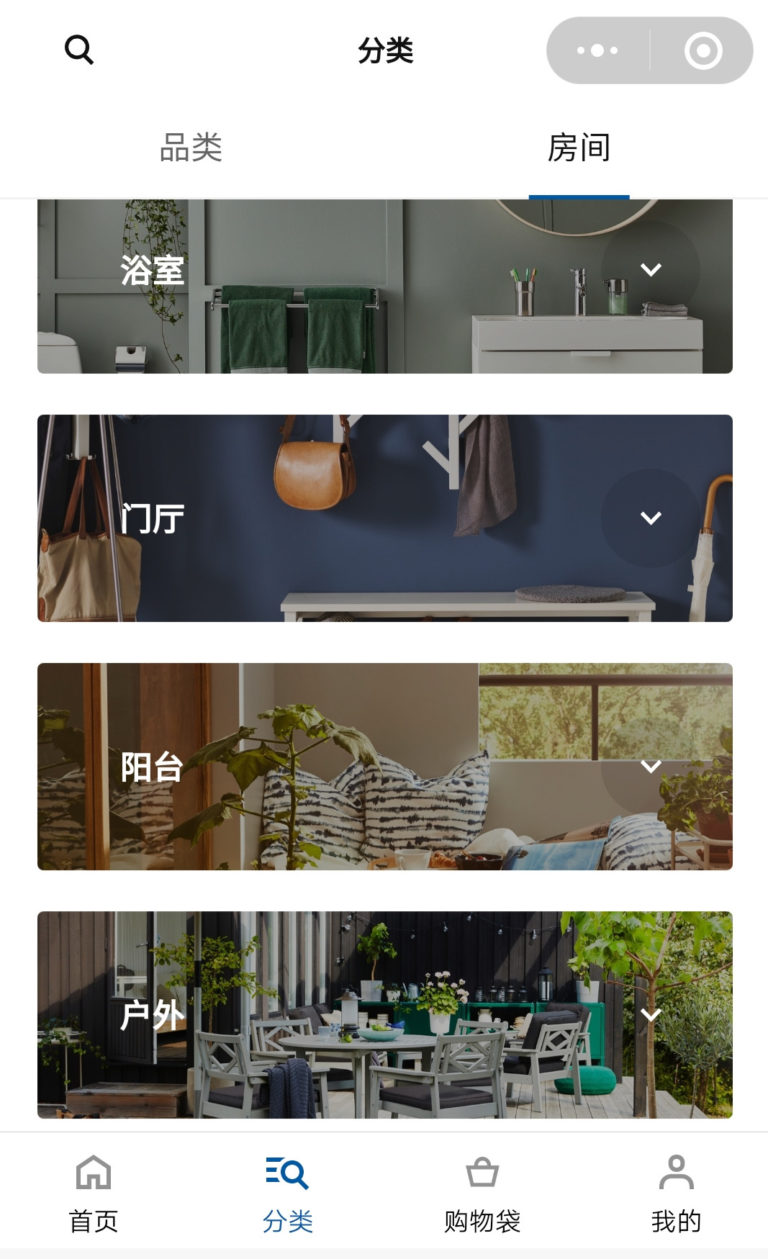
In terms of digital construction, IKEA China is accelerating its catch-up efforts. In fiscal 2025, IKEA’s omni-channel visitor volume increased significantly, reaching 477 million visits, a 4.7% increase compared with the previous fiscal year; online channel sales also achieved a 2% growth [2]. IKEA has built a nationwide multi-channel sales network through self-owned digital channels such as official websites, APPs, and WeChat shoppable mini-programs, as well as third-party platforms such as Tmall and JD.com.
On the positive side, IKEA’s transformation has achieved initial results:
However, IKEA China’s transformation still faces multiple challenges:
China’s home furnishing market is undergoing profound structural changes. On one hand, the continued downturn of the real estate market has led to overall weakness in home furnishing consumption; on the other hand, the online migration of consumer behavior has exceeded expectations. The online decision-making penetration rate of home improvement and home furnishing consumers has reached as high as 97%, meaning that consumers almost all conduct online information collection and comparison before making purchase decisions [1].
During key nodes such as “6·18” and “Double 11”, platforms such as Tmall and JD.com have launched large-scale promotions for home appliances, home improvement, and home furnishing categories, such as “official instant discount of 15%”, “10 billion subsidies”, and “trade-in”, further strengthening the attractiveness of online channels [1]. This trend poses a fundamental challenge to traditional offline home furnishing retailers.
What adds to IKEA’s pressure is the rapid rise of local home furnishing brands. Domestic brands represented by Lin’s Wood Furniture, Kuka Home, Yuan’s Wood Furniture, and Sleemon are rapidly occupying the market with aesthetics closer to young consumers, more agile supply chains, and more competitive prices. These brands have more active layouts in online channels, with more flexible gameplay in live streaming e-commerce, content marketing, and social grass-roots marketing, forming stronger appeal to young consumers.
Taking Douyin as an example, on the home living category list, Sleemon, Kuka Home, and Atour Planet rank top three, while IKEA is absent from the top brand lists [1]. This phenomenon reflects that IKEA’s influence in emerging channels is being surpassed by local brands.
IKEA’s current adjustments reflect the common dilemmas of foreign retail enterprises in China. In recent years, foreign retail brands such as Walmart, Metro, and Decathlon have also experienced performance declines and store closures in China, with the industry as a whole shifting from “scale expansion” to “precision cultivation” [1]. NITORI (Japan’s largest home furnishing chain store) also began to contract in the Chinese market last year, closing 21 stores in the first half of 2025 alone, accounting for 20% of its total stores [4].
Behind this trend are the common challenges faced by foreign brands in responding to competition in the Chinese market: insufficient localization, slow supply chain response speed, lagging digital capabilities, relatively declining brand appeal, etc. IKEA’s transformation exploration has reference significance for other foreign brands.
Based on comprehensive analysis, for IKEA China’s e-commerce transformation to achieve substantive breakthroughs, it needs to make breakthroughs in the following key areas:
IKEA China is undergoing a strategic transformation from “scale expansion” to “precision cultivation”. The lagging online channel layout is one of the important reasons for its performance decline, but not the only one. Multiple factors such as the rapid rise of local brands, profound changes in consumer behavior, and weakened price advantage jointly constitute the challenges faced by IKEA.
On the positive side, IKEA has clarified its transformation direction and is accelerating the promotion of e-commerce layout, channel structure adjustment, and localization innovation. Measures such as the 25.7% online business share in fiscal 2025, settling on JD.com, and launching instant retail pilots show its determination and action in transformation. The strategic adjustment of closing 7 large stores and transforming to small stores is also a pragmatic response to market changes.
However, the transformation still faces deep-seated challenges such as insufficient supply chain agility, need for improved online operation capabilities, and relatively declining brand appeal. IKEA needs to demonstrate greater flexibility and innovation in the Chinese market to regain growth momentum in the fierce competition.
Overall, IKEA China’s e-commerce transformation is expected to reverse the performance decline to a certain extent, but it is difficult to return to historical highs in the short term. The success of the transformation depends on whether IKEA can truly achieve localization innovation and systematic improvement of digital capabilities. For this global home furnishing giant, the transformation experience in the Chinese market will also provide important reference for its strategic adjustment worldwide.
[1] Caijing Magazine - “IKEA Closes Seven ‘Large Stores’ and Turns to ‘Small Stores’” (https://www.mycaijing.com/article/detail/562062)
[2] The Paper - “IKEA China to Close Seven Stores from February, Plans to Open Over 10 Small Stores in Two Years” (https://finance.sina.com.cn/stock/t/2026-01-07/doc-inhfnemv7613316.shtml)
[3] Huxiu - “Closing 7 Stores in a Row, Is IKEA Collapsing in China?” (https://www.huxiu.com/article/4824398.html)
[4] CBNData - “IKEA China Closes 7 Stores in a Row, Are Large Home Furnishing Stores Struggling?” (https://www.cbndata.com/information/294875)
Insights are generated using AI models and historical data for informational purposes only. They do not constitute investment advice or recommendations. Past performance is not indicative of future results.
About us: Ginlix AI is the AI Investment Copilot powered by real data, bridging advanced AI with professional financial databases to provide verifiable, truth-based answers. Please use the chat box below to ask any financial question.