
Valuation Analysis of Zejing Pharmaceutical's A+H Listing and Internationalization Strategy
Unlock More Features
Login to access AI-powered analysis, deep research reports and more advanced features
About us: Ginlix AI is the AI Investment Copilot powered by real data, bridging advanced AI with professional financial databases to provide verifiable, truth-based answers. Please use the chat box below to ask any financial question.
Related Stocks
Based on the latest market data and company information, I will provide you with an in-depth analysis of Zejing Pharmaceutical’s A+H listing fundraising plan and the impact of its internationalization strategy on valuation.
Zejing Pharmaceutical (Stock Code: 688266.SH) landed on the STAR Market in 2020 as the first unprofitable biotech enterprise on the A-share market, creating a landmark case of capital market supporting hard technology breakthroughs [1][3]. The company has currently formed an A+H dual-platform listing strategy, and formally submitted a listing application to the Hong Kong Stock Exchange on December 19, 2025, with CICC as the exclusive sponsor [1][2].
| Time | Fundraising Method | Funds Raised | Main Uses |
|---|---|---|---|
| 2020 | STAR Market IPO | RMB 2.026 billion | New drug R&D projects |
| 2023 | Private Placement | RMB 1.2 billion | New drug R&D projects |
| April 2025 | Private Placement via Simplified Procedure | No more than RMB 300 million | R&D and operations |
As of the first half of 2025, a total of RMB 1.677 billion from the initial public offering has been invested, and RMB 406 million from the private placement has been invested. Some sub-projects have seen changes in fund usage, with the proportion of changed usage accounting for 25.38% of the IPO funds and 19.88% of the private placement funds [1][3].
The company currently has
- Zepsun (Donafenib Tablets):Approved in June 2021, it is China’s first domestically developed small-molecule multi-target drug for first-line treatment of advanced liver cancer
- Zepin (Recombinant Human Thrombin):A surgical hemostatic drug that has been included in the national medical insurance catalog
- Zepning (Gigacixitinib Tablets):The first domestically developed Class 1 new drug for the treatment of myelofibrosis, included in the national medical insurance drug catalog in 2025
- 2022: RMB 302 million
- 2023: RMB 386 million
- 2024: RMB 533 million
- First three quarters of 2025: RMB 593 million (54.49% year-on-year growth)
Net loss narrowed year by year: RMB 457 million loss in 2022 → RMB 138 million loss in 2024 → RMB 93.42 million loss in the first three quarters of 2025 [1][2].
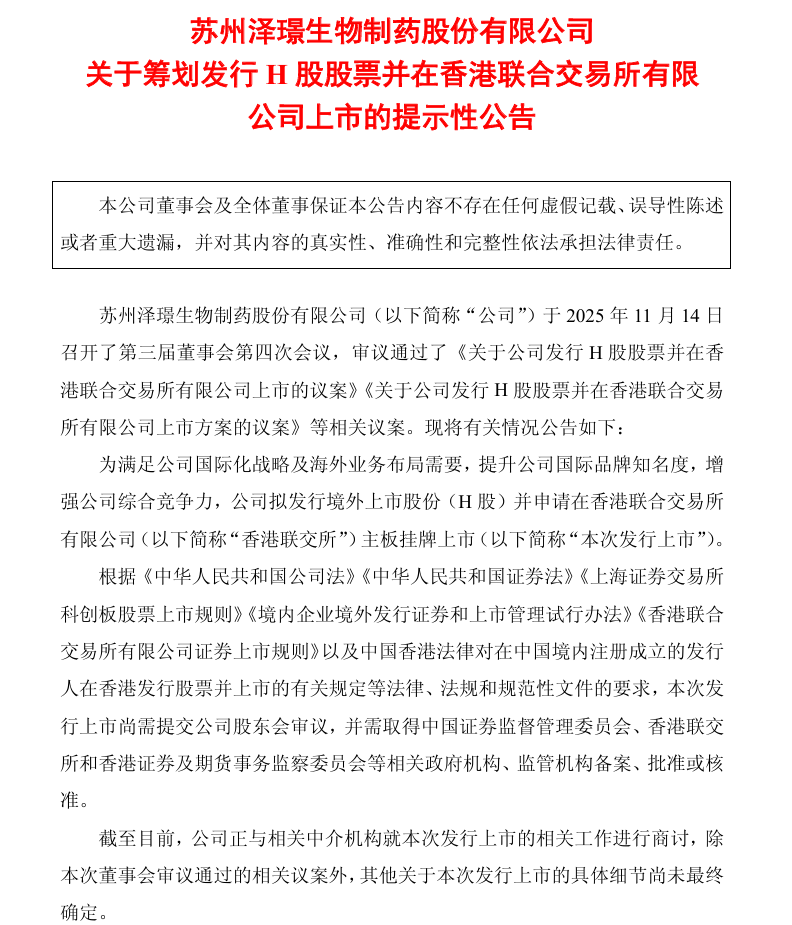
According to the company’s announcement, the core purpose of the Hong Kong listing is
Zejing Pharmaceutical and AbbVie have reached a global strategic cooperation and license option agreement regarding the
- Upfront Payment:USD 100 million
- Milestone Payments:Up to more than USD 1.1 billion
- Sales Royalties:Potential sales royalty rights
This collaboration adopts a
Although the company claims internationalization as its core strategy, the market has significant doubts about the substance of its internationalization efforts:
| Time | Transaction/Event | Amount |
|---|---|---|
| 2016 | GENSUN founded by Sheng Zeqi, younger sister of the actual controller | - |
| 2022 | Acquired 4% stake in GENSUN (from the actual controller’s younger sister and son) | USD 3.6112 million |
| July 2024 | Acquired 36.43% stake in GENSUN | USD 32.8887 million |
| November 2025 | Deregistered GENSUN |
- |
| Overall valuation of GENSUN at the time of acquisition | USD 90.2793 million | Sustained loss status |
- The company acquired the overseas R&D center at a high related-party transaction price, increasing its shareholding from 55.74% to 92.17% [1][2]
- It suddenly deregistered the overseas subsidiary one month before submitting the Hong Kong IPO application (November 2025)
- The reason for deregistration was “to integrate resource allocation, optimize internal management structure, and reduce R&D management costs”
- Since its listing in 2021, although the company has obtained investigational new drug (IND) approvals for multiple drug candidates in the US, none of its products have entered Phase II clinical trials overseas[1][3]
In April 2025, the company’s “Phase I Clinical Trial (International Development) of Jackinib Tablets for the Treatment of Myelofibrosis” project underwent major changes:
- Original planned investment: RMB 77.61 million
- Adjusted investment: RMB 1.61 million
- Reason for reduction: Considering that the US FDA has approved products such as Ruxolitinib, Fedratinib, Pacritinib, and Momelotinib, the market competition is fierce [1]
| Indicator | Value | Market Interpretation |
|---|---|---|
| A-share Market Capitalization | Approximately RMB 25.67 billion | Mid-cap in the STAR Market biopharmaceutical sector |
| P/E Ratio (TTM) | -196.13x | Loss-making enterprise, limited reference value |
| P/B Ratio | 22.76x | Relatively high, reflecting the value of R&D assets |
| Beta Coefficient | 0.31 | Low correlation with the broader market |
| 12-Month Price Increase | +66.36% | Significantly outperformed the broader market |
- MACD: Golden Cross (bullish signal)
- KDJ: Bullish (in overbought territory)
- Trend Judgment: Sideways consolidation, no clear direction(reference range: $96.24-$101.36) [0]
| Indicator | 2022 | 2023 | 2024 | First Three Quarters of 2025 |
|---|---|---|---|---|
| Monetary Funds | - | - | Over RMB 2 billion | RMB 2.07 billion |
| Short-term Borrowings | RMB 391 million | RMB 795 million | RMB 952 million | RMB 967 million |
| Long-term Borrowings | RMB 50.09 million | RMB 0 | RMB 44.35 million | RMB 126 million |
| Total Interest-bearing Debt | Approximately RMB 441 million | Approximately RMB 795 million | Approximately RMB 996 million | RMB 1.115 billion |
As of the end of September 2025, the company’s book monetary funds amount to RMB 2.07 billion, but the balance of cash and cash equivalents is only RMB 133 million (a year-on-year decrease of 93.59%), mainly due to the use of some idle raised funds for cash management (no more than RMB 400 million from IPO + RMB 850 million from private placement) [2].
- Sales expenses in the first three quarters of 2025 reached RMB 332 million, accounting for approximately 56% of revenue
- Sales expenses have exceeded R&D expenses in the same period (RMB 302 million)
- Sales expense ratios from 2022 to 2024 were 75.5%, 65.3%, and 51.1% respectively [1][2]
This indicates that the company has not yet established an efficient commercialization model, and revenue growth still highly relies on capital-driven marketing.
- Enhanced Dual-Platform Financing Capability:The Hong Kong listing will expand international financing channels and reduce dependence on a single market
- International Brand Endorsement:The Hong Kong listing will help enhance the company’s international reputation and pave the way for subsequent overseas business expansion
- AbbVie Collaboration Endorsement:The collaboration with a global pharmaceutical giant validates the company’s R&D capabilities and may boost international investor confidence
- Unlocking Value of R&D Pipeline:The Hong Kong listing will bring more transparent information disclosure, which may drive a revaluation of the pipeline
- Governance Concerns:The related-party transaction and deregistration of GENSUN may raise investors’ doubts about the transparency of the company’s governance
- Tougher Market Environment:In November 2025, Bio-Lily delayed its H-share offering after passing the HKEX hearing due to poor market conditions, reflecting a decline in risk appetite of overseas investors for unprofitable biotechs [2]
- Doubts about the Substance of Internationalization:There is a gap between the “internationalization” of the technology export model and true global commercialization
- Irrational Financial Structure:The phenomenon of high cash holdings alongside high debt may be interpreted by investors as low capital utilization efficiency
- Zejing Pharmaceutical has had multiple related-party transactions with the founder’s relatives, and in 2018, it recognized a share-based payment expense of RMB 309 million for Sheng Zeqi [1]
- The HKEX and potential investors may conduct strict reviews on the fairness of related-party transactions and the completeness of information disclosure
- This may become a key inquiry item during the hearing stage
- Sales expense ratio remains above 50%, with excessive channel construction costs
- Has not yet formed a self-sustaining cash flow capability and relies on external financing to drive growth
- All three products are in the market expansion phase, and the volume growth effect after medical insurance access remains to be seen
- After the deregistration of GENSUN, the company’s overseas physical R&D capabilities are questionable
- Although the license-out model reduces risks, it also means giving up long-term revenue sharing
- The realization of huge milestone payments highly depends on the future clinical progress and regulatory approval results of ZG006
- The overall valuation of the innovative drug sector is in a correction cycle
- Industry competition is intensifying, especially in niche areas such as myelofibrosis
- Downward pressure from medical insurance price negotiations persists
- Market doubts about the GENSUN deregistration incident may affect the offering pricing in the short term
- The phenomenon of high cash holdings alongside high debt may raise investors’ concerns about capital utilization efficiency
- The overall valuation of the Hong Kong innovative drug sector is under pressure
- The USD 100 million upfront payment from the AbbVie collaboration will significantly improve the company’s cash flow
- The effectiveness of international platform construction after the Hong Kong listing remains to be verified
- Whether the sales expense ratio can drop to a reasonable level will determine the speed of profitability improvement
- If the company can successfully transform from technology export to commercialization, there is significant upside potential for valuation
- The continuous advancement of clinical trials and international registration of the R&D pipeline is the key to valuation re-rating
The core of the valuation dilemma faced by Zejing Pharmaceutical currently is that
- Whether the Hong Kong IPO can successfully pass the hearing and complete pricing
- Clinical progress milestones of the AbbVie collaboration
- Whether the sales expense ratio can gradually decline
- Substantial progress of overseas clinical pipeline
[1] Zejing Pharmaceutical Pursues A+H Listing, Substance of Internationalization in Doubt - Rui Caijing
[4] Kunshan, Jiangsu’s Innovative Biotech Company Makes Another IPO Attempt - Investment Journal
[5] Suzhou Zejing Biopharmaceuticals Co., Ltd. - Overview | STAR Market, Shanghai Stock Exchange
[0] Jinling AI Financial Data API
Insights are generated using AI models and historical data for informational purposes only. They do not constitute investment advice or recommendations. Past performance is not indicative of future results.
About us: Ginlix AI is the AI Investment Copilot powered by real data, bridging advanced AI with professional financial databases to provide verifiable, truth-based answers. Please use the chat box below to ask any financial question.