
2030 Outlook of China's Global Share in Manufacturing and Analysis of Its International Competitiveness
Unlock More Features
Login to access AI-powered analysis, deep research reports and more advanced features
About us: Ginlix AI is the AI Investment Copilot powered by real data, bridging advanced AI with professional financial databases to provide verifiable, truth-based answers. Please use the chat box below to ask any financial question.
Based on the forecast in the Future of Industrialization report released by the United Nations Industrial Development Organization (UNIDO) in October 2024, as well as the latest industry data analysis, I will systematically sort out the 2030 development prospects of China’s manufacturing industry and its most internationally competitive sub-sectors for you.
According to the forecast by the United Nations Industrial Development Organization (UNIDO), by 2030, China’s share of global industrial added value will rise to
In 2024, China’s manufacturing added value exceeded
- Calculated by output value, China’s share in 2024 was31.6%
- Calculated by added value, China’s share in 2023 was28.8%
Notably, from 2020 to 2024, China’s manufacturing added value increased from 26.6 trillion yuan to 33.6 trillion yuan. During the 14th Five-Year Plan period, the increment of manufacturing added value reached 8 trillion yuan, contributing over
Calculated by output, these sectors account for more than half of the global market and have
| Industry Sector | Global Share | Performance of Competitive Advantages |
|---|---|---|
Photovoltaic Products |
>50% | Dominant in the entire industry chain, from silicon materials to modules |
New Energy Vehicles |
>50% | Ranked first in the world in production and sales, with a complete industrial chain |
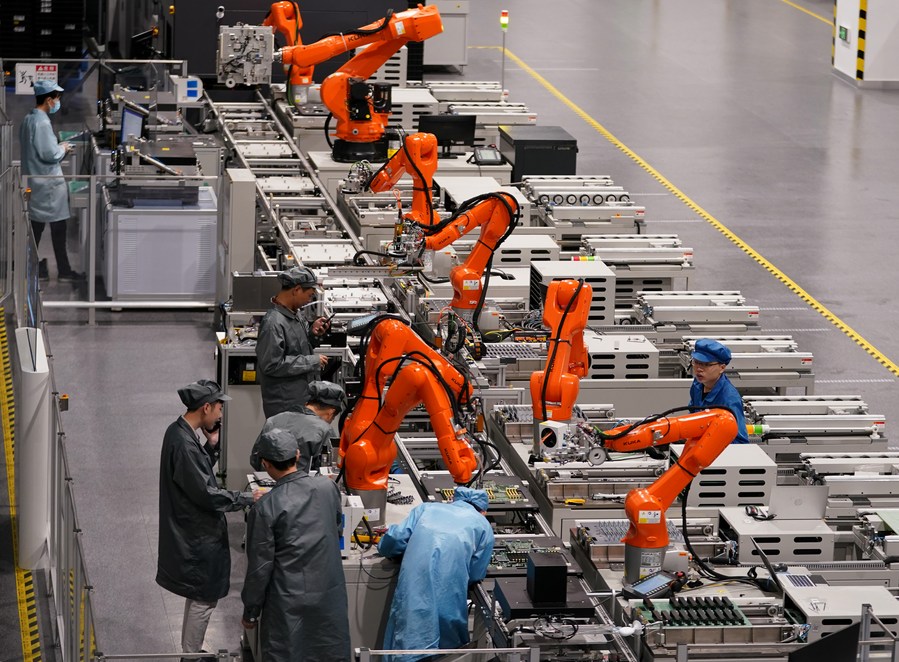
Industrial Robots |
>50% | The world’s largest consumer and producer |
Steel |
>50% | Ranked first in the world in output for consecutive years |
Shipbuilding |
>50% | Leading in global order intake |
Home Appliances (Air Conditioners/Refrigerators/TVs) |
>50% | Strong in both brand and manufacturing capabilities |
Mobile Phones/Computers |
>50% | The world’s largest production base |
Chemical Fibers |
>50% | Absolute advantage in global production capacity |
Cement/Float Glass |
>50% | Scale advantage supported by infrastructure |
Common characteristics of these sectors:
- Output: In 2024, China’s automobile output reached 31.28 million units, accounting for33.8%of the global total [1]
- Exports: 6.41 million units with an export value of US$117.1 billion; imports: 700,000 units with an import value of US$43.2 billion
- Trade Surplus: US$73.9 billion, indicating significant industry competitiveness
- Development Potential: Accelerated transformation to new energy vehicles, leading in intelligent technologies, expected to further expand global share
- Export Value: In 2024, apparel exports reached US$159.1 billion, accounting for approximately30.7%of the global total [1]
- Output: Annual production of over 70 billion pieces, accounting formore than halfof the global total in volume
- Characteristics: Domestic demand accounts for as high as 70% of the market, with a complete industrial chain and integrated advantages from raw materials to finished apparel
According to the latest data, the following sectors are emerging as new growth poles [2]:
- Investment in sectors such as power grid equipment, energy storage equipment, photovoltaics, and lithium batteriescontinues to grow strongly
- Output of high-end products such as new energy vehicles and industrial robots increased by over 30%
- The effects of large-scale equipment renewal policies continue to unfold, with investment in equipment, tools, and instrument purchases growing by 13.0%year-on-year
- R&D investment in the manufacturing of computers, communications, and other electronic equipmentreached 189.145 billion yuan (data from Guangdong Province) [2]
- R&D expenditure in high-tech manufacturing increased by 13.2%, higher than the average level of industrial enterprises above the designated size
- Continuous breakthroughs in intelligent manufacturing, such as industrial testing technology supporting high-end manufacturing and national defense security
Chips are currently the
- 2023 deficit: US$213.4 billion
- 2024 deficit: US$226.1 billion
- H1 2025 deficit: US$100.9 billion
- By the end of 2024, the equivalent 8-inch wafer production capacity of mainland Chinese chip factories reached 8.6-8.85 million units per month, accounting for approximately 29%of the global total
- Wafer processing is the core link, and the industry as a whole is relatively backward
- However, this is also the most watched and most heavily invested catch-up area
According to analysis reports [1][2], the international competitiveness of China’s manufacturing industry stems from the following key factors:
- Economies of Scale Advantage: Cost advantage brought by a complete industrial system and huge market scale
- Full Industrial Chain Layout: Control over the complete industrial chain from raw materials to end products
- Continuous R&D Investment:
- R&D expenditure in Guangdong exceeded 500 billion yuan, with an intensity of 3.60%, surpassing the EU average [2]
- R&D resources are accelerating to converge in high-end manufacturing and digital technology sectors
- Enterprises such as Huawei rank among the top globally in R&D investment (Huawei ranked 6th globally with 22.94 billion euros) [2]
- R&D expenditure in Guangdong exceeded 500 billion yuan, with an intensity of
- Domestic Demand Market Support: In 2024, manufacturing exports accounted for only26.6%of total output value, making the domestic sales-oriented development model more robust [1]
- Policy Support System: Industrial upgrading policies guided by “New-Quality Productive Forces”
Based on the current development trend, China’s manufacturing industry is expected to show the following characteristics by 2030:
| Sector | Expected Development Target |
|---|---|
Traditional Advantage Sectors |
Consolidate global share of over 50% and enhance brand premium capabilities |
New Energy Vehicles |
Global share is expected to exceed 40-50% |
Semiconductors |
Significantly increase self-sufficiency rate of mid-to-low-end chips and achieve breakthroughs in high-end manufacturing processes |
High-End Equipment |
Realize independent controllability of aero-engines, industrial robots, etc. |
- International Trade Frictions: Need to address challenges such as the EU’s anti-subsidy investigation into Chinese electric vehicles
- Technology Blockades: Restricted access to high-end chip manufacturing equipment
- Overcapacity Risk: Need to balance scale expansion and efficiency improvement in some sectors
[1] Chen Jing. “China’s Manufacturing Industry Ranks First in the World for 15 Consecutive Years: What Does It Mean for Domestic and International Markets?” Guancha.cn. October 20, 2025. https://www.guancha.cn/chenjing/2025_10_20_793928.shtml
[2] Zheng Kangxi. “Guangdong’s R&D Expenditure Tops the Nation for 9 Consecutive Years: Exceeds 500 Billion Yuan, Intensity Surpasses the EU”. 21st Century Business Herald. January 5, 2026. https://www.21jingji.com/article/20260105/herald/73bcf302b25301938381428c312174db.html
[3] UNIDO. Future of Industrialization Report. United Nations Industrial Development Organization. October 2024.
Insights are generated using AI models and historical data for informational purposes only. They do not constitute investment advice or recommendations. Past performance is not indicative of future results.
About us: Ginlix AI is the AI Investment Copilot powered by real data, bridging advanced AI with professional financial databases to provide verifiable, truth-based answers. Please use the chat box below to ask any financial question.