
Analysis of Optimization Paths for the Single-Store Profit Model of Bulk Snack Stores
Unlock More Features
Login to access AI-powered analysis, deep research reports and more advanced features
About us: Ginlix AI is the AI Investment Copilot powered by real data, bridging advanced AI with professional financial databases to provide verifiable, truth-based answers. Please use the chat box below to ask any financial question.
Based on the latest industry data and development trends collected, I will provide an in-depth analysis of the optimization paths for the single-store profit model of bulk snack stores against the backdrop of the industry’s shift from expansion to efficiency improvement.
The bulk snack industry is undergoing a critical transformation from scale expansion to efficiency improvement. According to the latest data, as of September 2025, Mingming Hen Mang operates 19,517 stores across 28 provinces in China, with the number of franchisees increasing from 7,241 in 2024 to 9,552[1]. However, as store density continues to increase, industry competition intensifies, and profit margins are under pressure after the ebbing of price wars, leading to a prolonged profit cycle for franchisees — according to some franchisees, the payback period has extended from approximately 12 months in the early stage to an average of 29 months[2].
From a financial perspective, Mingming Hen Mang achieved revenue of RMB 46.371 billion in the first three quarters of 2025, representing a year-on-year increase of 75.2%, with adjusted net profit of RMB 1.81 billion, a significant year-on-year surge of 240.8%[1]. However, the adjusted net profit margin is only approximately 3.9%, remaining at a relatively low level. In terms of gross profit margin, the company’s gross profit margin has steadily increased from 7.5% in 2022 to 9.7% in the first three quarters of 2025[1], but still lags behind Wanchen Group’s 11.7% gross profit margin[2].
The bulk snack industry has moved from the “scale competition and traffic grabbing” first phase to the “fierce close-quarters competition” second phase[3]. There are three driving factors behind this transformation: first, same-store sales decline due to increased store density; second, profit compression caused by intensified price wars; third, the upgrading of consumer demand from “cost-performance ratio” to “quality-performance ratio”.
According to industry research reports, the typical single-store model for bulk snack stores is as follows:
| Indicator | Parameter Assumptions |
|---|---|
| Store Area | 100-150 square meters |
| Initial Investment | RMB 500,000 - 600,000 |
| Daily Foot Traffic | 250+ person-times |
| Average Transaction Value | Approximately RMB 32 |
| Daily Sales | Approximately RMB 8,000 |
| Monthly Sales | Approximately RMB 240,000 - 300,000 |
| Gross Profit Margin | 15-20% |
| Monthly Costs & Expenses | Approximately RMB 50,000 |
| Net Profit Margin | 8-10% |
| Annual Operating Revenue | Approximately RMB 3,000,000 - 3,500,000 |
Note: Data sourced from official brand websites and industry research reports[4]
The bulk snack industry is essentially a “small profits but quick turnover” business model. The total markup for terminal products across brand owners, distributors, and retailers is only 36%, far lower than the 60% of traditional distribution channels, 65% of BC stores, and over 80% of KA stores[5]. This means that single-store profitability is highly dependent on high turnover; once foot traffic declines, profits will come under immediate pressure.
Single-store costs mainly include: franchise fee (RMB 30,000 - 50,000), deposit (RMB 20,000 - 30,000), decoration cost (RMB 80,000 - 200,000), equipment investment (RMB 70,000 - 130,000), initial stock (RMB 180,000 - 250,000), plus fixed monthly management fees (RMB 800 - 1,300), rent, and labor costs[4]. Amid slowing revenue growth, the erosion of profits by rigid costs has become increasingly obvious.
Mingming Hen Mang has 3,997 SKUs in stock, of which approximately 34% are custom-developed with manufacturers[1]. However, the problem of product homogeneity in the industry remains prominent. Some brands have attempted to launch themed store formats (such as Lingshi Henda, which specializes in large-package snacks, and Lingshi Hela, which focuses on spicy snacks), but it is still difficult to achieve fundamental differentiation[3].
As market saturation increases, multiple stores in the same business district divert customers from each other, leading to “customer poaching” in some areas, which undermines single-store profitability.
Mingming Hen Mang has established partnerships with over 2,500 high-quality manufacturers, including 50% of the enterprises listed on the 2024 Hurun China Top 100 Food Companies[1]. The bargaining advantage brought by large-scale procurement is the foundation of the bulk snack industry’s low-price strategy. In the future, store-level operations can further amplify supply chain efficiency advantages by increasing the sales proportion of high-turnover SKUs.
In 2024, Mingming Hen Mang’s inventory turnover days were only 11.6 days, and warehousing and logistics costs accounted for 1.7% of total revenue, both of which are at leading levels in the industry[1]. Stores should make full use of the headquarters’ digital system to achieve precise replenishment and reduce the inefficient state of simultaneous stockouts and overstocking.
Over 38% of products use the bulk-weighing model[1], which not only lowers the threshold for consumers to try new products but also brings higher repurchase rates. Stores can adjust the ratio of bulk-weighing to packaged products based on business district characteristics to strike a balance between customer acquisition and profit.
The gross profit margin of retailers’ private labels is generally around 50%, far higher than the 20%-30% level of third-party brands[3]. Mingming Hen Mang has launched two private label series: Red Label (focusing on low prices, 20%-30% cheaper than similar products) and Gold Label (with stricter raw material control)[3]. Stores should actively cooperate with the headquarters’ private label promotion strategy to increase the sales proportion of private labels to a reasonable level.
Leading brands launch up to 100 new products per month[1]. Stores need to establish a scientific category management mechanism: classify products into “customer-acquisition type, profit type, and image type”, and reasonably allocate display positions and promotion resources for each type of product to avoid sacrificing profits for a “low-price-only” approach.
Some brands have expanded their product lines from casual snacks to short-shelf-life products such as fresh food, fresh milk, frozen products, and baked bread[6]. While category expansion brings higher gross profit potential, it also requires attention to the higher loss rates, cold chain costs, and equipment investment associated with fresh products. Stores should select suitable store format upgrading plans based on the consumption characteristics of their located business districts.
Mingming Hen Mang has built end-to-end digital capabilities covering product selection and procurement, warehousing and logistics, franchisee and store management, and launched application tools such as a smart retail middle platform, intelligent remote store inspection, and the “National Product Selection” mini-program[1]. Stores should make full use of these digital tools to realize intelligent sales forecasting, inventory early warning, and performance management.
The company provides visual display templates that support differentiated customer flow lines and product displays, enabling “one thousand stores, one thousand faces” store displays[1]. Stores should make personalized adjustments based on the preferences of surrounding consumers within the framework set by the headquarters to improve sales per square meter.
As of September 30, 2025, Mingming Hen Mang has over 180 million registered members, with a member repurchase rate of 77% in the past 12 months[1]. Stores should strengthen member acquisition and activation, and increase average transaction value and repurchase frequency through targeted marketing.
Store areas generally range from 100 to 150 square meters, and rent is the main fixed cost. When selecting a store location, stores should comprehensively evaluate the matching degree between rent and expected foot traffic to avoid “loss-making stores” with high rent but low output. For stores in mature business districts, they may consider negotiating a rent floating mechanism with landlords, linked to performance.
On the premise of ensuring service quality, labor costs can be controlled through scheduling optimization, cross-positioning, self-service checkout, and other methods. Some pilot stores can introduce intelligent equipment to reduce reliance on manual labor.
Store lighting, air conditioning, and refrigeration equipment are the main sources of energy consumption. Electricity expenses can be reduced by selecting energy-efficient equipment, optimizing operating hours, and using electricity during off-peak periods.
Mingming Hen Mang has announced its plan to upgrade its business format from bulk snacks to discount supermarkets[3]. This transformation brings two major changes: first, room for increasing average transaction value through category expansion; second, the potential for profit improvement by using low-priced products to attract customers and high-margin products to generate profits. However, at the same time, category expansion also means larger store areas, exponentially increased rent and labor costs, and rising logistics costs due to cold chain transportation of fresh products[3]. Stores need to assess the conditions for transformation and proceed according to their capabilities.
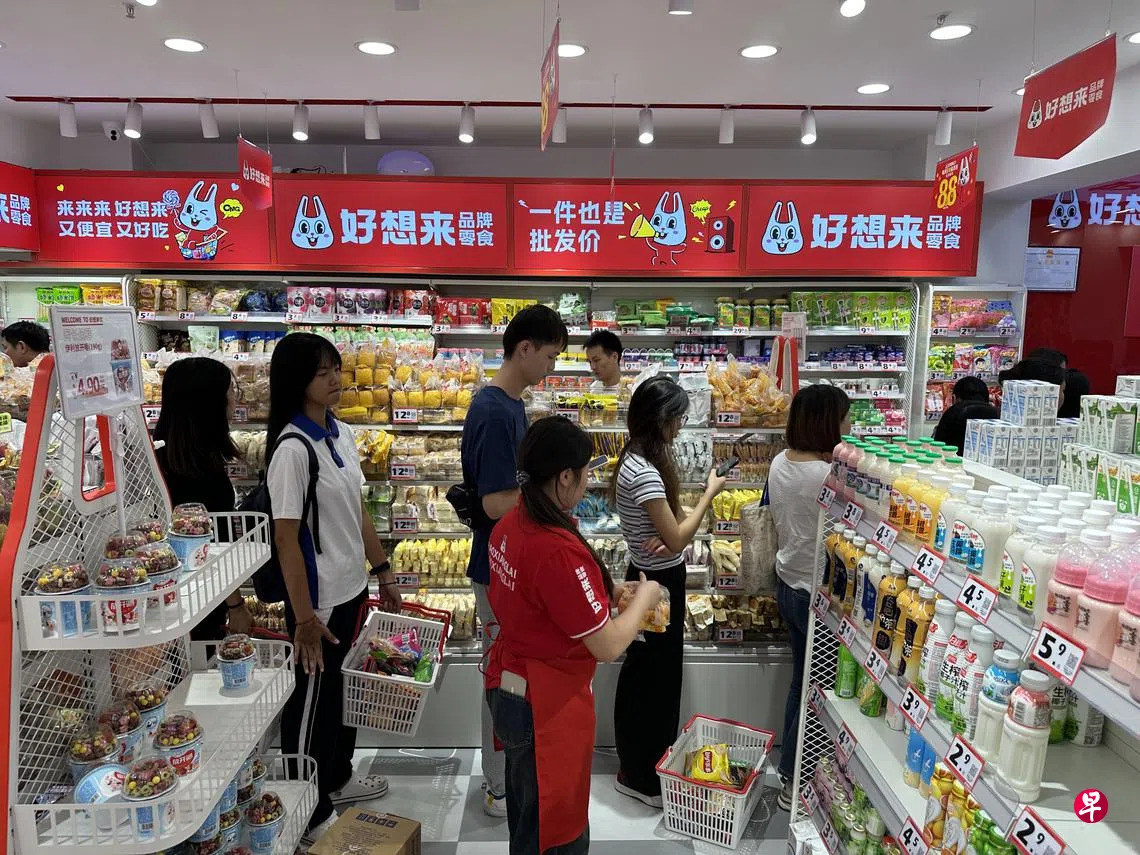
Industry players are seeking breakthroughs through differentiated store formats: Mingming Hen Mang has launched Chaoji Lingshi Hen Mang and Lingshi Henda; Haoxianglai has opened Haoxianglai Snack Paradise, which integrates “shopping, entertainment, and check-in”[6]. Although these innovative store formats cannot be replicated by all stores, the idea of upgrading consumer experience behind them is worthy of reference.
Upgrading stores from pure shopping places to “third spaces” that combine social and experiential functions can increase consumer stay time and willingness to spend. Scenario-based operation methods such as festival-themed displays, IP co-branded activities, and tasting experiences can effectively drive sales.
Based on the above analysis, the optimization of the single-store profit model for bulk snack stores can be carried out in accordance with the following framework:
| Optimization Dimension | Core Measures | Expected Outcomes |
|---|---|---|
| Supply Chain Efficiency | Precise replenishment, priority for high-turnover SKUs | 5-10% reduction in inventory costs |
| Merchandise Structure | Increase private label proportion, optimize category portfolio | 2-3 percentage point increase in gross profit margin |
| Operational Efficiency | Application of digital tools, standardized management | 15-20% improvement in labor efficiency |
| Cost Control | Rent negotiation, energy consumption management, labor optimization | 8-12% reduction in fixed costs |
| Format Upgrading | Category expansion, scenario-based operations | 10-15% increase in average transaction value |
The optimization of the single-store profit model requires collaborative cooperation between the headquarters and franchisees. The headquarters needs to continuously empower supply chain capabilities, product development capabilities, and digital capabilities; franchisees need to enhance their awareness of refined operations and execution capabilities. Only through two-way efforts can the paradigm shift from “scale growth” to “efficiency growth” be achieved.
Institutions predict that by 2027, the market size of China’s bulk snack industry is expected to exceed RMB 150 billion, with a theoretical national store opening potential of approximately 86,000[4]. The market will present a “two superpowers and many strong players” pattern, with Mingming Hen Mang and Wanchen Group as the two leading players[4].
Future industry competition will unfold in four dimensions: supply chain integration capabilities, product differentiation, digital operation level, and consumer service experience. Brands and franchisees that can quickly adapt to changes, accurately grasp consumer demand, and build core competitive barriers will eventually find their own “new continent” in the red ocean market.
[1] China Securities Journal - Mingming Hen Mang Passes Listing Hearing, Hong Kong Stock Exchange to Welcome Its First Bulk Snack Enterprise (https://www.cs.com.cn/ssgs/gsxw/202601/t20260107_6532038.html)
[2] Southern Plus - One Step Away, Mingming Hen Mang May Become the First Bulk Snack Stock on Hong Kong Stock Exchange (https://www.nfnews.com/content/EynGXlpd3Z.html)
[3] 21st Century Business Herald - Behind the Frenzy of Bulk Snacks: The Urgent Need to Balance Scale, Low Prices, and Profit (https://www.21jingji.com/article/20250307/herald/96b0e79c69079c39586b3748f153afb6.html)
[4] LeadLeo Research Institute - 2024 China Bulk Snack Store Industry Research Report (https://pdf.dfcfw.com/pdf/H3_AP202502261643529245_1.pdf)
[5] Securities Times - Bulk Sales Model Restructures the New Landscape of Snack Sales, Over 40,000 Stores Support a Hundred-Billion-Yuan Market (https://stcn.com/article/detail/2332440.html)
[6] Jiemian News - Snack Brands Battle in 2025: Fierce Competition Under the New Order (https://www.jiemian.com/article/12375579.html)
[7] CBNData - 2025 Retail Industry Review: The Industry Breakout Battle Begins, Where Will Bulk Snack Stores Go? (https://www.cbndata.com/information/294876)
[8] Retail Business Finance - 2025 Retail Industry Review: The Industry Breakout Battle Begins, Where Will Bulk Snack Stores Go? (https://www.cbndata.com/information/294876)
Insights are generated using AI models and historical data for informational purposes only. They do not constitute investment advice or recommendations. Past performance is not indicative of future results.
About us: Ginlix AI is the AI Investment Copilot powered by real data, bridging advanced AI with professional financial databases to provide verifiable, truth-based answers. Please use the chat box below to ask any financial question.