
U.S.-China Trade Truce Implementation Triggers Market Rotation as Dow Hits Record High
Unlock More Features
Login to access AI-powered analysis, deep research reports and more advanced features
About us: Ginlix AI is the AI Investment Copilot powered by real data, bridging advanced AI with professional financial databases to provide verifiable, truth-based answers. Please use the chat box below to ask any financial question.
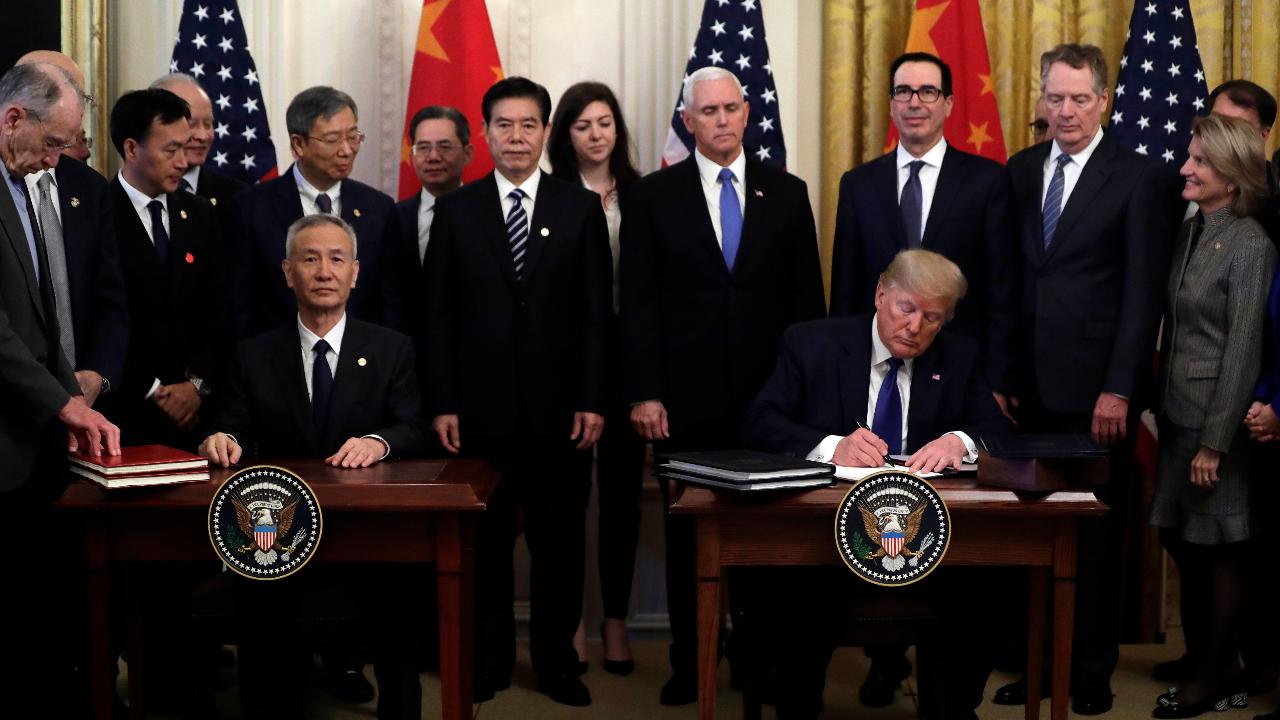
This analysis is based on the CNBC report [1] published on November 11, 2025, which documented the implementation of the U.S.-China trade truce measures. The trade agreement’s rollout triggered significant market rotation, with the Dow Jones Industrial Average surging to a record high of 47,927.96 (+1.15%) while technology stocks faced profit-taking pressure. The market response reflects both optimism over reduced trade tensions and caution about the fragile nature of the détente.
The trade truce implementation coincided with a pronounced sector rotation pattern across major U.S. indices [0]:
- Dow Jones Industrial Average: surged 543.45 points (+1.15%) to close at a record 47,927.96
- S&P 500: gained 30.97 points (+0.45%) to finish at 6,846.61
- Nasdaq Composite: declined 60.58 points (-0.26%) to close at 23,468.30
- Russell 2000: added 6.47 points (+0.26%) to end at 2,458.28
The performance divergence highlighted a clear rotation from technology to traditional industrial and financial sectors. Communication Services led with +1.22%, followed by Basic Materials and Healthcare at +0.53% each, while Technology lagged at -1.00% and Energy declined -1.22% [0].
The trade measures that took effect on Monday represented a significant de-escalation in U.S.-China tensions [1]:
- U.S. tariff reductions: Fentanyl-linked tariffs on Chinese imports were halved to 10%
- Chinese concessions: Beijing rolled back export restrictions on critical minerals and rare earth materials
- Duration extension: Both sides extended tariff truce measures for one year
However, Wendy Cutler, senior vice president at Asia Society Policy Institute, cautioned that “these steps suggest ‘so far, so good,’ but in reality, this is just the beginning” [1].
Concurrent with the trade developments, Congressional leaders reached a tentative bipartisan agreement to reopen federal agencies and extend funding through early 2026 [2]. This breakthrough significantly boosted investor sentiment, particularly benefiting sectors sensitive to government spending and economic activity.
Morgan Stanley economists noted that Beijing has maintained its export-control framework to preserve leverage, viewing “rolling negotiations, episodic flare-ups, and policy asymmetry as the new equilibrium” [1]. This suggests that while tariffs may be reduced, the underlying strategic competition between the U.S. and China continues to shape economic relationships.
The sector rotation pattern indicates investors are positioning for economic recovery scenarios that would benefit cyclical industries over high-growth technology stocks. The strength in Communication Services, Basic Materials, and Healthcare sectors suggests expectations of improved global economic growth following the trade truce implementation [0].
The market’s mixed response—with the Dow reaching record highs while the Nasdaq declined—reflects uncertainty about the sustainability of the trade détente. The title of the CNBC report, “Tariffs thaw, rivalry simmers,” aptly captures this tension between short-term trade relief and long-term strategic competition [1].
- Trade Policy Uncertainty: Despite the truce, underlying strategic competition persists, with Morgan Stanley warning of “episodic flare-ups” as the new normal [1]
- Implementation Challenges: The trade measures are complex, and any issues in implementation could trigger market volatility
- Sector Rotation Sustainability: The tech sell-off could accelerate if economic data disappoints or if trade tensions resurface
- Industrial and Financial Sectors: Traditional industries benefiting from reduced trade tensions and expected economic recovery
- Global Supply Chain Optimization: Companies positioned to benefit from normalized U.S.-China trade relations
- Infrastructure Spending: Resolution of the government shutdown could unlock infrastructure spending opportunities
The November 11, 2025 market session was characterized by significant sector rotation driven by the implementation of U.S.-China trade truce measures and progress on government shutdown resolution. The Dow Jones Industrial Average reached a record high of 47,927.96, while technology stocks faced profit-taking pressure. The trade agreement included halved fentanyl-linked tariffs to 10% and China’s rollback of export restrictions on critical minerals, though analysts caution that the underlying strategic competition persists [1]. The market response reflects both optimism over reduced trade tensions and caution about the fragile nature of the détente, with sector rotation indicating positioning for economic recovery scenarios [0].
Insights are generated using AI models and historical data for informational purposes only. They do not constitute investment advice or recommendations. Past performance is not indicative of future results.
About us: Ginlix AI is the AI Investment Copilot powered by real data, bridging advanced AI with professional financial databases to provide verifiable, truth-based answers. Please use the chat box below to ask any financial question.