
Analysis of the Impact of Amap Street Ranking on Alibaba's Local Life Service Competitive Landscape
Unlock More Features
Login to access AI-powered analysis, deep research reports and more advanced features
About us: Ginlix AI is the AI Investment Copilot powered by real data, bridging advanced AI with professional financial databases to provide verifiable, truth-based answers. Please use the chat box below to ask any financial question.
Related Stocks
Based on the collected data and research materials, I will provide you with a systematic and comprehensive analysis report.
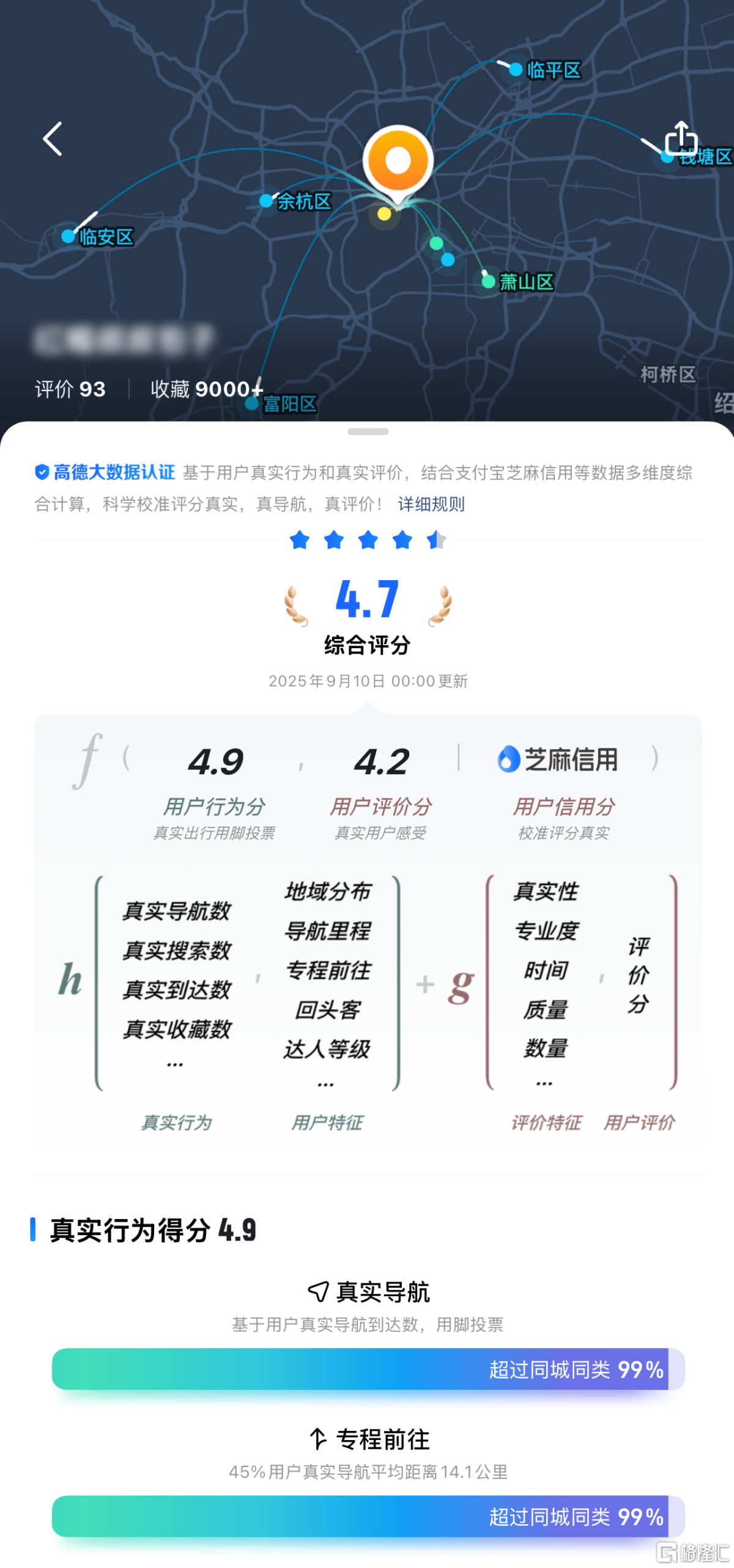
Amap Street Ranking was officially launched on September 10, 2025, positioned as “the world’s first local life service list built based on real navigation behavior data”[1]. The launch of this product marks a major strategic layout of Alibaba in the local life service sector. Guo Ning, CEO of Amap, emphasized at the press conference that the core value of this list lies in “authenticity” — it is constructed based on users’ actual navigation-to-store behavior rather than subjective reviews[2].
According to the latest public data, Amap Street Ranking has achieved remarkable results within 100 days of its launch[3][4]:
Indicator |
Data |
Remarks |
|---|---|---|
| Monthly Active Users (MAUs) of Amap App | 996 million |
The 4th largest App by user scale in China |
| Cumulative Users | 660 million |
- |
| Monthly New MAUs | 46 million |
Driven by Street Ranking |
| Number of Settled Merchants | 860,000 |
Newly settled merchants |
| Month-on-Month Growth of Merchant Orders | 330% |
For settled merchants |
| Month-on-Month Growth of Merchant Turnover | 270% |
For settled merchants |
| Number of Covered Categories | 1,550 |
Including hiking, trekking, camping, etc. |
| Covered Countries/Regions | 220+ |
Nearly 1,700 cities |
| Number of Seasonal Lists | 6,553 |
Dynamically generated |
| Daily Average User Behavior Sequences | 290 million |
Supports list calculation |
On the occasion of its 100th day of launch, Amap Street Ranking announced three strategic upgrades[3][4]:
- Aerial Street View Feature: Relying on the self-developed world model, it realizes seamless connection from street view to in-store real scene
- Dynamic Seasonal Lists: Launches dynamic local life service lists tailored to seasons, timing, and locations
- Introduction of Social Features: Adds friend relationship and friend feed functions
Amap also announced that it will invest hundreds of millions of yuan in computing power resources to provide free aerial street view access to 1 million small local businesses.
The launch of Amap Street Ranking is not an isolated event, but a continuation and upgrade of Alibaba’s long-term layout in the local life service sector. Looking back at Alibaba’s local life service strategic journey[1][5]:
- Koubei Era: Early attempt, but failed to challenge Meituan’s position
- Acquisition of Ele.me: Gained food delivery capabilities, but in-store services remained a weakness
- Amap’s Transformation: Upgraded from a navigation tool to a super entrance for local life services
- Launch of Street Ranking: Directly targets Dianping, filling the gap in in-store services
Morgan Stanley pointed out in its research report that the launch of Amap Street Ranking is “a clear signal of Alibaba’s renewed focus on in-store services”[6]. Amap’s position within Alibaba’s ecosystem has the following characteristics:
- Traffic entrance advantage with nearly 1 billion MAUs
- Support from Alibaba’s ecosystem resources (computing power, AI technology, Alipay entrance, etc.)
- Deep integration of spatial intelligence technology base with Tongyi Large Model
- The only “outlier” within Alibaba that has not been fully integrated with Tongyi and Qianwen[7]
- Maintains a relatively independent operation model
- Achieved profitability for the first time in 2025 (mainly through cost control)
The entry of Amap Street Ranking is changing the competitive structure of the local life service market[6][8]:
Evolution of Competitive Landscape:
┌─────────────────────────────────────────────────────────────┐
│  Traditional Landscape: Meituan (Food Delivery + In-store) vs Ele.me (Food Delivery)              │
├─────────────────────────────────────────────────────────────┤
│  New Landscape: Alibaba (Amap + Ele.me + Taobao Flash Sale) vs Meituan vs Douyin vs JD.com  │
│         vs Xiaohongshu                                           │
└─────────────────────────────────────────────────────────────┘
- Increases Meituan’s profit pressure in the short term
- In-store services have a lower entry threshold compared to on-demand delivery
- Intensified competition erodes profit margins
Based on the above judgments, Morgan Stanley lowered its long-term profitability forecast for Meituan’s in-store business from 2.5% to 2%[6].
Dimension |
Amap Street Ranking |
Meituan Dianping |
|---|---|---|
Data Source |
Real navigation behavior (in-store check-in records) | Users’ subjective reviews and ratings |
Objectivity |
Based on physical location and movement trajectory | May have fake reviews and guided ratings |
User Base |
996 million MAUs | 32 million DAUs (August data) |
List Logic |
Navigation to store = Authentic recognition | Active user reviews = Subjective recognition |
Commercialization |
Claims “never to be commercialized” | Commission + advertising model |
Coverage Breadth |
1,550 categories | Mature but relatively fixed categories |
- Traffic Diversion Effect: Amap Street Ranking exceeded 40 million users within one week of launch[9], while Dianping had about 32 million DAUs in the same period, showing strong catching-up momentum
- Merchant Resource Competition: 860,000 merchants have settled in, with a 330% month-on-month growth in orders, directly diverting merchant resources
- User Perception Shift: 83% of users still define Amap as a “navigation tool”[7], but Street Ranking is changing this perception
- Subsidy Competition Pressure: Amap announced an investment of over 1 billion yuan in subsidies[8], competing with Dianping’s 25 million consumer coupons
- Technological Moat: Technologies such as aerial street view and world model build differentiated competitiveness
- Ecosystem Synergy Effect: Linkage with Taobao, Ele.me, and Alipay (though not fully integrated yet)
- Review System Restructuring: If the “real navigation data” model gains user recognition, it may subvert the traditional review logic
- Business Model Innovation: The non-commercial list model may reshape industry rules
- Global Expansion: Covers 220+ countries and regions, forming cross-border local life service capabilities
In the face of Amap’s challenge, Dianping has adopted the following response measures[8][10]:
-
Restart of Premium Food Delivery:
- Emphasizes the concept of “AI + Authentic High Scores”
- Relying on self-developed large models and massive review data
- Eliminates fake reviews to improve credibility
- Has attracted over 1,400 restaurants from the Must-Eat List and nearly 30 restaurants from the Black Pearl Restaurant Guide to settle in
-
AI Technology Upgrade:
- Meituan’s C-side AI agent service is to be launched soon
- Launched NoCode, an AI Coding Agent tool
- Launched “Meituan Jibai”, an AI agent for hotel operation
- Launched “Kangaroo Advisor”, an operation decision-making assistant
-
Content Ecosystem Enhancement:
- Generated a total of 363 million authentic reviews in the past year
- Daily page views of “photo reviews” increased by 11% year-on-year
- The priority view rate of negative reviews reached 14%, and user attention increased by 36%
The “real navigation data” model of Amap Street Ranking has the following unique advantages[3][4][11]:
-
Data Authenticity:
- The cost for users to fake navigation behavior is much higher than faking reviews
- Judges authenticity through location and store matching relationships
- Introduces Alibaba’s security anti-cheating system
-
Coverage Breadth:
- 290 million daily average user behavior sequences
- A natural traffic pool with 1 billion users
- Expanded from food to 1,550 categories
-
Technological Barrier:
- Self-developed “Amap World Model”
- Spatial intelligence technology base
- Aerial street view realizes continuous restoration from street view to in-store real scene
-
Business Trust:
- Commitment of “never to be commercialized”
- Supported by Sesame Credit system
- Credit system free of fake reviews
Despite its obvious advantages, this model still faces the following challenges[7][9]:
-
Difficulty in Changing User Perception:
- 83% of users still regard it as a navigation tool
- Cognitive leap from a tool to a consumption decision-making entrance
-
Data Accumulation Gap:
- Dianping has been deeply engaged in the sector for many years, and the total review data gap is difficult to fill in the short term
- Truly “hidden gem small shops” may be overlooked due to stable customer groups and no need for navigation
-
Insufficient Ecosystem Synergy:
- Not yet fully integrated with other Alibaba businesses
- Cannot directly access Ele.me’s food delivery services
- Lacks support from Taobao consumption data to improve recommendation accuracy
-
Compliance Risks:
- Navigation and travel behavior data are sensitive personal information
- Must strictly comply with relevant provisions of the Personal Information Protection Law
- There are disputes over the boundaries of user data usage
According to Morgan Stanley’s forecast, Amap Street Ranking will have the following impacts on Meituan’s finances[6]:
Indicator |
Forecast Adjustment |
Explanation |
|---|---|---|
| Core Local Business Operating Loss in Q3 2025 | 10 billion yuan |
15 billion yuan loss from instant delivery, 5 billion yuan profit from in-store services |
| Core Local Business Operating Profit in FY2025 | 2.4 billion yuan |
95% year-on-year decline |
| Long-term Profitability of In-store Business | 2% |
Down 0.5 percentage points from 2.5% |
Company |
Stock Performance |
Time Node |
|---|---|---|
| Alibaba | +12.9% |
After earnings release following the food delivery war |
| Meituan | -12.55% |
Single day after earnings release |
| Alibaba (US Stock) | +30% |
Since the July food delivery war |
| Meituan | -20% |
Decline in the same period |
In the first half of 2025, the subsidy war among the three giants (Meituan, Alibaba, JD.com) in the food delivery and instant retail sectors led to a total increase of over 37 billion yuan in marketing expenses, becoming one of the most expensive business wars in China’s internet history[8].
The current local life service market presents a situation of “fierce competition among multiple players”[8][12]:
- Meituan: Its position as the market leader is challenged, and it needs to face attacks from multiple sides
- Alibaba: Opens a new front through Amap, making its local life service layout more complete
- : Invested over 10 billion yuan in the food delivery battlefield, competing directly with Meituan
- Douyin: The content platform penetrates local life services, with high-speed GMV growth
- Xiaohongshu: Launched the local life service product “Xiaohong Card”, with Shanghai as the pilot city
The success of Amap Street Ranking will bring the following to Alibaba:
- Traffic Value Monetization: Convert nearly 1 billion MAUs from tool traffic to transaction scenarios
- Completing In-store Services: Fills the biggest gap in Alibaba’s local life services
- Building Data Ecosystem: The evaluation system based on real behavior forms a competitive moat
- Verification of Technological Capabilities: A successful case of applying world models to local life services
- Sustainability Risk: Amap’s 2025 profit mainly relies on cost control, and its adjusted EBITA is still on the verge of loss[7]
- User Habit Risk: Changing user habits requires long-term investment
- Regulatory Compliance Risk: The boundary of sensitive personal information usage needs to be clarified
- Ecosystem Synergy Risk: Lack of integration with other Alibaba businesses limits the exertion of synergy effects
As Alibaba’s strategic product in the local life service sector, Amap Street Ranking, with its differentiated positioning of “real navigation data”, is posing a substantial threat to Meituan Dianping. Within 100 days of launch, it achieved 996 million MAUs, attracted 860,000 merchants to settle in, and saw a 270% month-on-month growth in merchants’ turnover, demonstrating strong competitiveness.
Time Dimension |
Threat Level |
Main Manifestations |
|---|---|---|
| Short-term (1-6 Months) | Medium-High |
Traffic diversion, merchant competition, user diversion |
| Mid-term (6-18 Months) | Medium-High |
Subsidy competition, technological moat, ecosystem synergy |
| Long-term (18+ Months) | To Be Observed |
Business model verification, user habit cultivation |
The subversiveness of Amap Street Ranking to traditional review platforms lies in: it replaces “subjective reviews” with “physical behavior”, replaces “active writing” with “authentic in-store visits”, and redefines the offline service evaluation system. Despite challenges such as changing user perception and insufficient ecosystem synergy, its profound impact on the local life service competitive landscape has already emerged.
In the future, the local life service market will shift from “traffic competition” to “trust competition”. Whoever can better solve the problem of “authenticity and credibility” will occupy a dominant position in this competition.
[1] CBNData - Amap Street Ranking: A Challenging Story (https://www.cbndata.com/information/294457)
[2] Wall Street CN - Morgan Stanley: Amap Street Ranking Will Reshape the Local Life Service Competitive Landscape (https://wallstreetcn.com/articles/3755397)
[3] Beijing News - Amap Launches New Initiative to Build a Super Entrance for Local Life Services (https://www.bjnews.com.cn/detail/1767782690129710.html)
[4] Xinhua News - Amap Street Ranking Gets a Full Upgrade on Its 100th Day (http://www.news.cn/tech/20260107/850acf6846254d1bb02e4c4189f72551/c.html)
[5] The Paper - Alibaba Attacks Meituan Again! Amap Kicks Off a New Round of Local Life Service War (https://m.thepaper.cn/newsDetail_forward_31587672)
[6] Zhuifeng Trading Desk - Analysis of Morgan Stanley’s Research Report (Cited from Wall Street CN)
[7] Caizhongshe - Amap’s “Dilemma”: Monetization Anxiety with Nearly 1 Billion MAUs (https://m.caizhongshe.cn/news-8592388417648948481.html)
[8] Securities Times - Surprise Attack on Meituan with Over 1 Billion Yuan in Subsidies (https://www.stcn.com/article/detail/3332477.html)
[9] Jiefang Daily - Xiaohongshu, Amap, and Douyin Enter the Market to Challenge Meituan (https://www.jfdaily.com/news/detail?id=986108)
[10] Yicai Global - “Amap Street Ranking” Challenges “Dianping” (https://www.yicai.com/news/102818803.html)
[11] 36Kr - 100 Days, 1 Billion Users, One Super Entrance (https://m.36kr.com/p/3628814355268616)
[12] WoShipM - Major Tech Companies Invade Meituan’s Core Market Again (https://www.woshipm.com/it/6103348.html)
[13] 36Kr - Food Delivery War: Meituan Passes the “Extreme Test” of Industry Competition (https://m.36kr.com/p/3578093023460228)
Insights are generated using AI models and historical data for informational purposes only. They do not constitute investment advice or recommendations. Past performance is not indicative of future results.
About us: Ginlix AI is the AI Investment Copilot powered by real data, bridging advanced AI with professional financial databases to provide verifiable, truth-based answers. Please use the chat box below to ask any financial question.