
Analysis of the Rumored Acquisition of Shuijingfang by Jiannanchun and Research on M&A Trends in the Baijiu Industry
Unlock More Features
Login to access AI-powered analysis, deep research reports and more advanced features
About us: Ginlix AI is the AI Investment Copilot powered by real data, bridging advanced AI with professional financial databases to provide verifiable, truth-based answers. Please use the chat box below to ask any financial question.
Related Stocks
Now let me present the complete analysis report for you.
On the afternoon of December 25, 2025, the baijiu sector witnessed a dramatic capital game. Shuijingfang (600779.SS) saw a sudden influx of capital during the trading session, with its stock price surging rapidly and hitting the daily limit, and its market value surged by nearly RMB 4 billion in a single day [1]. The source of this capital frenzy was an unconfirmed market rumor of just over 20 words - Jiannanchun, another member of the “Six Golden Flowers of Sichuan Baijiu”, might acquire Shuijingfang.
However, the Clarification Announcement Regarding Media Reports released by Shuijingfang that evening poured cold water on the market. The company clearly stated, “After verification by the company, the relevant reports are not true, and the company has no plans or negotiations for being acquired” [2]. On the following day (December 26), relevant personnel from Jiannanchun also told the media that the rumor was false. Affected by this, Shuijingfang’s stock price fell back quickly after the market opened.
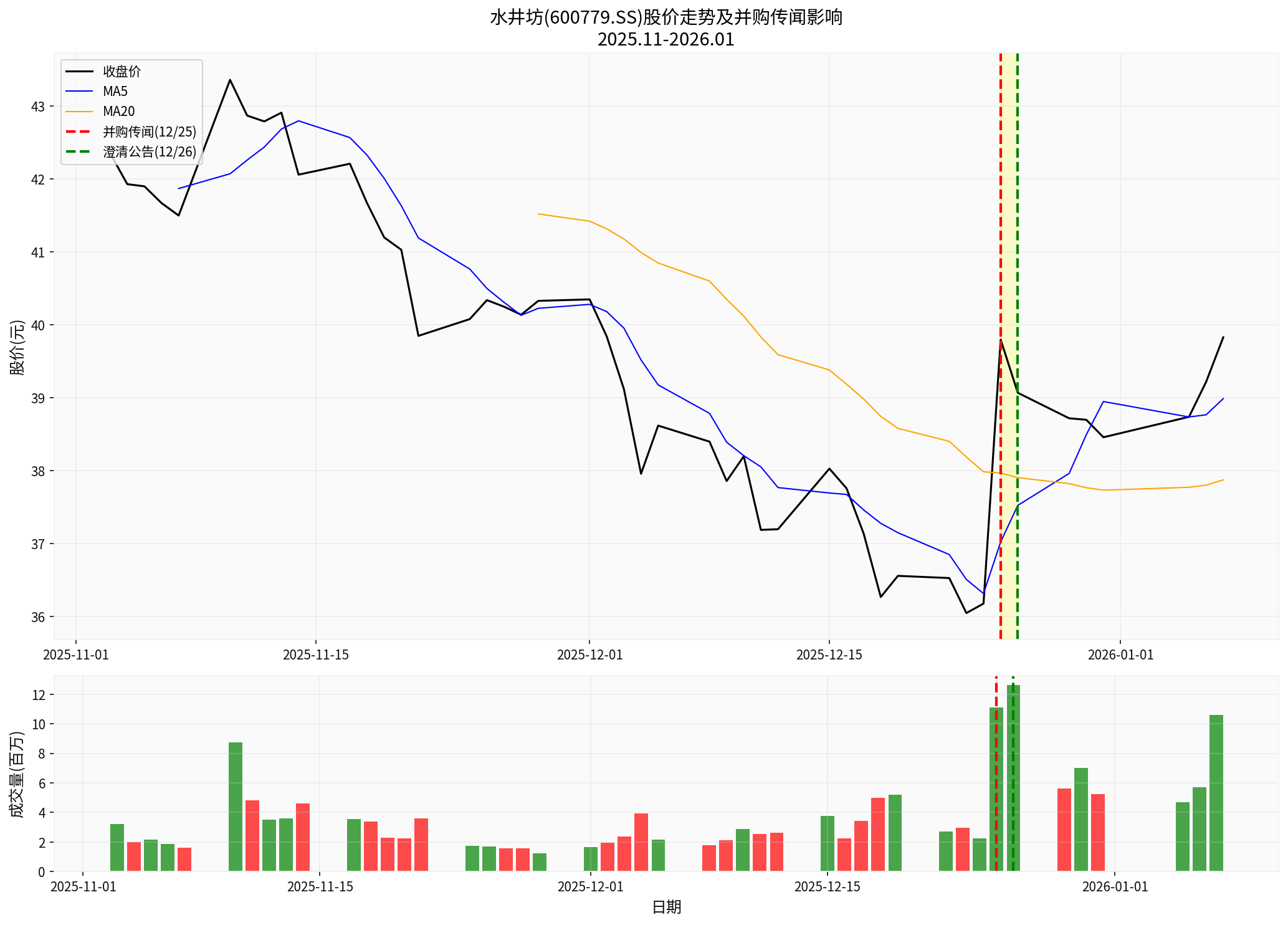
Looking at the stock price data, Shuijingfang’s closing price on December 25 reached RMB 39.80, with a single-day increase of 10.01%, making it the strongest-performing stock in the baijiu sector that day [0]. On December 26, after the clarification announcement was released, the stock price fell back to RMB 39.07, and trading volume increased significantly, indicating a rapid shift in market sentiment.
| Date | Closing Price (RMB) | Change | Event Nature |
|---|---|---|---|
| 2025-12-25 | 39.80 | +10.01% | Acquisition Rumor (Limit Up) |
| 2025-12-26 | 39.07 | -1.83% | Clarification Announcement |
| 2026-01-08 | 39.83 | - | Return to Normal |
From a technical chart analysis, Shuijingfang’s stock price was in a downward channel before the rumor emerged, with a closing price of only RMB 36.16 on December 24, hitting a nearly two-month low. The limit-up triggered by the rumor is a typical “bear market rally”; without substantial improvement in fundamentals, the stock price subsequently fell back to its original oscillation range [0].
Shuijingfang is currently facing severe operational difficulties. According to the 2025 third quarterly report, the company’s operating revenue was only RMB 2.348 billion, a year-on-year sharp drop of 38.01%; net profit attributable to parent company shareholders was RMB 326 million, a year-on-year plummet of 71.02% [1]. Even more worrying is that the net cash flow from operating activities was -RMB 867 million, a year-on-year decline of 212%, and the book monetary funds can no longer cover short-term borrowings, highlighting liquidity pressure.
Looking at the latest quarterly data, the Q3 2025 revenue was only USD 85 million, far lower than the market expectation of USD 165 million, a gap of 48.61%; earnings per share (EPS) was USD 0.46, far below the expected USD 1.46, with an expectation gap of as high as 68.82% [0].
| Indicator | 2024 | 2023 | 2022 | 2021 |
|---|---|---|---|---|
| Operating Revenue (RMB 100 million) | YoY - | YoY - | YoY - | YoY - |
| Net Profit (RMB 100 million) | Decline | Decline | Decline | Decline |
| Cash Flow Status | Negative | Negative | Strained | Healthy |
Shuijingfang’s current major shareholder is global alcohol giant Diageo, with a shareholding ratio of approximately 63% [1]. However, Diageo’s performance in the Chinese market has continued to face pressure in recent years. The Q1 2025 fiscal year trading statement shows that the Greater China region dragged down Asia-Pacific sales by 7.5%, with double-digit sharp declines in both volume and net sales in the region, mainly due to the reduction in baijiu consumption scenarios in China [1].
By the end of 2025, Diageo’s stock price had fallen by a cumulative 37% in the London and New York markets, falling into a long-term slump. Pressure on management from activist investors has further intensified market speculation about a change in Shuijingfang’s ownership [1]. It is worth noting that Diageo recently announced the sale of its shares in East African Breweries to Asahi Group Holdings, Japan. This asset disposal action has led the outside world to speculate whether it will re-evaluate its asset portfolio including Shuijingfang.
From a strategic positioning perspective, Diageo’s attitude towards Shuijingfang is undergoing a subtle shift. When the equity acquisition was completed in 2013, then-Diageo CEO Paul Walsh clearly stated that he would “build Shuijingfang into an internationally leading Chinese baijiu brand”, positioning it as a “strategic high ground”. However, since the first half of 2025, management has begun to frequently attribute the underperformance of the Asia-Pacific region to “the weakness of the Chinese baijiu business” in investor conference calls [1].
The baijiu industry highly relies on local relationship networks, in-depth distribution, and channel control, while foreign management models have obvious “acclimatization” problems when facing the complex ecosystem of Chinese baijiu. Shuijingfang’s performance volatility has increased in recent years, and problems such as “high investment, low output”, channel and inventory issues have gradually emerged [1]. The foreign shareholder’s insufficient ability to respond to changes in Chinese baijiu consumption scenarios has led to continuous loss of market share.
Against the background of deepening stock competition in the baijiu industry, cross-regional integration led by state-owned enterprises (SOEs) is accelerating. On November 21, 2025, Chengdu Rongjiu Liquor Co., Ltd. was officially established. This state-controlled enterprise jointly held by five state-owned enterprises (with a registered capital of RMB 500 million, and the actual controller is the Chengdu State-owned Assets Supervision and Administration Commission) launched the M&A process for Jiangkouchun, one of the “Ten Small Golden Flowers of Sichuan Baijiu”, just over ten days after its establishment [3].
This cross-regional M&A spanning Chengdu and Bazhong is not only a key move by local state-owned assets to implement the industrial upgrading strategy of Sichuan baijiu, but also reflects the new integration logic of “SOE platform + regional brand” in the baijiu industry [3]. The acquired party, Jiangkouchun, is a time-honored Chinese brand with a century-old history. Although it holds honors such as national geographical indication products and intangible cultural heritage, it has faced operational challenges in recent years, and high debts have weighed on the enterprise.
- Government Credit Endorsement: Integrate scattered production capacity, cellars, brands, and channels by leveraging government credit and capital leverage
- Resource Sharing Platform: Provide small and medium-sized liquor enterprises with a shared backend for “unified procurement, unified standards, unified marketing”
- Cost Optimization: Expected to reduce operating costs by more than 15% [3]
- Industry Goal-Oriented: Highly aligned with local government industrial development strategies
Looking back at the M&A history of the baijiu industry in the past five years, a profound shift from scale expansion to stock integration has already occurred. Before 2021, the industry’s upward cycle spawned a large number of cross-border M&A and scale expansion cases, such as the acquisition of Fenlian Liquor (under Legend Holdings) by Laobaigan Liquor, and China Resources Beer’s successive takeovers of Jingzhi and Jinzhongzi, which were all hot topics at that time [4].
But since the industry entered an adjustment period in 2022, the logic of M&A has undergone a fundamental shift:
| Period | M&A Characteristics | Dominant Players |
|---|---|---|
| 2018-2021 | Cross-border M&A, Land Grabbing | Industrial Capital, Cross-border Capital |
| 2022-2024 | Strategic Integration, Stock Game | Leading Liquor Enterprises, SOE Platforms |
| 2025-Present | Regional Integration, Bad Asset Clearance | SOE-led, Professional Players |
According to industry data, there were 23 M&A and restructuring events in the baijiu industry in 2024, with a total transaction volume exceeding RMB 100 billion, and an annual growth rate of over 30% [3]. The trend of head concentration is becoming increasingly obvious, and resources are accelerating to concentrate on high-quality brands, core production areas, and professional players.
In sharp contrast to SOE-led integration, cross-border M&A is facing unprecedented setbacks. Shanghai Kuijiu (ST Yanshi) saw its revenue plummet by 84.92% in the first three quarters of 2025, with a net loss of RMB 111 million, and has been issued a delisting risk warning, becoming a typical case of small and medium-sized liquor enterprises being cleared out during the industry adjustment period [4].
Some enterprises are divesting non-performing assets through low-price transfers. In November 2025, Liujin Technology, a comprehensive TV channel operation service provider, announced its plan to transfer 51% of the shares of its holding subsidiary Sichuan Liujin Liquor Co., Ltd. to Xiong Yuguo at a price of RMB 1 [4]. This “RMB 1 bottom-fishing” case reflects the market’s re-evaluation of the value of baijiu assets.
- Insufficient Industry Cognition: Cross-border capital has limited understanding of the attributes of the baijiu industry
- Difficult Channel Integration: The in-depth distribution system of baijiu is difficult to replicate quickly
- Shortcomings in Brand Operation: Cultural accumulation and consumer mindshare cannot be cultivated overnight
- Impact of Inventory Cycle: The industry adjustment period amplifies operational risks
Value reconstruction in the baijiu industry is underway, and M&A and restructuring have become the core path for the high-quality development of the industry. From a trend perspective:
- Accelerated Head Concentration: The market share of first-tier brands such as Moutai and Wuliangye continues to expand
- Differentiation of Regional Brands: Second and third-tier brands with brand heritage are favored by state-owned assets, while uncharacteristic small liquor enterprises are cleared out at an accelerated pace
- Selection of M&A Targets: Shifting from scale superposition to capability complementarity and value co-creation
- Return to Industrial Logic: Respecting industry laws has become a prerequisite for M&A success
Although the rumor has been clarified by both parties, the market still paid high attention to it, which reflects multiple underlying logics:
From a practical perspective, it is difficult for Jiannanchun to acquire Shuijingfang in the short term, mainly based on the following considerations:
- Valuation Differences: Shuijingfang’s current market value is approximately RMB 19.5 billion (estimated at RMB 39.83 × 490 million shares), and Diageo will not sell at too low a price
- Approval Difficulty: Involving foreign capital’s acquisition of a state-owned enterprise (due to historical evolution), the approval process is complex
- Financial Pressure: Jiannanchun itself is facing the pressure of an IPO performance bet, and a large-scale M&A may exacerbate financial tension
- Integration Challenges: The difficulty of cultural integration between the foreign management model and local liquor enterprises cannot be solved in the short term
- Short-Term Stock Price Volatility Risk: Before Shuijingfang’s fundamentals improve, any M&A rumor may trigger short-term speculative volatility, but there is no basis for sustained growth.
- Definite Industry Integration Trend: M&A and integration in the baijiu industry will continue to deepen, with clearer logic - head concentration, SOE leadership, and capability complementarity.
- Beware of “M&A Traps”: Investors should distinguish between substantive integration and theme speculation, and remain cautious about M&A rumors that lack industrial logic.
- Focus on Signals of Fundamental Improvement: The key to whether Shuijingfang can stabilize and rebound lies in whether the new management can reverse the channel dilemma and improve operational efficiency, rather than relying on external M&A.
| Risk Type | Specific Performance | Risk Level |
|---|---|---|
| Operational Risk | Sustained revenue decline, deteriorating cash flow | High |
| Liquidity Risk | Monetary funds cannot cover short-term borrowings | High |
| Industry Risk | Reduction in baijiu consumption scenarios, high inventory | Medium |
| Foreign Shareholder Risk | Strategic adjustment, potential share reduction | Medium |
| Valuation Risk | Passive valuation increase due to performance decline | Medium |
[1] Sina Finance - Jiannanchun Denies Rumors of Acquiring Shuijingfang, Both Parties Clarify Market Speculation (https://finance.sina.com.cn/roll/2026-01-04/doc-inhfchyt2918808.shtml)
[2] Sina Finance - Shuijingfang Responds to Acquisition Rumors: Reports of “A Certain Liquor Enterprise Planning to Acquire Shuijingfang” Are Not True (https://finance.sina.com.cn/jjxw/2025-12-26/doc-inheaqmt2874589.shtml)
[3] Sina Finance - State-Owned Assets Take Action to Integrate Sichuan Baijiu: Chengdu Rongjiu Plans to Acquire Jiangkouchun (https://finance.sina.com.cn/stock/aigcy/2025-12-09/doc-inhaeytz2925573.shtml)
[4] Eastmoney.com - Bottom-Fishing for RMB 1: How Magical Is Baijiu M&A in 2025? (https://caifuhao.eastmoney.com/news/20251230145802371678620)
[0] Gilin AI Financial Database - Shuijingfang (600779.SS) Stock Price Data and Financial Analysis
Insights are generated using AI models and historical data for informational purposes only. They do not constitute investment advice or recommendations. Past performance is not indicative of future results.
About us: Ginlix AI is the AI Investment Copilot powered by real data, bridging advanced AI with professional financial databases to provide verifiable, truth-based answers. Please use the chat box below to ask any financial question.