
Store Shrinkage at IKEA China: An Analysis of Profound Transformations in the Home Furnishing Retail Industry
Unlock More Features
Login to access AI-powered analysis, deep research reports and more advanced features
About us: Ginlix AI is the AI Investment Copilot powered by real data, bridging advanced AI with professional financial databases to provide verifiable, truth-based answers. Please use the chat box below to ask any financial question.
Based on the collected information, I will conduct an in-depth analysis of the profound changes in the home furnishing retail industry reflected by the store shrinkage at IKEA China from multiple dimensions.
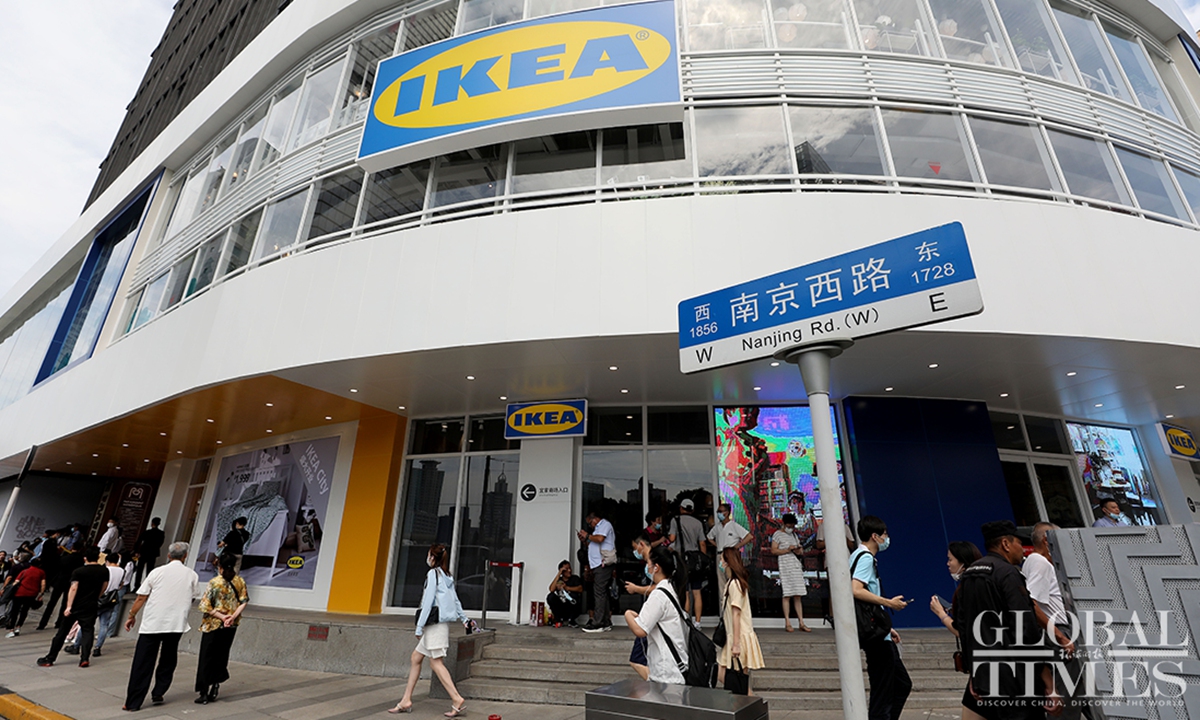
On January 7, 2026, IKEA China announced the closure of 7 offline stores, including Shanghai Baoshan Store, Guangzhou Panyu Store, Tianjin Zhongbei Store, Nantong Store, Xuzhou Store, Ningbo Store, and Harbin Store. This decision will take effect on February 2, 2026 [1]. This is IKEA’s largest strategic adjustment since entering the Chinese market in 1998, involving approximately 18% of its total stores in mainland China (as of the end of FY2024, IKEA operated 39 stores in mainland China) [1]. Meanwhile, IKEA announced a shift from “scale expansion” to “targeted deep cultivation”, and will open more than 10 small-format stores in key markets such as Beijing and Shenzhen within the next two years, including Dongguan Store and Beijing Tongzhou Store [1].
China’s home furnishing retail market is undergoing a profound transformation from the incremental era to the stock era. According to industry research, the current market is characterized by “shrinking and fluctuating”, and the industry is operating at the bottom of an L-shaped curve, with stock market competition becoming the new normal [2]. This change is reflected in the following aspects:
The home furnishing consumption boom driven by the rapid growth of the real estate industry is fading. Demand for new home decoration is declining, while demand for existing home renovation, though present, is being released at a slower pace than expected, leading to a significant slowdown in the overall market size growth.
The industry’s competitive landscape has undergone profound changes, with five major players competing head-to-head: traditional decoration companies, real estate developers, internet giants, and leading custom home furnishing enterprises [2]. Cross-sector competitors such as tech giants Xiaomi and Huawei are aggressively entering the market with their smart home ecosystems, breaking the boundaries of the traditional home furnishing industry [3]. This diversified competitive landscape is forcing traditional home furnishing retailers to re-examine their positioning and strategic direction.
There is a clear differentiation in market performance between first-tier cities and second- and third-tier cities. IKEA’s choice to close some stores in second- and third-tier cities while focusing on expanding in first-tier cities such as Beijing and Shenzhen reflects the company’s more prudent and targeted market selection strategy.
IKEA’s strategy of closing large-format malls and opening small-format stores reflects the predicament of the traditional “large-store model” and the evolution trend of the industry’s business model.
The traditional large-store model for home furnishing retailers faces multiple challenges: high rental costs, declining operational efficiency, reduced consumer store visit frequency, etc. Research shows that large stores have fallen out of favor, making chain operations difficult [2]. Most of the 7 stores IKEA is closing in this round are located in second- and third-tier cities, where these stores may face issues such as insufficient foot traffic and mismatched operating costs and revenues.
The small-format stores IKEA plans to open focus more on scenario-based experiences and community reach. This “small and sophisticated” store model can reduce operating costs while being closer to consumers’ daily living circles, improving shopping convenience and experience.
The industry is transitioning from single-category stores to “one-stop” experience malls that integrate home appliances, home furnishings, and decoration services [4]. The “Home Living Center” developed by Red Star Macalline integrates multiple functions such as design services, community activities, coffee culture, and art exhibitions, upgrading the store from a transaction site to a lifestyle platform [3].
Changes in consumer demand are the core driving force for the transformation of the home furnishing retail industry.
The trend of turnkey home furnishing consumption is becoming increasingly obvious, with custom home furnishing and building materials retailers transitioning to turnkey decoration services. The “turnkey decoration” and “whole-home” models may converge, and this iteration of the business model will reshape the industry’s future landscape [2]. Consumers are increasingly inclined to obtain one-stop supporting services from design, material selection to construction, rather than purchasing various home furnishing products individually.
Against the backdrop of the stock market, the decoration business is continuously segmented. Five major business segments—turnkey renovation of old homes, partial renovation, turnkey soft furnishings, custom private homes, and custom hardcover—are redividing the market share [2]. This segmentation trend requires home furnishing retailers to have more flexible service capabilities and product portfolios.
Consumers’ attention to smart home and eco-friendly products continues to increase. During the 2026 New Year’s Day holiday, smart consumption is gradually moving from a trend to the mainstream [5]. Consumers are more focused on the health-promoting effects of their home environment, increasing the importance of eco-friendly materials, ergonomic designs, and air and water treatment products [4].
The development of e-commerce and digital channels has profoundly changed the competitive landscape of the home furnishing retail industry.
Foot traffic in traditional home furnishing stores has been significantly diverted to e-commerce platforms. Consumers are accustomed to comparing products, checking prices, and making purchase decisions online, leading to a decline in the frequency and duration of in-store experiences.
Leading home furnishing brands in 2025 have completely broken down the barriers between online and offline channels, building an “omnichannel integrated” consumer experience. Easyhome’s “One Store, Three Forms” model (offline flagship store, mini-program community, live streaming center) realizes seamless conversion of user traffic [3].
The industry’s marketing methods are shifting from traditional marketing to a combination of digital marketing, word-of-mouth marketing, and new retail for products [2]. Home furnishing retailers need to build a complete online reach and conversion system, rather than relying solely on foot traffic to offline stores.
The home furnishing retail industry is undergoing a fundamental restructuring of its value chain.
The industry is shifting from “earning service fees” to “earning product price differences”, with services becoming an important traffic entry point [2]. This means home furnishing retailers need to rethink their profit models and cannot rely solely on product price differences or venue rental income.
Leading home furnishing retailers have established core competitive advantages through improved supply chain systems, nationwide intelligent production bases, and mature turnkey operation experience [2]. Supply chain integration capability has become a key competitive barrier.
Future competition in home furnishing retail will focus on customer lifecycle value management. Only when CRM enables every customer communication to accurately match needs and every service connection to seamlessly cover the lifecycle can enterprises achieve the transition from “pre-sales transaction-oriented” to “customer lifecycle value-oriented” operations [6].
IKEA’s store closure adjustment reflects a fundamental shift in its China market strategy:
Closing underperforming stores and optimizing the store network layout is a pragmatic choice to improve overall return on investment. IKEA stated that it will invest over 5 billion euros by FY2027 to open new stores and optimize existing ones in multiple markets [1], indicating that it is not shrinking its presence in the Chinese market but rather optimizing resource allocation.
The transition from large-format malls to small-format stores reflects IKEA’s exploration of business format innovation. Small-format stores are more flexible and closer to communities, and may be more suitable for meeting consumers’ “proximity” and “immediacy” needs.
IKEA China announced that it will invest 160 million yuan in FY2026 to launch over 150 lower-priced products, having invested a total of 673 million yuan in the previous two fiscal years [1]. This indicates that while closing stores, IKEA is using a pricing strategy to attract more consumers and offset the impact of channel adjustments.
Based on the above analysis, China’s home furnishing retail industry will present the following development trends:
| Trend Direction | Specific Performance |
|---|---|
Intelligentization |
Evolution from single-product intelligence to whole-home smart scenarios, with AI technology deeply embedded in daily life scenarios [5] |
Service-Oriented |
Shift from product sales to turnkey services, with turnkey decoration becoming the core competitive track [2] |
Greenization |
Sustainability becomes a basic demand, with eco-friendly materials and circular economy models becoming widespread [3] |
Integration |
Deep integration of online and offline channels, building an omnichannel consumer experience [3] |
Refinement |
Shift from scale expansion to targeted operation, focusing on single-store efficiency and customer value [2] |
IKEA China’s decision to close 7 stores is a microcosm of the profound transformations in the global home furnishing retail industry. This event reflects that: China’s home furnishing retail market has shifted from incremental expansion to stock competition; the traditional large-store model faces efficiency bottlenecks; consumer demand is evolving toward turnkey, personalized, and intelligent solutions; online channels continue to impact offline retail; and the industry’s value chain is being restructured from product sales to service operations.
For home furnishing retail enterprises, future competition will no longer be about single-asset competition, but a contest of overall asset portfolio optimization capabilities and ecosystem construction capabilities. Successful enterprises need to have accurate market insights, flexible business format innovation capabilities, strong supply chain integration capabilities, and customer-centric operation systems.
[1] Sohu - IKEA China Announces Closure of 7 Malls, Plans to Open Over 10 Small-Format Stores in Two Years (https://m.sohu.com/a/973449648_313745)
[2] Smile Cloud - 2025 China Top 10 Home Furnishing New Trends Release & Turnkey Decoration Successful Model Exchange Conference (http://www.smile2012.com/html/2025/zhengzhuangxinwen_1229/16484.html)
[3] China2000.com - Breaking the Deadlock and Restructuring: 2025 Panoramic View of Global Leading Home Furnishing Brand Strategies (http://www.china2000.org/Skill/View_11474.html)
[4] Sina Finance - 2025 Year-End Recommendation of Beijing Home Furnishing Malls: Focus on Smart Home and Partial Renovation Cases (https://finance.sina.com.cn/tjhz/2026-01-02/doc-inhewuuw9368540.shtml)
[5] Eastmoney.com - Smart Consumption Dominates New Year’s Day Home Furnishing Market: Industrial Upgrading Driven by Both Policies and Concepts (https://wap.eastmoney.com/a/202601053608978278.html)
[6] KPMG China - Leading PropTech 50 · 2025 REBC^AI Smart Practice Cases (https://assets.kpmg.com/content/dam/kpmg/cn/pdf/zh/2025/12/re-china-leading-proptech50-2025.pdf)
Insights are generated using AI models and historical data for informational purposes only. They do not constitute investment advice or recommendations. Past performance is not indicative of future results.
About us: Ginlix AI is the AI Investment Copilot powered by real data, bridging advanced AI with professional financial databases to provide verifiable, truth-based answers. Please use the chat box below to ask any financial question.