
Analysis of the Impact of Share Reduction by the Actual Controller of Heliantai (002402.SZ) on Investment Value
Unlock More Features
Login to access AI-powered analysis, deep research reports and more advanced features

About us: Ginlix AI is the AI Investment Copilot powered by real data, bridging advanced AI with professional financial databases to provide verifiable, truth-based answers. Please use the chat box below to ask any financial question.
Related Stocks
According to Heliantai’s announcements dated January 6, 2026 [1][2], the company’s controlling shareholder, actual controller, chairman, and president Liu Jianwei plans to reduce his shareholding by no more than 18,417,800 shares, accounting for no more than 2% of the company’s total share capital (excluding shares in the share repurchase special account). The details are as follows:
| Item | Details |
|---|---|
Share Reduction Subject |
Liu Jianwei (Controlling Shareholder, Actual Controller, Chairman, President) |
Current Shareholding |
138,760,000 shares, accounting for 15.0673% |
Planned Reduction Quantity |
No more than 18,417,800 shares |
Reduction Ratio |
No more than 2% |
Reduction Period |
January 28, 2026 to April 27, 2026 (3 months) |
Reduction Method |
Concentrated bidding or block trading |
Reason for Reduction |
Repay pledged financing debts, personal capital needs [1][2] |
Impact on Control |
Will not lead to a change in control |
As a technology enterprise in the intelligent control field, Heliantai has shown strong growth in recent years [0]:
- P/E Ratio (TTM):60.49x (in a relatively high valuation range)
- P/B Ratio:7.04x
- ROE (Return on Equity):12.35%
- Net Profit Margin:5.63%
- Operating Profit Margin:6.90%
- Current Ratio:1.44 (good short-term solvency)
- Quick Ratio:1.05
- Debt Risk Rating:Low risk [0]
- Financial Stance:Neutral (no extreme aggressive or conservative accounting treatments)
| Reporting Period | EPS | Revenue (USD 100 million) |
|---|---|---|
| Q3 2025 | $0.27 | $28.1 |
| Q1 2025 | $0.18 | $25.9 |
| Q4 2024 | $0.01 | $26.2 |
| Q3 2024 | $0.17 | $24.7 |
The latest quarterly financial report shows that profitability continues to improve, with revenue increasing by approximately 14% year-on-year.
The current P/E ratio of 60x is significantly higher than the industry average, and the following factors need attention:
- The stock price has risen by 148.23% in the past year, reflecting the market’s high recognition of the company’s growth potential [0]
- The intelligent controller industry benefits from the development of emerging fields such as the Internet of Things (IoT) and smart homes
- The company’s leading technological position in the industry
- The stock price has fallen by approximately 33% from the 52-week high of $60.71, indicating pressure for valuation correction [0]
- The latest free cash flow figure is negative (approximately -$200 million), and the conversion of profitability into cash flow remains to be observed [0]
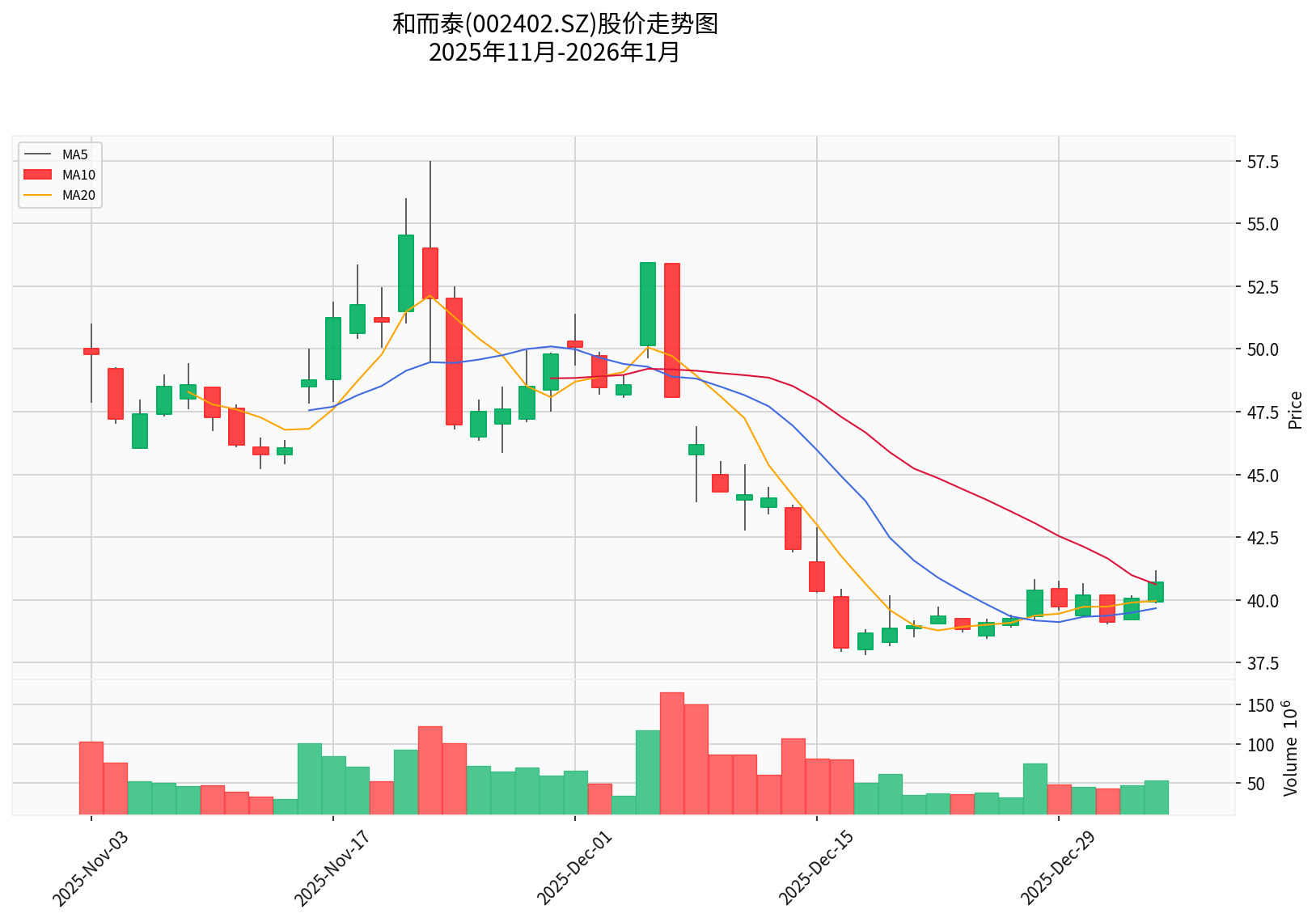
Heliantai has shown an amazing growth performance in the past year and a half [0][3]:
| Period | Price Change |
|---|---|
| 1 Year | +148.23% |
| 6 Months | +81.34% |
| 3 Months | -19.80% |
| 1 Month | -15.33% |
| 3 Years | +166.08% |
| 5 Years | +123.31% |
Since the low point in August 2024, the stock price has increased by more than 338% cumulatively [3].
- Current Stock Price: $40.71
- 20-day Moving Average: $40.61 (stock price is slightly above the short-term moving average) [3]
- 50-day Moving Average: $46.23 (stock price is approximately 12% below the medium-term moving average)
- 200-day Moving Average: $32.31 (stock price is approximately 26% above the long-term moving average) [3]
| Indicator | Value | Signal Interpretation |
|---|---|---|
| KDJ | K:64.1, D:52.9, J:86.6 | Bullish Bias |
| MACD | No Death Cross | Bullish Bias |
| RSI | Normal Range | No Overbought/Oversold |
| Beta | 0.76 | Relatively low volatility compared to the market |
| Support Level | $39.81 | Strong short-term support |
| Resistance Level | $41.61 | Selling pressure exists above |
- The announcement clearly states that the purpose of the reduction is “repaying pledged financing debts and meeting personal capital needs” [1][2], rather than a negative view on the company’s development prospects
- Repaying pledged debts helps reduce the risk of equity pledges and improves the transparency of corporate governance
- After the reduction, Liu Jianwei’s shareholding ratio will remain above 13% [1], and the company’s control structure will remain stable
- The announcement clearly promises that “it will not lead to a change in the company’s control” [1]
- The 2% reduction ratio is within market expectations and will not cause huge selling pressure on the stock price
- The reduction will be completed over 3 months, giving the market sufficient time to absorb the impact
- Share reduction by the actual controller is usually interpreted as a signal of “insufficient confidence from insiders”, which may trigger short-term selling
- The company’s stock price has already corrected by approximately 33% from its high point, and the share reduction announcement may intensify the adjustment pressure
- The current 60x P/E is at a historical high, and the controlling shareholder’s share reduction may trigger a downward shift in the valuation center
- Share reduction at a high level may strengthen the market’s perception that the company is “overvalued”
- Based on the current price of $40, the cash from selling 18,417,800 shares will be approximately RMB 740 million
- Large-scale share reduction may put pressure on short-term liquidity
From market experience, the impact of controlling shareholder’s share reduction on stock price usually follows the following rules:
| Stock Price Position Before Reduction | Impact After Reduction |
|---|---|
| At historical high | High probability of decline |
| In a reasonable valuation range | Limited impact |
| Supported by performance | The stock price is expected to stabilize after correction |
Heliantai is currently at a relatively low level after correcting from its high point, and the company’s fundamentals remain stable. It is expected that the impact of the share reduction will be relatively controllable.
| Dimension | Evaluation |
|---|---|
Growth |
Revenue and profit have maintained double-digit growth in the past year |
Industry Prospects |
Intelligent controllers benefit from emerging fields such as AIoT, smart homes, and automotive electronics |
Financial Health |
Low debt risk, sufficient liquidity |
Technological Barriers |
Leading technological advantages in the segmented field |
| Risk Type | Risk Description |
|---|---|
Valuation Risk |
The 60x P/E is at a historical high, with potential correction risk |
Reduction Pressure |
The controlling shareholder’s share reduction may trigger short-term selling |
Market Sentiment |
The overall valuation of technology stocks is greatly affected by the macro environment |
Performance Volatility |
Quarterly earnings fluctuate significantly, and stability needs to be improved |
| Investor Type | Recommendation |
|---|---|
Short-term Investors |
Should remain cautious during the reduction period (January 28 to April 27), and consider participating based on market reactions after the reduction is completed |
Medium-term Investors |
May gradually build positions when the price pulls back to the $39-$40 range, with a stop-loss set at $37 |
Long-term Investors |
If optimistic about the company’s long-term growth logic, may deploy in batches after the pullback, and set a long-term trailing stop-loss |
- Entry Timing:Wait for the controlling shareholder’s reduction plan to be implemented, and enter when the stock price stabilizes above the support level of $39.81
- Target Price:Short-term rebound target of $44-$46, medium-term target of $55-$60
- Stop-loss Setting:Stop loss if the price breaks below $37 to control downward risks
Liu Jianwei, the actual controller of Heliantai, plans to reduce his shareholding by no more than 2%, and the impact on the company’s investment value is
-
Short-term Impact (Negative but Limited):The share reduction announcement may put pressure on the short-term stock price, but given the clear reason for the reduction, unchanged control, and moderate reduction ratio, the impact is expected to be limited.
-
Medium-term Impact (Neutral Bias):After the reduction is completed, market sentiment is expected to gradually recover, and the company’s fundamentals will remain the core factor determining the stock price.
-
Long-term Impact (Positive):The actual controller’s repayment of pledged debts through share reduction helps reduce corporate governance risks. If the company can maintain a good growth momentum, the stock price still has upside potential.
Investors should focus on the
[1] Eastmoney - Heliantai: Liu Jianwei Plans to Reduce Shareholding by No More Than 2% (https://finance.eastmoney.com/a/202601063610355444.html)
[2] Yicai - Heliantai: Controlling Shareholder Liu Jianwei Plans to Reduce Shareholding by No More Than 2% (https://www.yicai.com/brief/102989926.html)
[3] Caizhongshe - [Announcement Summary] List of Share Reductions by Listed Companies on January 6 (https://m.caizhongshe.cn/news-7414282573000144203.html)
[0] Jinling AI Financial Database (Company Profile, Real-time Quotes, Financial Analysis, Technical Analysis)
Insights are generated using AI models and historical data for informational purposes only. They do not constitute investment advice or recommendations. Past performance is not indicative of future results.
About us: Ginlix AI is the AI Investment Copilot powered by real data, bridging advanced AI with professional financial databases to provide verifiable, truth-based answers. Please use the chat box below to ask any financial question.