
Analysis of the Surge in Brain-Computer Interface Concept Stocks: The Substantive Correlation Between Neuralink and A-Share Companies
Unlock More Features
Login to access AI-powered analysis, deep research reports and more advanced features
About us: Ginlix AI is the AI Investment Copilot powered by real data, bridging advanced AI with professional financial databases to provide verifiable, truth-based answers. Please use the chat box below to ask any financial question.
Related Stocks
Let me provide a systematic analysis of the surge in brain-computer interface concept stocks and their substantive correlation with Neuralink’s commercialization progress.
On January 2, 2026, the first trading day of 2026 for the A-share market, the brain-computer interface sector (Index Code: 886047) performed exceptionally strongly, with a daily surge of
| Stock Name | Price Surge | Category |
|---|---|---|
| Beiyikang | 30CM Limit-Up | Leading Stock |
| Sanbo Brain Hospital | 20CM Limit-Up | Core Target |
| Xiangyu Medical | 20CM Limit-Up | Core Target |
| Wizmed | 20CM Limit-Up | Core Target |
| Apeng Medical | 20CM Limit-Up | Core Target |
| Medlander | 20CM Limit-Up | Core Target |
| Chengyitong | 20CM Limit-Up | Core Target |
Approximately
The core catalyst for this rally was a heavyweight statement from
“Neuralink plans to launch large-scale production of brain-computer interface devices in 2026, while advancing a more streamlined and almost fully automated surgical procedure.” [1][4]
According to his disclosure, the core breakthroughs of the new generation technology are:
- The electrode wire can directly penetrate the dura mater without resection, significantly reducing surgical trauma and complication risks
- Automated surgical robotshave reduced the duration of a single procedure from the initial 6 hours towithin 20 minutes
- Implantation costshave also dropped from the million-dollar range tounder US$100,000, laying the foundation for large-scale implementation [1][5]
Since its establishment in 2016, Neuralink’s technical route has become increasingly clear, and it currently adopts
| Time Node | Milestone Event | Technical Indicators |
|---|---|---|
| January 2024 | Completed first human transplant surgery | First volunteer implanted with N1 chip |
| September 2025 | Clinical trial expansion | 12 people worldwide have been implanted with the device, with a cumulative usage time exceeding 15,000 hours |
| Summer 2025 | Technology conference | Demonstrated mind control of computers, drawing, games, and Optimus robot arms |
2026 |
Launch of large-scale production |
Number of electrode channels increased to 3,000 , conducting clinical tests for blindsight |
2027 |
Technology iteration | Number of electrodes increased to 10,000 , multi-device implantation |
2028 |
Full brain connection | Number of electrodes exceeds 25,000 , covering deep brain regions |
Neuralink’s recent clear technological breakthroughs are reflected in three dimensions [4][5][7]:
- Reduced from traditional 6-hour surgery to 20 minutes
- Almost fully automated surgical solution
- Significantly lowers surgical thresholds and labor costs
- Implantation costs reduced from million-dollar range to under US$100,000
- Removes economic barriers for large-scale commercial implementation
- First batch of recipients can already type, play gameswith their minds
- Control range extended to assistive robot arms
- Future plans to control more physical devices through “neural connectivity”
According to an analysis report by
- Neuralink’s current valuation is approximately US$9 billion(after the 2025 Series E financing)
- In the U.S. market alone, the potential market size of brain-computer interface implantation devices could reachUS$80 billionby 2035
- Mainly covering the treatment of neurological diseases such as amyotrophic lateral sclerosis (ALS) and stroke
By sorting out the business layouts of major A-share concept stocks, a
| Technical Route | Neuralink | A-Share Company Layout |
|---|---|---|
Mainstream Technology |
Invasive (requires craniotomy for implantation) |
Non-invasive (signal collection outside the scalp) |
| Signal Collection | Flexible electrode wires implanted in the cerebral cortex | External devices such as scalp electroencephalography (EEG) |
| Technical Difficulty | High (surgical safety, material biocompatibility) | Relatively low (signal accuracy is limited) |
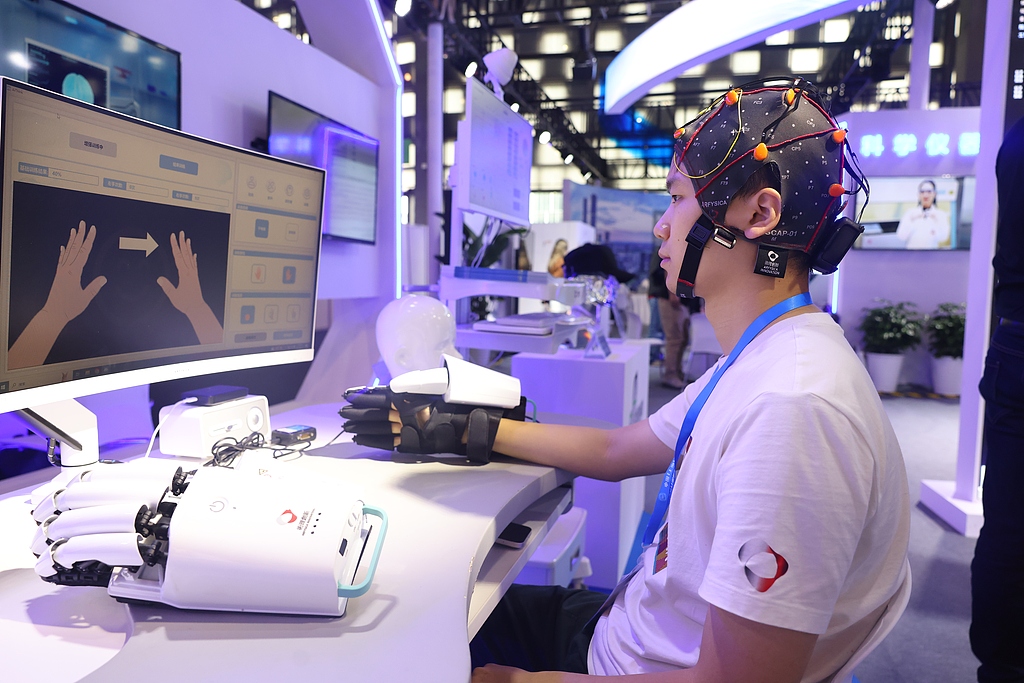
| Application Scenarios | Treatment of severe paralysis, neurological diseases | Rehabilitation training, sleep monitoring, concentration improvement |
- Main Business: R&D, production, and sales of rehabilitation medical devices, with products used in mental rehabilitation, pelvic and postnatal rehabilitation, neurological rehabilitation, and other fields
- Substantive Correlation: Its new brain-computer interface productsare in the early stage of market cultivation, mainly focusing onnon-invasivetechnical routes, with significant path differences from Neuralink’s invasive technology. Related productshave not yet achieved large-scale salesand contribute limited to overall revenue [2]
- Main Business: Rehabilitation medical devices covering full rehabilitation scenarios such as occupational therapy, exercise therapy, cognitive speech, and swallowing
- Substantive Correlation: Focuses onnon-invasivebrain-computer interface technology, with certain layouts in technology, products, and channel markets. However, as of the end of 2025,related products have not achieved large-scale sales, accounting for a small proportion of revenue [2][9]
- Main Business: In vitro diagnostic products, covering emergency care, brain disease diagnosis, pediatrics, and other fields
- Substantive Correlation: Layouts throughstrategic cooperation, signing a “Strategic Cooperation Framework Agreement” with Shenzhen Brain-Computer Star Chain Technology Co., Ltd. to provide channel empowerment for its brain-computer interface products,no self-developed brain-computer interface products have been launched yet[2]
- Substantive Correlation: Expected to obtain the first brain-computer interface medical device registration certificate (brain-computer interface transcranial magnetic stimulator) in the first quarter of 2026, which is anon-invasivedevice [8]
- Main Business: A medical service group with a focus on neurosurgery, providing comprehensive medical services centered on high-precision neurosurgery
- Substantive Correlation:Explicitly stated that it is not involved in the R&D, production, or sales of brain-computer interface products, and revenue from neuromodulation technology accounts for an extremely small proportion, havingbasically no impact on the company’s performance[2]
- Main Business: Three major segments: military electronics, public security, and high-end medical equipment
- Substantive Correlation:Has not actually carried out related businesses such as brain-computer interface[2]
Companies such as Beiyikang, Apeng Medical, Entropy Technology, Mehow Medical, Chengyitong, and Pony Testing
Based on industry research and company announcements, a hierarchical assessment of A-share brain-computer interface concept stocks is conducted [6][8][9]:
| Industrial Chain Segment | Representative Companies | Correlation with Neuralink | Business Substance |
|---|---|---|---|
Upstream Core Hardware |
Hanwei Technology (flexible sensors) | ★☆☆☆☆ | Sensor technology has certain versatility but is not dedicated to invasive brain-computer interfaces |
Midstream Algorithm Technology |
iFLYTEK (emotion recognition algorithms) | ★☆☆☆☆ | Algorithms have versatility, but there are significant differences from Neuralink’s underlying technology |
Downstream Clinical Application |
Sanbo Brain Hospital | ★☆☆☆☆ | Medical service institution, not involved in brain-computer interface product R&D |
Rehabilitation Devices |
Wizmed, Xiangyu Medical | ★☆☆☆☆ | Non-invasive devices, different from invasive technical routes |
| Dimension | Assessment |
|---|---|
Technical Correlation |
Extremely low — A-share companies mainly focus on non-invasive technology, with fundamental differences from Neuralink’s invasive technology |
Business Correlation |
Extremely low — Most companies have negligible brain-computer interface business proportions, or only stay at the cooperation intention stage |
Commercialization Progress Correlation |
No direct correlation — Neuralink’s 2026 large-scale production will not directly contribute to the performance of A-share companies |
Valuation Support |
Weak — Current price surge mainly relies on market sentiment and concept speculation, lacking fundamental support |
| Stage | Neuralink | China |
|---|---|---|
Clinical Progress |
12 people implanted, cumulative usage exceeding 15,000 hours | Most products are still in the clinical trial stage |
Mass Production Capacity |
Launch large-scale production in 2026 | Non-invasive products have been commercialized, while invasive ones still take time |
Technological Maturity |
Third-generation technology (3,000 channels in 2026) | Semi-invasive systems such as “Beijing Brain-1” are advancing in clinical trials |
Pu Muming, an academician of the Chinese Academy of Sciences, frankly stated [8]: “To achieve true brain-computer integration as seen in sci-fi movies, it will take at least 5-10 years.”
Thomas Oxley, founder of
- It will take another 3-5 yearsfor medical applications of brain-computer interfaces to be approved
- Consumer-grade implanted devices will take at least 15-20 years
This indicates that even for the technologically leading Neuralink, the commercialization path still has considerable uncertainty.
“Behind the booming market, we need to be alert to the mismatch between technological maturity and commercialization progress. Currently, brain-computer interfaces are still in the clinical validation stage. Both the surgical safety verification of the invasive route and the signal accuracy improvement of the non-invasive route require long-term technological iteration and large-scale clinical data support. The current frenzy in the capital market is clearly divorced from the actual pace of industry development and is overly premature.”
For investments in brain-computer interface concept stocks, it is recommended to focus on the following indicators [6][8]:
| Focus Indicator | Specific Content | Evaluation Criteria |
|---|---|---|
Product Registration Certificate Progress |
Status of obtaining medical device registration certificates | Time of first certificate, number of approved certificates |
Clinical Data Verification |
Clinical trial effectiveness and safety data | Sample size, efficacy data |
Commercialization Implementation Capability |
Actual sales and customer feedback | Revenue proportion, repurchase rate |
From the industrial chain perspective, A-share companies that have certain correlations with brain-computer interfaces include [6][8]:
| Company | Related Business | Substantive Level |
|---|---|---|
Hanwei Technology |
Flexible brain-computer interface materials | Upstream hardware with certain technical barriers |
iFLYTEK |
Brainwave signal algorithms, communication devices for ALS patients | Midstream algorithms with patent advantages |
Sanbo Brain Hospital |
Neurosurgery clinical resources | Downstream clinical, but no product business |
Xiangyu Medical/Wizmed |
Rehabilitation non-invasive devices | Certain layouts have been formed, but technical routes are different |
It is worth noting that
- Brain-computer interface has been included in the future industry direction of the national “15th Five-Year Plan”
- Shanghai issued the “Action Plan for Cultivating the Future Industry of Brain-Computer Interfaces (2025—2030)”, clarifying that by 2027, it will promote more than 5 invasive and semi-invasive products to complete clinical trials
- Beijing has established a special incubation fund for brain-computer interfaces, with a single maximum financing amount exceeding RMB 50 million
- Different technical routes: Neuralink focuses on invasive technology, while most A-share companies focus on non-invasive layouts
- Extremely weak business correlation: Most companies have negligible brain-computer interface business proportions, or only have cooperation intentions
- Disconnected commercialization progress: Neuralink’s commercialization will not directly contribute to the performance of A-share companies
- Valuation divorced from fundamentals: Current price surge mainly relies on market sentiment rather than substantive business improvement
When participating in such concept speculation, investors should maintain a prudent attitude, focus on enterprises with
[1] Sina Finance - “Brain-Computer Interface ‘Speculation’ is Too Premature” (https://finance.sina.com.cn/roll/2026-01-06/doc-inhfivet7316585.shtml)
[2] 21st Century Business Herald - “Brain-Computer Interface Concept Surges, What is the Substance of Related Listed Companies’ Businesses?” (https://www.21jingji.com/article/20260106/herald/90ea0f8e98b078736e9ce6ee511f6f45.html)
[3] Securities Times - “Leading Stocks Hit Limit-Up! Low-Altitude Economy Takes the Spotlight” (https://stcn.com/article/detail/3570575.html)
[4] Wall Street China - “Musk Releases ‘Mass Production Timeline’, Brain-Computer Interface Stocks Surge Limit-Up, Is the Commercialization Inflection Point Coming?” (https://wallstreetcn.com/articles/3762545)
[5] World Internet Conference - “Musk: In 2026, Neuralink Launches ‘Large-Scale Mass Production’” (https://cn.wicinternet.org/2026-01/04/content_38517304.htm)
[6] Jiuyangongshe - “Brain-Computer Interface Concept Surges: Musk’s Mass Production Announcement Ignites a Hundred-Billion Track” (https://www.jiuyangongshe.com/a/jjw4xqwxdh)
[7] Eastmoney - “Brain-Computer Interface Becomes a Capital ‘Favorite’, Strong Brain Technology Completes RMB 2 Billion Financing, Second Only to Neuralink in Scale” (https://finance.eastmoney.com/a/202601063610339031.html)
[8] TMTPost - “Brain-Computer Interface 2025: Policy Orientation, Technological Breakthroughs, Capital Inflow, Medical Application Takes the Lead” (https://www.ebrun.com/20260101/634623.shtml)
[9] Securities Times - “Musk’s Mass Production Announcement Ignites the Market, Brain-Computer Interface Commercialization Accelerates, Chinese Industrial Clusters Emerge” (https://www.stcn.com/article/detail/3572633.html)
[10] Caifuhao - “Brain-Computer Interface ‘Speculation’ is Too Premature” (https://caifuhao.eastmoney.com/news/20260106101014171473140)
Insights are generated using AI models and historical data for informational purposes only. They do not constitute investment advice or recommendations. Past performance is not indicative of future results.
About us: Ginlix AI is the AI Investment Copilot powered by real data, bridging advanced AI with professional financial databases to provide verifiable, truth-based answers. Please use the chat box below to ask any financial question.