
Analysis Report on Yonyou Network's Hong Kong Listing and AI Transformation Sustainability
Unlock More Features
Login to access AI-powered analysis, deep research reports and more advanced features
About us: Ginlix AI is the AI Investment Copilot powered by real data, bridging advanced AI with professional financial databases to provide verifiable, truth-based answers. Please use the chat box below to ask any financial question.
Related Stocks
Based on the obtained data and in-depth analysis, I have prepared this professional research report on
Yonyou Network Technology Co., Ltd., China’s largest enterprise software and service provider, officially submitted its listing application to the Hong Kong Stock Exchange (HKEX) on December 29, 2025. This is the company’s second submission to HKEX within the year, following its first application on June 27, 2025[1][2]. The establishment of this “A+H” dual capital platform marks the official launch of the international strategic transformation of this established software giant that has been listed on the A-share market for over 20 years.
According to the prospectus, the company plans to focus the raised funds on R&D of technologies such as AI and product iteration and upgrading, especially improving the iuap platform, YonGPT and YonAI, while advancing global capability building, including global product adaptation, overseas business operation and brand building[3]. However, behind the ambitious AI blueprint, the financial pressure faced by the company cannot be ignored either — the cumulative loss from 2023 to H1 2025 reached as high as RMB 3.984 billion[4].
| Financial Indicators | 2022 | 2023 | 2024 | H1 2025 |
|---|---|---|---|---|
| Revenue (RMB 100 million) | 104.6 | 97.6 | 88.0 | 34.34 |
| YoY Change | - | -6.7% | -9.8% | -5.9% |
| Net Profit (RMB 100 million) | 2.25 | -9.33 | -20.70 | -9.81 |
| Gross Profit Margin | 55.0% | 52.0% | 46.0% | 46.7% |
- Revenue has declined for three consecutive years, with a cumulative drop of 15.9%
- Net profit turned from a profit of RMB 225 million in 2022 to a loss of RMB 2.07 billion in 2024, with the loss magnitude expanding by 122%
- Gross profit margin shows a continuous downward trend, dropping a cumulative 8.3 percentage points from 55.0% in 2022 to 46.7% in H1 2025[1][4]
Yonyou Network’s R&D expense ratio has shown a significant upward trend:
| Year | R&D Expenses (RMB 100 million) | R&D Expense Ratio | YoY Change |
|---|---|---|---|
| 2022 | 17.54 | 19.7% | - |
| 2023 | 21.07 | 21.6% | +1.9pct |
| 2024 | 21.22 | 24.1% | +2.5pct |
| H1 2025 | 11.27 | 32.8% | +8.7pct |
Among R&D expenses, the proportion of depreciation and amortization soared from 13.9% in 2022 to 38.5% in 2024, mainly related to the amortization of capitalized costs associated with the development of the Yonyou BIP platform[1][2]. The R&D expense ratio surged to 32.8% in H1 2025, meaning that for every RMB 1 of revenue, the company needs to invest approximately RMB 0.33 in R&D, a ratio far exceeding the industry average.
The expense structure in H1 2025 reveals the severe cost pressure faced by the company:
| Expense Type | Expense Ratio | YoY Change |
|---|---|---|
| R&D Expense Ratio | 32.8% | +8.7pct |
| Sales Expense Ratio | 31.2% | +1.5pct |
| General & Administrative Expense Ratio | 14.5% | +0.6pct |
Total of Three Expenses |
78.5% |
+10.8pct |
The proportion of total three expenses to revenue has risen continuously from 57.5% in 2022 to 67.7% in 2024, and further reached 78.5% in H1 2025, far exceeding the 46.7% gross profit margin in the same period, resulting in severe operating losses[1][2].

Cash flow situation shows an accelerating deterioration trend:
| Indicators | 2022 | 2023 | 2024 | H1 2025 |
|---|---|---|---|---|
| Operating Cash Flow (RMB 100 million) | 2.86 | -0.90 | -2.74 | -9.28 |
| Cash and Cash Equivalents (RMB 100 million) | - | - | 56.57 | 27.34 |
| Current Ratio | 1.3 | 1.2 | 0.9 | 0.77 |
| Quick Ratio | 1.2 | 1.1 | 0.9 | 0.73 |
| Net Current Liabilities (RMB 100 million) | - | - | -13.34 | -23.49 |
As of June 30, 2025, the company’s cash and cash equivalents decreased by 51.3% compared to the end of 2024, dropping to RMB 2.734 billion, with net current liabilities reaching RMB 2.349 billion, facing significant liquidity pressure[1][3][4].
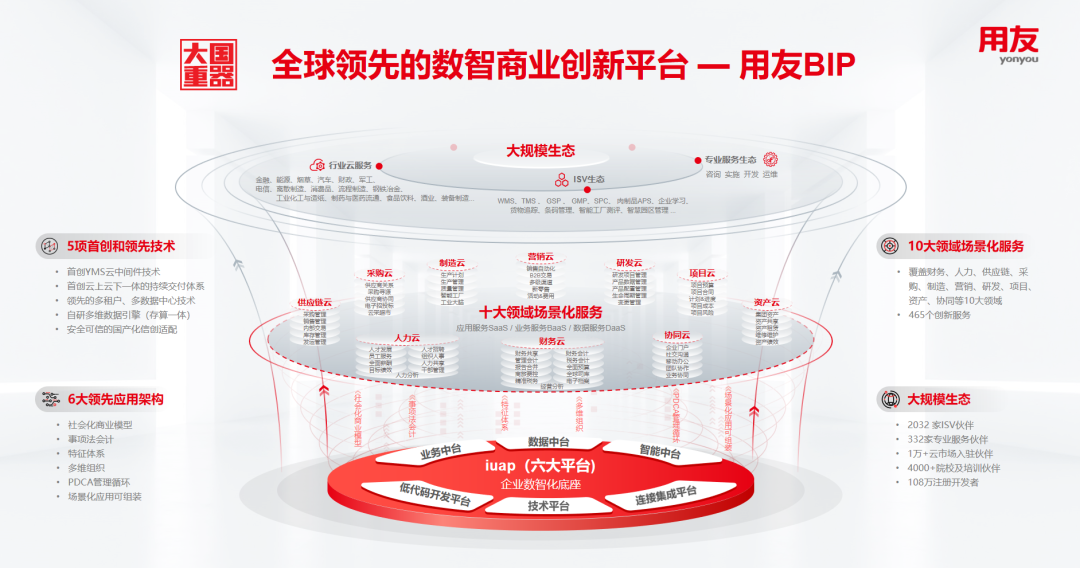
Yonyou Network’s strategic focus has fully shifted to the AI-centric Phase 3.0, transforming from traditional ERP to “Yonyou BIP (Business Innovation Platform)”. The company launched YonGPT, a vertical large model for enterprise services, in 2023, becoming the first vertical large model in the industry[3]. In 2025, Yonyou further launched the “Yonyou BIP Enterprise AI” application suite including “Agents”.
- Unified AI Base: Provides unified model management and inference capabilities
- AI-Driven Enterprise Business: Applied in complex scenarios such as financial analysis and supply chain forecasting
- AI Agents: Automatically execute enterprise-level task processes
By introducing technologies such as RAG (Retrieval-Augmented Generation), YonGPT aims to solve the pain points of “application silos” and “data fragmentation” in traditional enterprise software[3]. The total R&D investment from 2022 to 2024 reached RMB 6 billion, with continuous increases in R&D investment related to AI large models. The construction cost of the intelligent platform increased by 40.7% YoY in 2024[4].
The proportion of cloud service revenue has increased from 68.4% in 2022 to 80.0% in H1 2025, basically completing the transition from the traditional software licensing model to the cloud service subscription model[3].
| Customer Type | 2022 Gross Profit Margin | 2023 Gross Profit Margin | 2024 Gross Profit Margin | H1 2025 Gross Profit Margin |
|---|---|---|---|---|
| Cloud Services for Large Enterprises | 49.6% | 36.8% | 31.8% | 33.7% |
| Overall Cloud Services | 54.8% | 47.1% | 45.0% | 46.8% |
However, the high proportion of cloud services has not yet brought significant improvement to gross profit margin. The gross profit margin of cloud services for large enterprises dropped from 49.6% in 2022 to 33.7% in H1 2025, indicating that the high delivery and operation costs of AI and cloud services are still continuously squeezing profit margins[1][3].

Compared with its main domestic competitor Kingdee International (0268.HK), Yonyou Network shows the characteristic of “large but not strong”:
| Indicators | Yonyou Network | Kingdee International | Difference |
|---|---|---|---|
| 2024 Revenue (RMB 100 million) | 88.0 | 58.7 | Yonyou +50% |
| Gross Profit Margin | 46.0% | 57.2% | Kingdee +11.2pct |
| R&D Expense Ratio | 24.1% | 19.3% | Yonyou +4.8pct |
| Cloud Business Growth Rate | 1.6% | 25.0% | Kingdee +23.4pct |
- Yonyou’s revenue scale is 1.5 times that of Kingdee, but its gross profit margin lags by 11.2 percentage points
- Yonyou has higher R&D investment intensity, but its cloud business growth rate significantly lags behind Kingdee
- Kingdee International performs better in cloud transformation efficiency[1][2]

The global enterprise-level AI market is in a period of explosive growth:
- Since 2023, the scale of the enterprise-level AI market has grown from USD 1.7 billion to USD 37 billion, an increase of approximately 21 times[5]
- In 2025, total enterprise spending on generative AI reached USD 37 billion, an increase of approximately 3.2 times compared to USD 11.5 billion in 2024[5]
- Global SaaS market revenue is expected to reach USD 315 billion by early 2026, with AI being one of the main drivers[6]
- The Asia-Pacific region is the fastest-growing market for AI SaaS, with continuous increased investment from Chinese enterprises[6]
According to IDC data, the scale of China’s enterprise-level SaaS market reached RMB 186 billion in 2025, with a YoY growth of 22.3%, but the growth rate slowed significantly compared to 29.7% in 2024[7]. Even though the AI SaaS track has been highly touted as “fully exploding”, its actual ARR accounts for less than 15% of the overall market, and a large number of so-called “AI functions” still remain in the demo stage[7].
Zheng Qingsheng, Partner of Sequoia China, pointed out: “Many companies use AI as a fig leaf to cover up the core problems of product homogenization and sluggish growth. The real winners are those enterprises that deeply embed AI into business processes and form an irreplicable data flywheel.”[7]
| Risk Type | Specific Description | Severity |
|---|---|---|
Transformation Risk |
Transformation to cloud services leads to declining gross profit margin, with short-term performance under pressure | High |
Financial Risk |
Continuous losses, deteriorating cash flow, expanding net current liabilities | High |
Operational Risk |
Long delivery cycle and high cost for large enterprise projects, with declining retention rate | Medium-High |
Equity Risk |
Controlling shareholder Wang Wenjing has pledged 12.34% of shares | Medium |
Technology Iteration Risk |
Huge R&D investment in AI large models with high uncertainty | Medium-High |
Compliance Risk |
Overseas expansion faces risks of data security and trade barriers | Medium |
Goodwill Impairment Risk |
Book value of goodwill is RMB 1.519 billion, with RMB 156 million impairment provision already made | Medium |
The retention rate of cloud service customers for large enterprises was 74.1% in 2024, a decrease compared to the previous year, showing challenges in customer stickiness[4].
As of June 30, 2025, the company’s net current liabilities reached RMB 2.349 billion, while cash and cash equivalents were only RMB 2.734 billion. If operating cash flow remains negative, the company may face capital chain tension in the next 12-18 months. If the Hong Kong IPO is successfully completed, it will directly supplement working capital and relieve short-term debt repayment pressure[1][2][3].
| Assessment Dimension | Current Status (1-10) | Target Status (1-10) | Gap |
|---|---|---|---|
| Revenue Growth | 3 | 7 | -4 |
| Profitability | 1 | 6 | -5 |
| Cash Flow | 2 | 7 | -5 |
| R&D Efficiency | 4 | 8 | -4 |
| Gross Profit Margin | 5 | 7 | -2 |
| Cloud Business Growth Rate | 4 | 8 | -4 |
Based on a comprehensive assessment of factors including technical capability (weight 0.15, score 8), market opportunities (weight 0.20, score 7), capital pressure (weight 0.20, score 3), competitive landscape (weight 0.15, score 5), management execution (weight 0.15, score 6), and customer stickiness (weight 0.15, score 7):

| Scenario | 2026 Revenue | 2027 Revenue | 2028 Revenue | Profit Expectation |
|---|---|---|---|---|
| Bearish | RMB 7.5 billion | RMB 7 billion | RMB 6.5 billion | Continuous Losses |
| Base Case | RMB 8.5 billion | RMB 9 billion | RMB 9.5 billion | Expected to break even in 2028 |
| Bullish | RMB 9.5 billion | RMB 11 billion | RMB 13 billion | Expected to return to profit in 2027 |
- Market Opportunities: The global enterprise-level AI market has an annual growth rate of over 300%, with the Asia-Pacific region growing the fastest
- First-Mover Advantage: As the first vertical large model for enterprise services in the industry, YonGPT has technical barriers
- Cloud Service Foundation: Cloud revenue accounts for 80%, providing an implementation carrier for the AI strategy
- Hong Kong IPO: If successfully listed, it will relieve liquidity pressure and gain support from international capital
- Continuous Losses: Cumulative losses of nearly RMB 4 billion in three years, which is difficult to reverse in the short term
- Gross Profit Margin Under Pressure: High proportion of cloud services has not brought improvement to gross profit margin, with high AI delivery costs
- Deteriorating Cash Flow: Continuous outflow of operating cash flow, with rising liquidity risk
- Lagging in Competition: Compared with Kingdee, Yonyou is at a disadvantage in both cloud business growth rate and gross profit margin
- High Expenses: The total ratio of three expenses is 78.5%, far exceeding the gross profit margin, and the loss magnitude may continue to expand
- Not a Short-Term Investment Target: It is recommended to focus on a cycle of at least 2-3 years
- Key Observation Indicators:
- Whether gross profit margin can rebound to above 50%
- Whether cloud service customer retention rate stabilizes and rebounds
- Whether AI functions can achieve independent monetization (improved NDR)
- Progress of Hong Kong IPO and scale of raised funds
- Risk Warning: The current financial situation shows liquidity pressure, so close attention should be paid to changes in cash flow
Yonyou Network’s AI transformation is a “high-stakes bet” — betting that the explosion of the enterprise-level AI market can cover its huge investment costs, and that the technical advantages of YonGPT can be transformed into sustainable commercial competitiveness.
In the short term, the financial pressure faced by the company is real: 32.8% R&D expense ratio, half-year loss of nearly RMB 1 billion, and net current liabilities of RMB 2.349 billion — these numbers do not lie. In the medium term, if the Hong Kong IPO successfully secures capital injection and AI commercialization is gradually implemented, the company is expected to see a performance inflection point in 2027-2028. In the long term, whether Yonyou can win this AI competition depends on whether it can transform its technical advantages into customer stickiness and pricing power.
- Gross profit margin stabilizes and rebounds to above 50%
- Operating cash flow turns from negative to positive
- AI functions achieve independent monetization paths
- Retention rate of large enterprise customers stabilizes and rebounds
At the current stage, Yonyou Network’s AI transformation
[1] Sina Finance - “Yonyou Network Sprint for Hong Kong IPO: Net Loss Widened to RMB 2.07 Billion in 2024 with Three Consecutive Years of Declining Gross Profit Margin” (https://finance.sina.com.cn/stock/aigc/ggxg/zgs/2025-12-29/doc-inhentrz7713445.shtml)
[2] Sina Finance - “Yonyou Files for Hong Kong IPO Amid Huge Losses: When Will the Pain of ‘Cloud Transformation’ for Traditional Software Vendors End?” (https://finance.sina.com.cn/stock/relnews/cn/2025-12-31/doc-inhequph9533455.shtml)
[3] Eastmoney Wealth Account - “Betting on AI Amid Revenue Pressure: Can YonGPT and High R&D Investment Reverse the Loss Dilemma?” (https://caifuhao.eastmoney.com/news/20251231133354651127540)
[4] Sina Finance - Compiled from Prospectus Data
[5] Zhihu Column - “Growing 3.2 Times in a Year: Where Has the USD 37 Billion in Enterprise-Level AI Spending Gone?” (https://zhuanlan.zhihu.com/p/1985559359879677056)
[6] Thunderbit - “SaaS AI Tools: 60 Key Data Points for 2026” (https://thunderbit.com/zh-Hans/blog/saas-ai-tools-stats)
[7] 36Kr - “2025 Annual Review: The ‘AI Exam’ for the SaaS Industry and the Life-and-Death Breakthrough of Listed Companies” (https://m.36kr.com/p/3616263140312320)
[8] Jinling API Database - Financial Data of Yonyou Network (600588.SS) [0]
Insights are generated using AI models and historical data for informational purposes only. They do not constitute investment advice or recommendations. Past performance is not indicative of future results.
About us: Ginlix AI is the AI Investment Copilot powered by real data, bridging advanced AI with professional financial databases to provide verifiable, truth-based answers. Please use the chat box below to ask any financial question.