
In-depth Analysis Report on Yonghui Supermarket's Full Disposal of Yonghui Yunjin Equity and New Retail Transformation
Unlock More Features
Login to access AI-powered analysis, deep research reports and more advanced features
About us: Ginlix AI is the AI Investment Copilot powered by real data, bridging advanced AI with professional financial databases to provide verifiable, truth-based answers. Please use the chat box below to ask any financial question.
Related Stocks
On December 29, 2025, Yonghui Supermarket Co., Ltd. (Stock Code: 601933.SH) issued a major asset disposal announcement, planning to fully dispose of its 28.095% equity stake in Yonghui Yunjin Technology Co., Ltd. via the Chongqing United Assets and Equity Exchange at a
- Transaction Subject: Yonghui Yunjin Technology Co., Ltd., registered capital of RMB 500 million
- Current Shareholding Structure: Shanghai Paihui Technology holds 71.905%, Yonghui Supermarket holds 28.095%
- Transaction Method: Public listing transfer, reserve price determined based on a discount of Yunjin Technology’s net asset valuation of RMB 632 million as of November 30, 2025
- Official Rationale: Revitalize assets and focus on core operations [1][2]
| Time | Share Reduction Ratio | Transaction Price | Transaction Counterparty |
|---|---|---|---|
| April 2024 | 65% | Approximately RMB 336 million | Shanghai Paihui Technology (backed by FinVolution Group) |
| December 2025 | 28.095% | RMB 178 million (listing price) | To be determined |
Yonghui Supermarket’s eagerness to fully dispose of its remaining stake in Yunjin Technology stems from the
| Financial Indicator | 2023 | 2024 | Change Rate | H1 2025 |
|---|---|---|---|---|
| Operating Revenue | RMB 146 million | RMB 24.4977 million | -83.2% |
RMB 73.9433 million |
| Net Profit | RMB 92.23 million | RMB 38.5966 million | -58.1% |
RMB 9.0803 million |
| Profitability | Net Profit Margin 63.2% | 157.6% | — | 12.3% |
-
Cliff-like Drop in Operating Revenue: Yunjin Technology’s 2024 operating revenue plummeted 83.2% compared to 2023. Although there was a rebound in H1 2025, profitability continued to be under pressure, with the net profit margin dropping sharply from 63.2% in 2023 to 12.3% in H1 2025 [1][2]
-
Shrinkage of Core Business: Yunjin Technology’s business scope includes Class 1 and Class 2 value-added telecommunications services, mainly providing financial services for Yonghui Supermarket’s supply chain. As Yonghui Supermarket’s core business contracted, its fintech business lost its support
-
Intensified Industry Competition: The fintech industry faces stricter regulation, coupled with fierce competition in the consumer finance market, putting dual pressure on Yunjin Technology
Yonghui Supermarket’s own core business operations are also facing severe challenges [1][2]:
| Financial Indicator | 2022 | 2023 | 2024 | First Three Quarters of 2025 |
|---|---|---|---|---|
| Operating Revenue | Approximately RMB 90 billion | Approximately RMB 78.6 billion | Approximately RMB 67.4 billion | RMB 42.434 billion |
| Net Profit Attributable to Parent | -RMB 2.763 billion | -RMB 1.329 billion | -RMB 1.465 billion | -RMB 710 million |
| YoY Change in Operating Revenue | — | -12.7% | -14.3% | -22.21% |
| Operating Cash Flow | — | — | — | RMB 1.14 billion (-69.82%) |
In recent years, Yonghui Supermarket’s asset disposal actions can be summarized under the strategic theme of
- Sale of Yunjin Technology: Complete divestment of the fintech business
- Share Reduction in Hongqi Chain: Recover non-core investments
- Closure of Loss-making Stores: 227 long-term loss-making stores were closed in H1 2025 [1]
Ye Guofu, Head of Yonghui Supermarket’s Reform Leading Group, clearly stated at the extraordinary general meeting in March 2025:
- Focus on small supermarkets with an area of 2,000-3,000 square meters
- Develop high-quality community supermarkets
- Build “high cost-performance” product strength
- Restructure the supply chain system
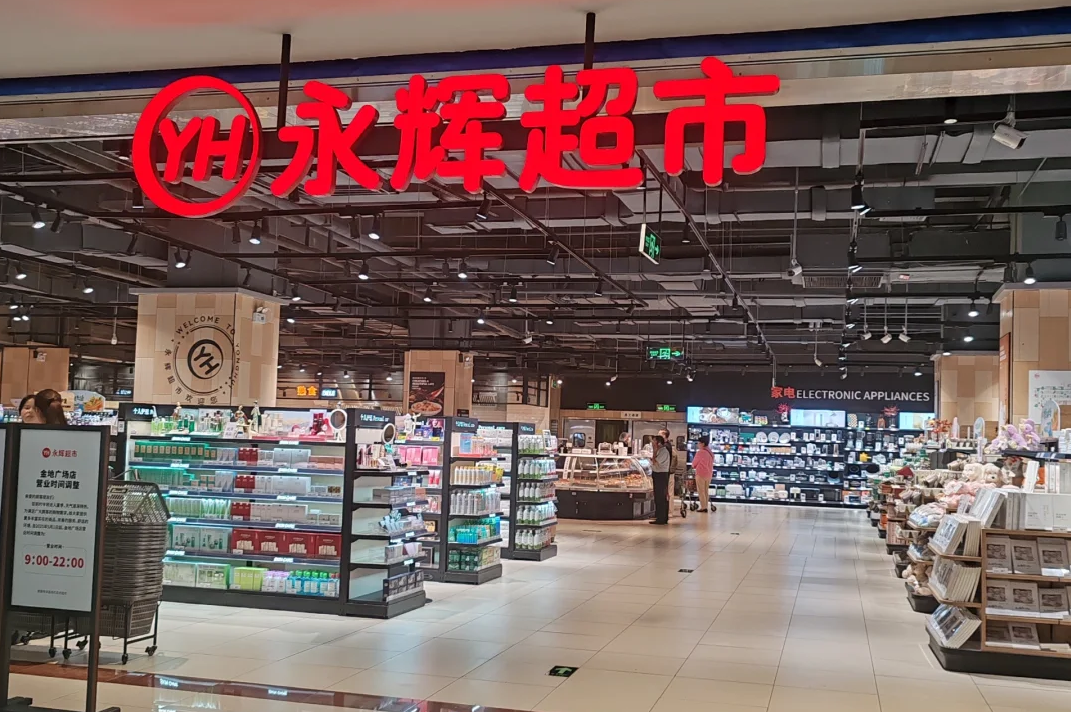
Since the opening of Yonghui’s first “Pang Donglai-style renovated store” (Zhengzhou Xinwan Plaza Store) in June 2024, the renovation work has progressed rapidly [1][4][5]:
| Time Node | Cumulative Number of Renovated Stores | Number of Covered Cities |
|---|---|---|
| June 2024 (First Store) | 1 | 1 |
| December 2024 | 17 | — |
| Before Spring Festival 2025 | 41 | — |
| March 2025 | 83 | — |
| June 27, 2025 | 124 | 66 |
| End of August 2025 (Projected) | 178 | — |
December 30, 2025 |
222 |
— |
Operating data of renovated stores shows that the model transformation has achieved initial results [4][5]:
- Zhengzhou Xinwan Plaza Store: After resuming operations, its average daily sales increased from approximately RMB 200,000 to over RMB 1 million
- Xi’an Zhongmao Plaza Store: Before renovation, average daily sales were approximately RMB 200,000, with an average daily foot traffic of 3,000 people; after renovation, average daily sales reachedRMB 1.6 millionin two days, with average daily foot traffic exceeding14,000 people
- Six New Stores Including Nanjing Jiangning Wanda Plaza Store: On June 15, 2025, the six stores together attracted over76,000 paying customersin a single day, achieving a GMV of nearlyRMB 10 million[4]
According to a September 2025 report from Shanghai Observer, after Yonghui completed the “drastic Pang Donglai-style renovation” of 11 supermarkets in Shanghai,
- On September 2, 2025, the Shanghai Fengxian Jinhui Longhu Store reopened after renovation, marking the completion of the “Pang Donglai model” renovation of all 11 Yonghui stores in Shanghai
- As the first city to complete the renovation, Shanghai provides valuable experience for Yonghui’s national promotion
- The “Shanghai Model” will be replicated and promoted in the Yangtze River Delta region [5]
Yonghui’s renovation is not just a change in store image, but also an
| Reform Area | Specific Measures | Results |
|---|---|---|
| Supplier Streamlining | Streamlined approximately 50% of suppliers | Focus on core suppliers |
| Naked Sourcing & Direct Sourcing | Signed naked sourcing contracts with 2,860 standard product suppliers | Eliminated markup from middlemen |
| Core Supplier Mechanism | Selected 200 core suppliers and established an annual dialogue mechanism | Strengthened strategic cooperation |
| Product Structure Optimization | Eliminated low-efficiency products and introduced high cost-performance items | Increased customer unit price |
The renovation has not only brought changes to products and environment, but also
- Employee salaries increased by 15%-20%
- Increased annual leave
- Significant improvement in service quality
- Employees are more motivated, forming a positive cycle
This “people-oriented” philosophy is the core essence of learning from Pang Donglai.
Although renovated stores have shown strong performance, Yonghui Supermarket as a whole is still in a stage of
- Net Profit Attributable to Shareholders of Listed Company: -RMB 240 million
- Net Profit Attributable to Shareholders of Listed Company After Deducting Non-recurring Gains and Losses: -RMB 830 million
- Costs related to store renovation: closed-store decoration, equipment investment, asset write-offs, and re-opening expenses
- Short-term impact from supply chain reform: upgrading and replacing a large number of suppliers and products
- Asset disposal losses from the closure of 227 long-term loss-making stores
In a research report released in August 2025, Kaiyuan Securities pointed out:
The market has given positive feedback amid wait-and-see. Wang Shoucheng, Yonghui Supermarket’s new CEO, stated at a new product launch conference in October 2025:
As of the close of trading on January 6, 2026, Yonghui Supermarket’s share price has shown a pattern of
| Indicator | Value |
|---|---|
| Latest Closing Price | RMB 4.96 |
| 2025 Highest Price | RMB 6.97 |
| 2025 Lowest Price | RMB 3.78 |
| 52-Week Change | -27.06% |
- May-June 2025: The share price peaked at RMB 6.97, as the market gave optimistic expectations for the renovation results
- Second Half of 2025: As renovation investment increased and performance continued to be under pressure, the share price fluctuated downward
- December 30, 2025: Affected by the announcement of fully disposing of Yunjin Technology, the share price dropped 6.46% in a single day, closing at RMB 4.92 [2]
- Negative Factors: Continuous losses, short-term financial pressure from asset disposal, weak consumer spending due to macroeconomic factors
- Positive Factors: Sales data of renovated stores verifies the feasibility of the model, the store profitability model has initially been proven viable, regional profitability has been achieved in Shanghai and other areas
Currently, offline supermarkets in China are facing a
- Sustained impact from e-commerce
- Changes in consumer habits
- Diversion by community group buying
- Rising operating costs
- The Pang Donglai model has verified the feasibility of “quality retail”
- Policies are being implemented to boost consumer willingness
- Consumers still have demand for offline experiences
In addition to Yonghui, other A-share retail supermarket enterprises have also gradually promoted store renovations [4]. According to data from the National Bureau of Statistics:
- Since October 2024, the decline in sales of 50 key large-scale retail enterprises has narrowed rapidly
- In April 2025, the sales of 50 key large-scale retail enterprises turned positive year-on-year
Phase 1 (2024-2025): Strategic Contraction and Model Exploration
├── Asset Disposal: Full disposal of Yunjin Technology, share reduction in Hongqi Chain
├── Store Renovation: Learning from the Pang Donglai model, first batch of pilot stores
├── Supply Chain Reform: Streamline suppliers, implement naked sourcing & direct sourcing
└── Organizational Change: Increase employee salaries and benefits

Phase 2 (2025-2026): Model Replication and Scale Effect
├── Store Renovation: Cover all existing stores nationwide
├── Regional Profitability: Model verification successful in Shanghai and other regions
├── Store Optimization: Eliminate low-efficiency stores
└── Supply Chain Maturity: Form differentiated product strength

Phase 3 (After 2027): Leader in Quality Retail
├── Stable Profitability: Achieve sustainable profitability
├── Brand Upgrade: From "People's Yonghui" to "Quality Yonghui"
└── Industry Benchmark: Become a sample for traditional supermarket transformation
- Sustained Profitability of Renovated Stores: Need to verify whether renovated stores can maintain foot traffic and sales growth after the novelty period
- Implementation Effect of Supply Chain Reform: Whether the naked sourcing & direct sourcing model can truly achieve “high quality at low price”
- Cash Flow Management Capability: Maintain healthy cash flow to support transformation during the continuous loss period
- Talent Team Building: Cultivation and promotion of independent renovation capabilities
| Risk Type | Specific Content |
|---|---|
| Performance Risk | Continuous losses may lead to cash flow pressure |
| Competition Risk | Sustained diversion by e-commerce and community group buying |
| Consumption Risk | Macroeconomic downturn affects consumer willingness |
| Execution Risk | Whether the renovation model can be successfully replicated nationwide |
- Full Disposal of Yunjin Technology is a Correct Decision: Facing the drastic shrinkage of the fintech business and the dilemma of its own core business, focusing on retail core business is a pragmatic choice. The two sales have cumulatively recovered approximately RMB 514 million, providing financial support for transformation [1][2].
- New Retail Transformation is Progressing Smoothly but Still in a Painful Period: 222 stores have been renovated, profitability has been achieved in the Shanghai region, and sales data of renovated stores verifies the feasibility of the model, all indicating that the transformation direction is correct. However, the company as a whole is still in a loss-making state, and continuous attention should be paid to the progress of loss reduction [4][5].
- The Pang Donglai Model is Replicable: From the first store in Zhengzhou to the full renovation of stores in Shanghai, it proves that the model can be successfully replicated in different cities. The key lies in the implementation of supply chain reform and service philosophy [4][5].
- Share Price Has Fully Priced in Pessimistic Expectations: After a 27% drop over 52 weeks, the current valuation may have reflected the market’s concerns about short-term performance; medium- and long-term attention should be paid to the effectiveness of transformation.
- Short-term: Focus on 2025 annual report performance and the progress of loss reduction
- Medium-term: Focus on the sustained profitability of renovated stores and same-store growth
- Long-term: Focus on gross margin improvement brought by supply chain reform and the effect of brand upgrading
[1] Eastmoney.com - “Yonghui Supermarket Fully Disposes of Yunjin Technology for RMB 178 Million! Accumulated Losses of Nearly 90% in Two Years, Can Core Business Restructuring Turn the Tide?” (https://caifuhao.eastmoney.com/news/20251229232210021478790)
[2] Economic Information Daily - “Yonghui Supermarket Plans to Fully Dispose of Its Subsidiary Yunjin Technology” (http://jjckb.xinhuanet.com/20251230/92c0f56278b842d1b13cc3bcfb7fccea/c.html)
[3] Eastmoney.com - “Yonghui Supermarket Plans to Fully Dispose of Its 28.095% Stake in Yunjin Technology with a Listing Reserve Price of RMB 178 Million” (https://finance.eastmoney.com/a/202512293604605490.html)
[4] Dongguan Securities - “In-depth Report on Yonghui Supermarket (601933)” (https://pdf.dfcfw.com/pdf/H3_AP202507221713619745_1.pdf)
[5] Jiefang Daily/Shanghai Observer - “Yonghui Completes ‘Drastic Pang Donglai-style Renovation’ of 11 Supermarkets in Shanghai; Shanghai Model to Be Promoted in Yangtze River Delta” (https://www.jfdaily.com/news/detail?id=975615)
[6] Southern Window - “The New Yonghui After ‘Pang Donglai-style Renovation’ is Selling Like Hot Cakes” (https://www.nfcmag.com/sv/4466.html)
[0] Jinling AI Financial Database - Real-time Market and Technical Analysis Data of Yonghui Supermarket (601933)
Insights are generated using AI models and historical data for informational purposes only. They do not constitute investment advice or recommendations. Past performance is not indicative of future results.
About us: Ginlix AI is the AI Investment Copilot powered by real data, bridging advanced AI with professional financial databases to provide verifiable, truth-based answers. Please use the chat box below to ask any financial question.