
Analysis and Evaluation: Can Meta's Smart Wearables Become a New Growth Engine?
Unlock More Features
Login to access AI-powered analysis, deep research reports and more advanced features
About us: Ginlix AI is the AI Investment Copilot powered by real data, bridging advanced AI with professional financial databases to provide verifiable, truth-based answers. Please use the chat box below to ask any financial question.
Related Stocks
Based on the data I collected and public information, the following is a rigorous analysis and assessment of investment impact focused on “Can Meta’s Smart Wearables Become a New Growth Engine?”
Core Conclusions (Simplified)
- In the short term, smart wearables (Ray-Ban Meta Glasses/Neural Wristband) have not significantly increased Meta’s revenue scale; Reality Labs is still in a phase of heavy investment [0][1][2].
- In the medium term, the smart glasses market has significant size and growth rate, and Meta has secured a leading share; if productization, channels, and ecosystem collaboration advance in tandem, the value of its hardware and ecosystem is expected to be gradually unlocked [0][3][4].
- Impact on overall investment value: It is not yet sufficient to replace the advertising business as the core growth engine, but it can be seen as an enhancement to technological reserves and user stickiness, categorized as a “long-term option”.
- Business Status: Product Progress and Financial Impact
- Meta’s Financial Overview (Data as of January 6, 2026 [0]):
- Stock price: $656.74; Market capitalization: Approximately $1.66 trillion
- P/E ratio: Approximately 28.2x; Net profit margin: Approximately 30.9%
- Consensus analyst target price: Approximately $825 (implying an upside of around +25.6%) [0]
- Reality Labs’ Revenue and Loss (2020 Q4 – 2025 Q3, Unit: Millions of USD) [0][1][2]:
- Q3 2025 quarterly revenue: Approximately 470; accounting for about 0.9% of Meta’s total revenue [0]
- Q3 2025 quarterly operating loss: Approximately -1,330 (around -$1.33 billion) [0][1]
- Cumulative loss of Reality Labs in 2024: Approximately $21.27 billion; cumulative loss expanded to approximately $21.3 billion by Q3 2025 [1][2]
- Product Developments:
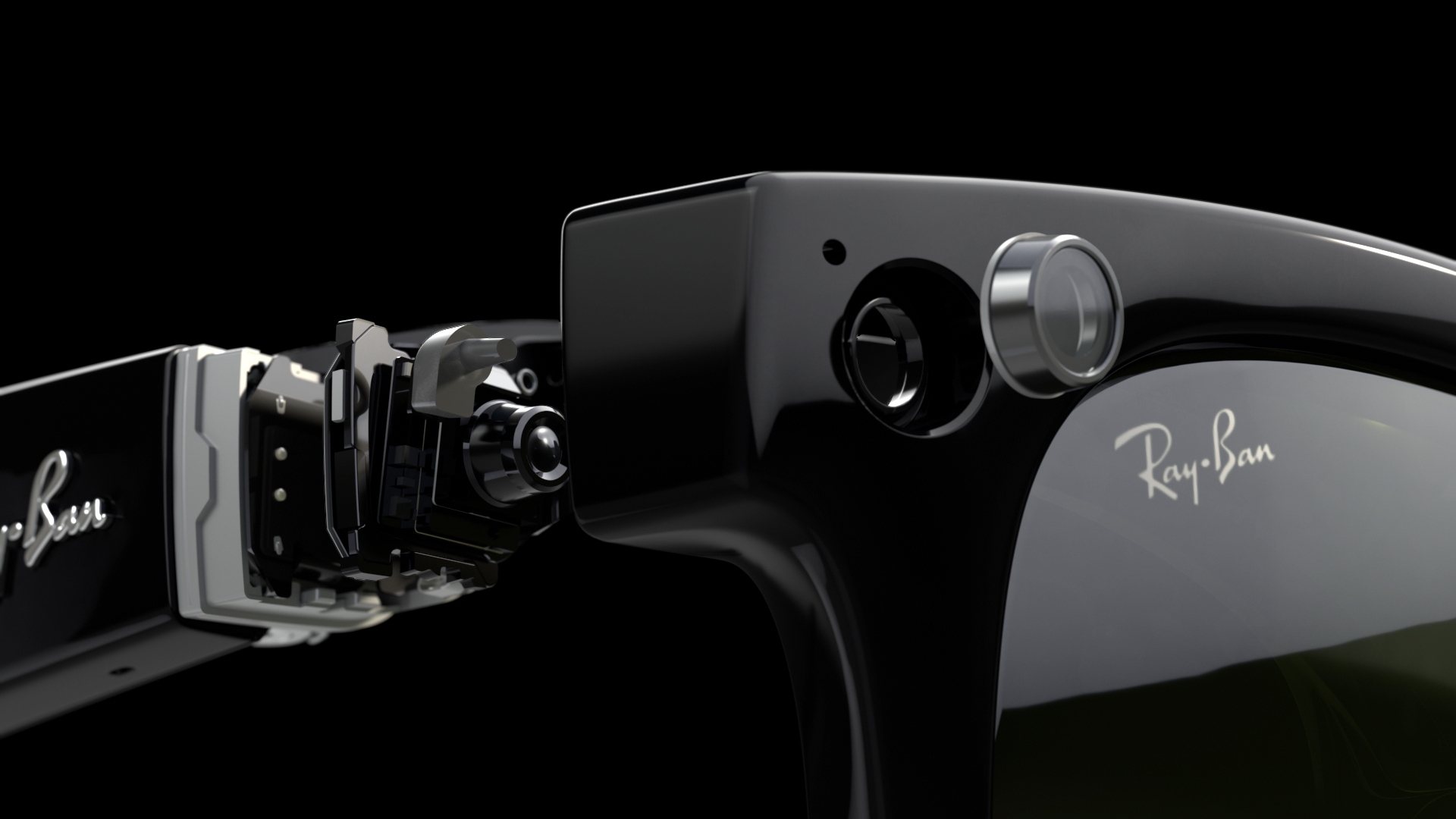
- Ray-Ban Meta Glasses: Market demand is strong; due to “unprecedented demand and limited inventory”, Meta has postponed the planned launch in markets including the UK, France, Italy, and Canada [4][5].
- Meta Neural Band: Based on EMG technology, it supports gesture input and potential multi-device control; public information shows that Meta is collaborating with Garmin on a proof-of-concept for in-vehicle infotainment systems, and partnering with the University of Utah to explore application scenarios such as assistive functions [8][9].
- Ecosystem Integration: User context indicates that “instant messaging features have been launched for Ray-Ban Meta Glasses and Neural Band on WhatsApp/Messenger (currently only available in the US/English)”. This reflects the closed-loop strategy of “Hardware - AI Assistant - Communication Ecosystem”, which can increase wearing time and ecosystem stickiness.
- Market Size and Competitive Landscape
- Global Smart Glasses/AR Glasses Market:
- Industry research shows that the global smart glasses/AR glasses market was approximately $14.9 billion in 2024, and is projected to reach approximately $37.59 billion by 2030, with a CAGR of around 16.5% from 2025 to 2030 [0][3].
- Another study shows that the smart glasses market size is projected to reach approximately $8.26 billion by 2030, with a CAGR of around 27.3% from 2025 to 2030 [0][3] (different calibers, both indicating high growth).
- Meta’s Market Position:
- According to third-party data, Meta held approximately 73% of the smart glasses shipment share in the first half of 2025, maintaining a leading position [0][4].
- Industry observers believe that as demand for VR headsets comes under pressure, market attention is shifting from “headsets” to “lighter-weight smart glasses” [0][7].
- Financial and Investment Value Impact (Evidence-Based)
- Revenue Contribution:
- Based on the current market size and Meta’s share (no extrapolation or forecasting), even if Meta maintains a high share, its direct contribution to Meta’s overall revenue will remain limited in the short term. For example: if the 2024 smart glasses market was approximately $14.9 billion and Meta held around 73% share, the corresponding potential revenue space would be at the billion-dollar level, while Meta’s annualized total revenue has reached the hundreds-of-billions-of-dollars level (Q3 2025 quarterly revenue was approximately $51.24 billion) [0].
- Although Reality Labs’ revenue is growing, it still posts quarterly losses at the billion-dollar level, creating a continuous drag on profits [0][1][2].
- Long-Term Value Dimensions:
- Technology and Ecosystem: Integration with WhatsApp/Messenger can increase users’ interaction time and scenario penetration on wearable devices, paving the way for more advanced AI functions and content distribution [6][8].
- Data and Closed Loop: Wearables bring new interaction and scenario data, which is beneficial for the iteration of advertising and content recommendation systems (the degree of relevance requires subsequent product verification).
- Moat: Hardware-software collaboration + ecosystem integration is a high threshold, but continuous observation of large-scale mass production, cost structure, and compliance/privacy implementation is required.
- Risks and Uncertainties:
- Heavy Investment and Uncertain Returns: The losses of Reality Labs create continuous pressure on profitability; attention should be paid to management’s disclosure of investment pace and return paths [0][1][2].
- Production Capacity and Channels: The postponement of the international version of Ray-Ban Meta Glasses indicates challenges in supply-demand and supply chain management [4][5].
- Privacy and Regulation: With the increase in cameras and sensors, data compliance and public acceptance are crucial for long-term volume growth.
- Competitive Landscape: The existence of competitors such as Apple Vision Pro will increase market education costs and ecosystem competition intensity, but there are differences in positioning and customer groups between the two, so it is not appropriate to directly compare shipment volume and market share [7].
- Analyst Perspective and Price Signals
- Valuation and Expectations: P/E ratio is approximately 28.2x, higher than some large tech companies but still matching its growth; the consensus analyst target price implies an upside of around +25.6% [0].
- Valuation Drivers: Current valuation is mainly supported by advertising business profits and AI infrastructure efficiency; hardware has not yet become an independent pricing driver, but is regarded as an important part of Meta’s long-term technology narrative [0][1][2].
- Strategic Recommendations and Key Focus Areas
- For Investors:
- Short term: View the wearables business as a “strategic reserve and user stickiness enhancer”, rather than a short-term profit driver.
- Medium term: Track key indicators — the extent of narrowing losses at Reality Labs, changes in hardware shipments and unit prices, increases in daily active users/usage duration of core applications such as WhatsApp/Messenger, and expansion of the AR content ecosystem and application scenarios.
- Risk Control: Pay attention to capital expenditure and cash consumption, privacy and security compliance, and the pace of international market rollout.
- For Product/Ecosystem (Assumed Internal Perspective):
- Accelerate the construction of supply chain and channel capabilities to resolve delivery bottlenecks for international versions.
- Deepen the end-to-end experience with WhatsApp/Messenger to reduce wearing friction and learning costs.
- Clarify the scenario priorities for the EMG wristband (information assistance, communication, in-vehicle/home control), and form commercializable POVs (Proofs of Value) and milestones with partners.
- Timeline Observations (Milestone-Based, Non-Committal)
- Short Term (6-12 months): Observe the speed of loss narrowing at Reality Labs, the rollout pace of the international version of Ray-Ban Meta Glasses, and user feedback on WhatsApp/Messenger features.
- Medium Term (1-3 years): Penetration and repurchase of smart glasses in mainstream European and American markets, and the path of the EMG wristband from “proof of concept” to “scalable B2B/consumer scenarios”.
- Long Term (3-5 years): Breakthroughs in the AR content ecosystem and application layer, hardware profitability, and its contribution to overall revenue.
Conclusion
Meta’s smart wearables (Ray-Ban Meta Glasses/Neural Wristband) are not currently Meta’s “new growth engine”, but they have the potential to become “the next computing platform entry point and ecosystem enhancer”. Their current impact on Meta’s investment value is mainly reflected in:
- Positive: Improved ecosystem stickiness, enriched data and scenarios, long-term technological reserves;
- Negative: Phased erosion of profits by heavy losses, uncertainty in investment returns.
It is recommended that investors view this business as a “long-term option” and closely track the aforementioned risk points and milestone indicators.
References
[0] Jinling API Data
[1] Invest.com - Meta delays global rollout of Ray-Ban Display glasses on strong US demand, supply squeeze
[2] Engadget - Meta’s EMG wristband is moving beyond its AR glasses
[3] Grand View Research - Smart Glasses Market Size To Reach $8.26 Billion By 2030
[4] Intellectia.ai - Meta Launches AR Smart Glasses, Poised to Become Consumer Electronics Giant
[5] The Verge - Meta hits pause on Ray-Ban Display expansion plans
[6] Walmart Customer Reviews - Ray-Ban Meta, Wayfarer Glasses with Meta AI, Audio, Photo, Video
[7] AppleInsider - Analysts need Apple Vision Pro to be a flop, whether Apple considers it one or not
[8] Meta Blog - CES 2026: Meta Ray-Ban Display Teleprompter, EMG Handwriting, Garmin Unified Cabin, University of Utah TetraSki
[9] Garmin Press Release - Garmin and Meta announce automotive OEM proof of concept with Garmin Unified Cabin and Meta Neural Band
Insights are generated using AI models and historical data for informational purposes only. They do not constitute investment advice or recommendations. Past performance is not indicative of future results.
About us: Ginlix AI is the AI Investment Copilot powered by real data, bridging advanced AI with professional financial databases to provide verifiable, truth-based answers. Please use the chat box below to ask any financial question.