
In-Depth Analysis of Ford F-Series Pickup's Competitive Advantages and Valuation Evolution
Unlock More Features
Login to access AI-powered analysis, deep research reports and more advanced features

About us: Ginlix AI is the AI Investment Copilot powered by real data, bridging advanced AI with professional financial databases to provide verifiable, truth-based answers. Please use the chat box below to ask any financial question.
Related Stocks
Based on the latest market data and financial analysis[0], the Ford F-Series pickup continues to maintain an
- F-Series Q3 2025 Sales: 207,732 units, up 4.7% year-over-year[1]
- Pickup Market Share: 37%, up 1 percentage point from the previous year[1]
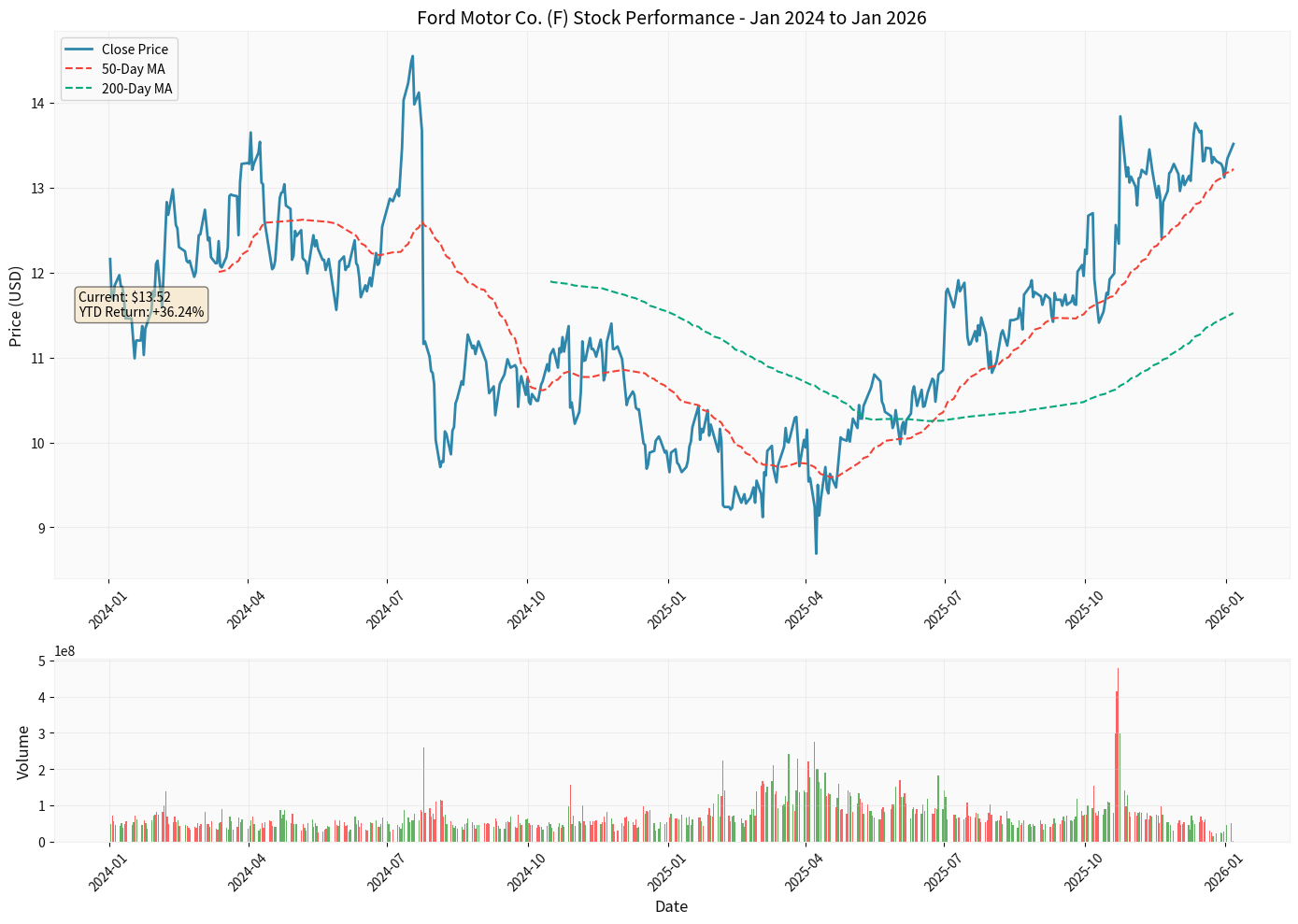
- Current Stock Price: $13.52, Market Capitalization: $52.89 billion[0]
- 2025 EBIT Outlook: Approximately $7 billion (after upward revision)[4]
Pickup Brand |
Market Share (Q3 2025) |
Year-Over-Year Change |
|---|---|---|
Ford F-Series |
37% |
+1 percentage point |
| Chevrolet Silverado | 24% | +1 percentage point |
| Ram Pickup | 15% | -1 percentage point |
| GMC Sierra | 15% | +1 percentage point |
| Toyota Tundra | 6% | -1 percentage point[1] |
The success of the F-Series is attributed to its
- Fuel-powered F-150/Super Duty: Accounts for 35% of total sales (ICE market share)
- All-Electric F-150 Lightning: Although it only holds a 2% market share, its Q3 2025 sales increased 40% year-over-year to 10,005 units, making it thebest-selling electric pickup in the U.S.[1]
- Hybrid Version: Will become a focus after the strategic adjustment
- Extremely High Customer Stickiness: Over 60% of pickup owners repurchase the same brand when replacing their vehicles
- Stable Commercial Customer Base: Industries such as construction, agriculture, and petroleum have a high dependence on the F-Series
- Pricing Power for Full-Size Pickups: Average selling price continues to rise, with 2025 models priced approximately 15% higher than 2024 models
- Super Duty Segment: Holds nearly 50% market share in the heavy-duty pickup segment
- Electric Transformation Pressure: Competitors (GM, Tesla) are rapidly launching electric pickups
- Fluctuations in Raw Material Costs: Fire at Novelis, the main aluminum supplier for F-Series body panels, impacts supply[7]
- Interest Rate Sensitivity: Pickup consumers are highly dependent on loans, and a high-interest-rate environment suppresses demand
- Launched in 2022 with massive initial attention, named 2023 Truck of the Year[2]
- Original price was $40,000, but the 2025 model’s price increased to $55,000, severely suppressing demand[2]
- Q3 2025 sales reached a peak of 10,005 units (up 40% year-over-year), surpassing Tesla Cybertruck’s 7,100 units[1]
Ford announced the
- Insufficient Profitability: The Lightning became a financial burden, with high production costs difficult to amortize through economies of scale[2]
- Lower-Than-Expected Demand: The company had predicted that U.S. EV penetration would reach 45% in 2025, but actual penetration is far below this forecast[3]
- Cancellation of Federal Tax Credits: Policy changes further weakened the appeal of EVs[4]
Ford announced the
Adjustment Item |
Amount |
Timeline |
|---|---|---|
| EV Asset Impairment | ~$19.5 billion | 2025-2027 |
| Cash Impact | $5.5 billion | Mainly 2026-2027 |
| Adjusted EBIT Outlook | $7 billion (2025) | Up from previous $6-$6.5 billion[4] |
-
Extended-Range Electric Pickup (EREV):
- Retain the Lightning name but adopt extended-range electric technology
- Combine a fuel engine and battery to address range anxiety
- Expected to launch in 2026
-
Hybrid-First Strategy:
- By 2030, 50% of global saleswill come from hybrid, extended-range electric, and all-electric vehicles (only 17% in 2025)[5]
- Learn from the Toyota model, using hybrid power as a transition solution for electrification[7]
- By 2030,
-
Low-Cost EV Platform:
- Develop a “Universal EV” platform, targeting the launch of affordable electric vehicles
- Start production of mid-size electric trucks in 2027, using LFP (lithium-iron-phosphate) batteries[7]
- Develop a “Universal EV” platform, targeting the launch of
-
Battery Energy Storage System (BESS) Business:
- Redirect part of the production capacity at BlueOval Battery Park Michigan to residential energy storage solutions
- Provide energy storage systems to commercial customers such as data centers[2, 7]
- This is an important initiative for Ford to diversify into energy services
- Redirect part of the production capacity at BlueOval Battery Park Michigan to
- Profit Contribution: Ford Blue (traditional fuel-powered vehicle business) contributesover 90% of operating profit
- Cash Flow Generation: The fuel-powered pickup business provides Ford with stable free cash flow, which reached$6.739 billionin 2024[0]
- Capital Efficiency: The ROI of the traditional pickup business is significantly higher than that of the EV business, with a return on equity (ROE) of 10.35%[0]
- P/E Ratio: 11.55x (current)[0]
- P/B Ratio: 1.14x[0]
- EV/OCF: 9.32x[0]
- Conservative Scenario: $87.45 (+549%)
- Base Scenario: $230.41 (+1,610%)
- Optimistic Scenario: $228.71 (+1,597%)
- Probability-Weighted Value: $182.19 (+1,252%)[0]
Note: The high premium in the DCF valuation reflects the strong cash flow generation capacity of Ford’s traditional business, but does not fully account for EV strategic risks
Time Period |
Contribution from Traditional Pickups |
Contribution from Electrification |
Valuation Drivers |
|---|---|---|---|
2024-2025 |
95% | 5% | Fuel vehicle profit margin, free cash flow |
2026-2028 |
80% | 20% | Hybrid sales, EREV acceptance |
2029-2030 |
60% | 40% | Low-cost EV platform scaling, BESS business |
- 2026: Launch of extended-range F-Series to test market acceptance
- 2027: Launch of mid-size electric truck, marking the start of low-cost EV strategy implementation
- 2029: Model e business targets profitability[4]
- Consensus Target Price: $12.00 (-11.2% from current price)[0]
- Rating Distribution:
- Buy: 31.8% (14 analysts)[0]
- Hold: 54.5% (24 analysts)[0]
- Sell: 13.6% (6 analysts)[0]
- EV transformation costs ($19.5 billion impairment) will pressure short-term earnings
- Traditional pickup market may be saturated, with limited growth potential
- Profitability path for electric vehicles remains unclear
- Upward revision of 2025 EBIT outlook indicates strong core business
- Hybrid strategy is more aligned with current market demand
- Ford Pro (commercial vehicle division) is growing rapidly, with higher profit margins than Ford Blue
- Traditional fuel-powered pickups continue to support valuation, with the F-Series’ market leadership position solid
- Stock Price Catalysts: 2026 launch of extended-range F-Series, growth in hybrid model sales
- Target Price: $14-$15 (based on 12x P/E, reflecting optimism about the hybrid strategy)
- Key to Valuation Restructuring: Whether the low-cost EV platform can be successfully scaled in 2027-2028
- BESS Business: If it successfully enters the data center energy storage market, it may become an important profit growth driver
- Risks and Opportunities Coexist: Successful transformation may drive the stock price back to $20+, while failure may push it below $10
- Electric Transformation Strategy Execution Risk: Extended-range and low-cost EV platforms may fail to meet expected sales volumes
- Increased Competition: Competitors such as Tesla Cybertruck, GM Silverado EV, and Rivian R1T continue to exert pressure
- Fluctuations in Raw Material Costs: Price fluctuations in aluminum, lithium, and battery raw materials impact profit margins
- High Leverage Level: Ford needs to invest huge amounts of capital in EV transformation, which may increase financial risks
- Sustained Losses in EV Business: When the Model e division will achieve profitability remains uncertain
- Interest Rate Environment: High-interest-rate environment suppresses auto demand, especially in the loan-dependent pickup market
- Fuel Vehicle Emission Regulations: Increasingly stringent emission standards may increase compliance costs
- Changes in EV Subsidy Policies: Uncertainty in federal and state-level policies
- Strong Cash Flow: Free cash flow of $6.739 billion provides financial support for transformation[0]
- Brand Value: The F-Series’ brand loyalty and market position cannot be easily shaken in the short term
- Ford Pro Growth: Commercial vehicle division has a profit margin of over 15%, becoming a new growth engine
- Dividend Yield: Current dividend yield is approximately 5%, providing stable returns for investors
- Market acceptance of the extended-range F-Series in 2026
- Proportion of hybrid models in total sales (target: 50% by 2030)
- Profitability path of the Model e division (target: profitability by 2029)
- Revenue contribution from the BESS business (to be reflected after 2027)
[0] Jinling API Data - Ford real-time quotes, company profile, financial analysis, DCF valuation, historical stock price data
[1] Ford Authority - “Ford F-Series Sales Up, Gaining Market Share In Q3 2025” (https://fordauthority.com/2025/12/ford-f-series-sales-numbers-figures-results-third-quarter-2025-q3/)
[2] Battery Technology Online - “Ford Ends F-150 Lightning, Rivals Tesla with BESS Plans” (https://www.batterytechonline.com/automotive-mobility/ford-ends-f-150-lightning-rivals-tesla-with-bess-plans)
[3] Fox Business - “Ford cuts electric F-150 Lightning production, takes $19.5B charge in strategic shift” (https://www.foxbusiness.com/markets/ford-cuts-electric-f-150-lightning-production-takes-19-5b-charge-strategic-shift)
[4] Ford Official News - “Reinvests in Trucks, Hybrids, Affordable EVs, Battery Storage” (https://www.fromtheroad.ford.com/us/en/articles/2025/ford-reinvests-trucks-hybrids-affordable-electric-vehicles)
[5] Design News - “Ford Unplugs F-150 Lightning EV, Pivots to Affordable Electric Vehicle Strategy” (https://www.designnews.com/automotive-engineering/ford-unplugs-f-150-lightning-ev-pivots-to-cheaper-evs)
[6] Auto Evolution - “2025 Sales Report: The Big Detroit Three Don’t Have the Podium All to Themselves Anymore” (https://www.autoevolution.com/news/2025-sales-report-the-big-detroit-three-don-t-have-the-podium-all-for-themselves-anymore-263658.html)
[7] Automotive Logistics - “Ford scraps F-150 Lightning, launches EREV in strategy shift” (https://www.automotivelogistics.media/ev-and-battery/ford-scraps-f150-lightning-in-favour-of-nextgeneration-hybrid-says-the-business-case-has-eroded/2578461)
Insights are generated using AI models and historical data for informational purposes only. They do not constitute investment advice or recommendations. Past performance is not indicative of future results.
About us: Ginlix AI is the AI Investment Copilot powered by real data, bridging advanced AI with professional financial databases to provide verifiable, truth-based answers. Please use the chat box below to ask any financial question.