
BrainCo's RMB 2 Billion Financing: Investment Insights for the Brain-Computer Interface Industry Chain and Enterprise Strategic Layout Logic
Unlock More Features
Login to access AI-powered analysis, deep research reports and more advanced features
About us: Ginlix AI is the AI Investment Copilot powered by real data, bridging advanced AI with professional financial databases to provide verifiable, truth-based answers. Please use the chat box below to ask any financial question.
Related Stocks
Based on public reports and online searches, BCI enterprise BrainCo recently completed approximately RMB 2 billion in financing, the second-largest single financing scale globally in this field after Neuralink [1]. The investor lineup shows obvious “cross-industry” and diversified characteristics, including:
- VC/PE institutions: IDG Capital, Walden International
- Apple supply chain enterprises: Lens Technology, Lingyi iTech
- Semiconductor enterprises: Will Semiconductor
- Education technology: TAL Education
Key information points behind this financing:
- Significant valuation differences between China and the US: Online searches show Neuralink is valued at approximately USD 12 billion, domestic BCI enterprises have an average valuation of about USD 300 million, BrainCo is valued at around USD 1.3 billion, and the single financing amount is also an order of magnitude different from Neuralink’s USD 650 million, reflecting differences in risk pricing and narrative logic between Chinese and US capital markets [1].
- Rising policy of China’s “patient capital”: The National Development and Reform Commission has launched a national venture capital guidance fund (20-year duration, 10-year investment period + 10-year exit period) and established three regional funds, emphasizing early-stage, small-scale, hard tech, and long-term investments, with BCI explicitly identified as a key support direction [2]. This means future domestic capital investment is expected to tilt toward earlier-stage, long-cycle hard tech, and BrainCo’s RMB 2 billion financing is a microcosm of this trend.
- Route selection: Non-invasive, focusing on dry electrode and electroencephalogram (EEG) signal acquisition to reduce surgical and ethical thresholds, targeting broader rehabilitation, education, and consumer groups [3].
- Core products and scenarios:
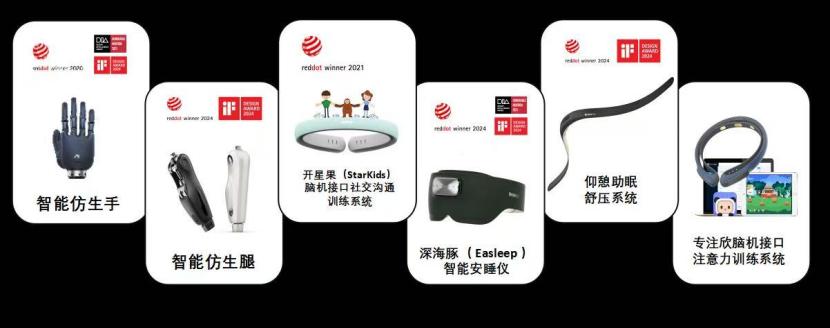
- Intelligent bionic series: Intelligent bionic hands (approved by the US FDA in 2022), bionic legs, etc., for disabled rehabilitation and assistance [3].
- Intelligent health series: Training systems for children with autism and attention deficit; wearable devices for sleep aid and mindfulness training for the general public [3].
- Scale and mass production: Public data shows BrainCo achieved mass production of approximately 100,000 units of a single BCI product in 2022, marking the scalability and mass production capability of the non-invasive route in the consumer sector [3].
- Complete technology stack: Self-developed electrode materials/dry electrodes + AI algorithms + multi-scenario application systems, forming an integrated hardware-software technical system [3].
- Data flywheel effect: Through cooperation with universities to establish strict data collection environments, accumulate high-quality, standardized labeled EEG datasets, and build a closed loop of “data → algorithm → product → user → data” [3]. This is particularly critical in the non-invasive path, as high-quality data acquisition is costly and time-consuming.
- Application structure: Among downstream applications, medical health accounts for approximately 56%, consumer electronics about 25%, education around 10%, industrial safety roughly 5%, and others 4% [4].
- Rhythm and risk: Medical scenarios have rigid demand and clear payment ends (hospital/medical insurance/device qualification paths are relatively clear), suitable for first-scale deployment; consumer scenarios have explosive potential but need to solve two critical points: “invisibility” and “rigidity” (e.g., wearing form and high-frequency刚需 functions) [1,4].
- Insight: Early investments should prioritize cutting into medical/rehabilitation fields with clear compliance paths and payment capabilities, while laying out underlying technology platforms that can extend to the consumer end.
- Market preferences: US capital is willing to pay higher premiums for “ultimate imagination space” and disruptive narratives (Neuralink’s valuation up to USD 12 billion); China currently emphasizes landing certainty and milestone verification [1].
- Changes in cooperation models: Capital and enterprises are moving toward “co-entrepreneurship”-style cooperation, i.e., reducing cognitive risks and building confidence through the achievement of pre-clinical/clinical key milestones [1].
- Insight: Domestic enterprises need to establish clear nodes and delivery paths between “long-term technical vision” and “verifiable phased milestones” to meet the integration needs of domestic risk preferences and policy guidance.
- Market share: Non-invasive products currently account for approximately 82% of the global BCI market, and their short-term dominant position is difficult to撼动 [1].
- Flexible deployment: Can be deployed in hospitals, communities, and home scenarios to achieve early, high-frequency interventions [1].
- Insight: Investment and R&D layout should重视 the comparative advantages of non-invasive routes in scalability, accessibility, and regulatory friendliness, especially in education, rehabilitation, and consumer scenarios targeting broader populations.
- High cost of high-quality data acquisition: Must be collected through professional processes in strict experimental environments to form dedicated datasets [3].
- Flywheel mechanism: Data → AI model optimization → experience upgrade → user growth → data re-iteration. This has formed a closed loop in BrainCo [3].
- Insight: Investments should focus on enterprises’ long-term investments in data collection infrastructure, annotation systems, and compliance, rather than just short-term hardware parameters or paper counts.
- National and regional guidance funds: Explicitly invest in early-stage, small-scale, hard tech, and long-term projects, covering key future industries such as BCI [2].
- Insight: Industrial investments can actively connect with national and regional guidance funds, form longer-cycle collaboration in investment and exit period matching, and take “milestone verification” as the core cooperation抓手.
- Lens Technology and Lingyi iTech have accumulated high-precision structural parts, modules, and process integration capabilities in consumer electronics (especially Apple supply chain), which have significant synergy with BCI devices (especially wearable forms) in structure, materials, lightweight, and ergonomics.
- Insight: Using mature precision manufacturing and large-scale mass production capabilities to reduce new product introduction (NPI) and ramp-up costs is the core advantage of Apple supply chain enterprises entering emerging hardware tracks.
- Reduce dependence on a single customer: By investing in cutting-edge directions such as BrainCo, diversify income concentration and establish new cross-cycle growth points.
- Extension of C-end scenarios: BCI wearable devices are highly compatible with next-generation terminal forms such as AR/VR, smart glasses, and headphones, in line with the long-term trend of consumer electronics toward “perception + interaction + health” integration [4].
- Insight: Against the backdrop of smartphone penetration peaking and AI hardware form diversification, Apple supply chain enterprises need to upgrade from “single manufacturing OEM” to “scene and platform-based manufacturing” to share the value growth of new hardware ecosystems.
- Apple supply chain enterprises have global brand endorsement, supply chain management, and global channel experience, which help accelerate BCI product certification, globalization, and mass production distribution.
- BCI highly relies on high-sensitivity, low-noise, and multi-channel signal acquisition chips/sensors (including EEG, near-infrared, photoelectric/chemical sensing, etc.) in both non-invasive and invasive paths.
- Will Semiconductor (OmniVision) has deep accumulation in image sensors (CIS) and analog/mixed-signal chips, and its signal chain, noise suppression, and low-power design capabilities can be transferred to EEG/neural signal processing chips.
- Future BCI will emphasize multi-modal perception (EEG + NIRS + eye movement + physiological signals) and localized reasoning. Will’s visual/sensing technology combined with edge AI processing is expected to support integrated “sensing + computing” solutions, improving real-time performance and privacy.
- Through ecological cooperation with enterprises such as BrainCo, Will can layout in advance on proprietary EEG/neural signal processing algorithms and dedicated circuit IP, integrating “hardware + algorithm + data” into more differentiated solutions.
- Priority layout: Medical health (rehabilitation devices, neurological disease intervention), non-invasive consumer-grade wearables, dedicated signal processing chips, and multi-modal fusion algorithms.
- Focus indicators: Milestone clinical progress, product mass production and installation volume, high-quality dataset scale and compliance, medical insurance/payment progress.
- Industrial synergy: Look for targets with four-fold synergy of manufacturing/process/chip/scene; BrainCo’s financing case is a composite model of “industry chain extension + technical synergy + scene application”.
- Technical path uncertainty: Invasive/semi-invasive have better long-term performance and clinical value, but higher regulatory and safety thresholds; non-invasive is easier to scale in the short term but has limited functional ceilings.
- Regulatory and ethical risks: Devices involving implantation and neural signal acquisition require strict approval; ethical and privacy reviews may affect product landing rhythm [1].
- Commercialization verification: Most products are still in the early stage of transitioning from “interesting” to “useful”; user retention and payment willingness still need time to verify [1].
- Capital market fluctuations: Significant differences in valuation and financing rhythm between China and the US; domestic markets need to continuously observe the efficiency of “patient capital” deployment and exit environment.
BrainCo’s RMB 2 billion financing event is not only an important milestone in the domestic BCI track but also reveals the underlying logic of Apple supply chain and semiconductor enterprises extending to emerging cutting-edge hardware: relying on precision manufacturing, chip design, and scene resources to layout the next-generation “perception-computation-interaction” integrated terminal form. Under the pragmatic path of “medical first, consumer follow”, enterprises with complete technology stacks, high-quality data flywheels, and clear milestone delivery capabilities are more likely to stand out with long-term support from policies and “patient capital”.
[0] Jinling API Data (Luxshare Precision 002475.SZ, Will Semiconductor 603501.SS company overview, real-time quotes; industry sector and market index data)
[1] Brain-Computer Interface Targets Key Leap (Liaowang/Xinhua News, 2025-12-29) — Reports on Neuralink and BrainCo valuations, financing scales, and Sino-US differences; non-invasive market share and medical/consumer commercialization paths; judgment on “invisibility” and “rigidity” critical points for consumer products.
[2] China Launches National and Three Regional Venture Capital Guidance Funds to Patiently Cultivate Hard Tech Little Giants (Yahoo Hong Kong Finance, reprinted from Bloomberg) — Details of national guidance funds and regional fund establishment; investment direction statements for key areas such as integrated circuits, quantum technology, and BCI.
[3] BrainCo (BrainCo) Technical Path, Product Line, and Mass Production Scale — Non-invasive route; self-developed dry electrode/solid gel electrode materials; AI algorithms and data flywheel; FDA approval of intelligent bionic hands; mass production scale of approximately 100,000 units of a single product in 2022.
[4] Brain-Computer Interface 2025: Policy Orientation, Technical Breakthrough, Capital Influx into Medical First Landing (Sina Finance/Phoenix Finance, 2026-01-01) — 2030 market size forecast; downstream application structure (medical 56%, consumer, industrial, education); non-invasive health consumer potential analysis.
Insights are generated using AI models and historical data for informational purposes only. They do not constitute investment advice or recommendations. Past performance is not indicative of future results.
About us: Ginlix AI is the AI Investment Copilot powered by real data, bridging advanced AI with professional financial databases to provide verifiable, truth-based answers. Please use the chat box below to ask any financial question.