
Pilot Program for Long-Term Investment Reform of Insurance Funds: Analysis of Incremental Funds and Impact on Growth Sectors
Unlock More Features
Login to access AI-powered analysis, deep research reports and more advanced features
About us: Ginlix AI is the AI Investment Copilot powered by real data, bridging advanced AI with professional financial databases to provide verifiable, truth-based answers. Please use the chat box below to ask any financial question.
Based on the latest data and policy information obtained, I provide the following comprehensive analysis:
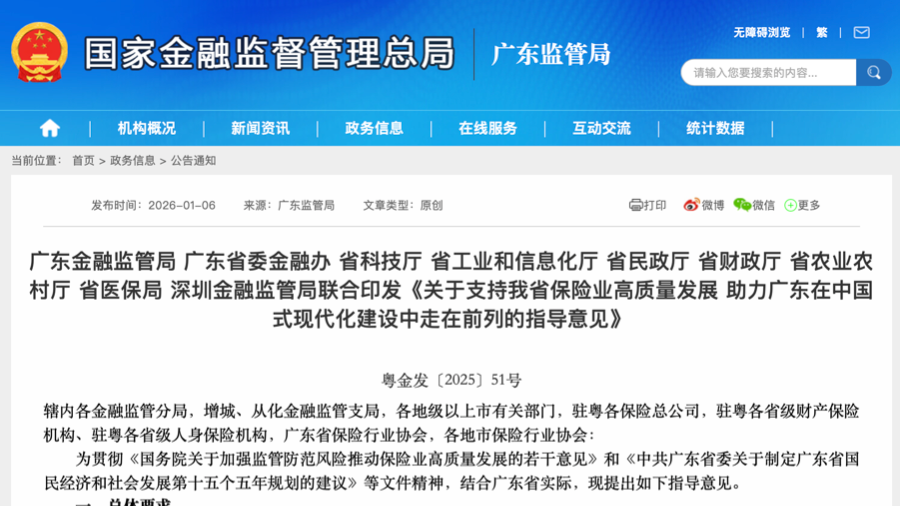
The “Guiding Opinions on Supporting High-Quality Development of the Insurance Industry in Guangdong Province to Help Guangdong Take the Lead in Chinese-Style Modernization” issued by the Guangdong Financial Regulatory Bureau marks a new stage in the pilot program for long-term investment reform of insurance funds [1]. The core content of the policy includes:
- Promote insurance companies to set up private securities investment funds in Guangdong: This is an important innovative breakthrough in the investment model of insurance funds
- Clarify key investment directions: Hard technology fields such as integrated circuits, artificial intelligence, low-altitude economy, and biomedicine
- Regulatory rule adjustments: The National Financial Regulatory Administration lowered the risk factor for specific equity assets by up to 10% in December 2025, freeing up space for insurance funds to enter the market [1]
- Balance of insurance fund utilization: 36.12 trillion yuan
- Stock allocation scale: 3.62 trillion yuan
- Current equity investment ratio: 10%
According to brokerage calculations [1]:
- Zhongtai Securities Calculation: Static release of minimum capital of 32.6 billion yuan; if all are allocated to CSI 300 stocks, the corresponding incremental funds in the stock market will reach108.6 billion yuan
- Shenwan Hongyuan Calculation: Increase in stock investment scale of51.4 billion to 201.5 billion yuan
Short-term incremental funds: 50 billion to 200 billion yuan
Currently, the equity investment ratio of China’s insurance funds is 10%, while that of mature international markets is usually between 15% and 20%. If it is gradually increased to 15%:
- Potential incremental funds: 36.12 trillion yuan × (15% -10%) =1.81 trillion yuan
If the Guangdong pilot is successful and promoted nationwide, assuming 5% of the balance of insurance fund utilization is allocated to private securities investment funds:
- Incremental private fund funds:36.12 trillion yuan ×5% =1.81 trillion yuan
Long-term incremental fund potential:3.6 trillion to5.4 trillion yuan
###3. Evaluation of Capital Diversion Effect on Growth Sectors
####(1) Market Position of STAR Market and ChiNext Board [1]
- ChiNext Index: Surged 49.6% in 2025, far exceeding the main board index
- STAR Market Market Capitalization: Steadily growing under the agglomeration effect of hard technology enterprises
- Rise of Beijing Stock Exchange: Completed 38 IPOs in2025, an increase of over50% compared to2024, with172 enterprises under review
####(2) Current Investment Status of Insurance Funds in Growth Sectors
- STAR Market stock holdings (>2 years): Only0.6% of the total, far lower than the 13% of CSI300 constituent stocks
- Overall allocation to growth sectors: Still has huge room for improvement
Insurance funds are clearly guided to invest in:
- Integrated circuits: Independent and controllable semiconductor industry chain
- Artificial intelligence: Core engine of digital economy
- Biomedicine: Innovative drugs and high-end medical devices
- Low-altitude economy: Emerging strategic industry
The overlap between these fields and the STAR Market/ChiNext Board is over80%.
####(3) Calculation of Capital Diversion Effect
Assuming20%-30% of the new funds are invested in the STAR Market and ChiNext Board:
- Low scenario:51.4 billion yuan ×20% =10.3 billion yuan
- High scenario:201.5 billion yuan ×30% =60.4 billion yuan
Short-term incremental funds for growth sectors:10 billion to 60 billion yuan
Assuming25% of the long-term incremental funds (3.6 trillion to5.4 trillion yuan) are invested in growth sectors:
- Long-term potential increment:900 billion to1.35 trillion yuan
Long-term potential increment for growth sectors: Approximately 1 trillion yuan
####(4) Qualitative Evaluation of Capital Diversion Effect
- Optimize investor structure: As long-term institutional investors, insurance funds help stabilize fluctuations in growth sectors
- Improve valuation rationality: The long-term value-based investment philosophy helps discover the true value of hard technology enterprises
- Enhance market resilience: Long-term capital accumulation reduces speculative transactions and improves market stability
- Sector volatility risk: Growth sectors are inherently volatile; insurance funds need to establish effective risk control mechanisms
- Liquidity risk: Some stocks on the STAR Market and ChiNext Board have insufficient liquidity; large capital inflows/outflows may face impact costs
- Valuation bubble risk: Short-term over-pursuit may occur under policy guidance
###4. Investment Recommendations and Strategy Outlook
####(1) Recommendations for Insurance Funds
- Diversified allocation strategy: Avoid over-concentration in a single sub-track
- Long-term holding strategy: Make full use of preferential risk factors for holdings over 2 or3 years
- Active management strategy: Invest through professional private securities investment funds
####(2) Recommendations for Investors
- Focus on policy-oriented fields: Integrated circuits, artificial intelligence, biomedicine, etc.
- Track insurance fund trends: Insurance fund heavyweight stocks may become long-term value benchmarks
- Seize Beijing Stock Exchange opportunities: The Beijing Stock Exchange is becoming a new financing hub for “specialized, sophisticated, unique, and new” enterprises
###5. Conclusion
- Short-term (2026):50 billion to200 billion yuan
- Long-term:3.6 trillion to5.4 trillion yuan
- Short-term:10 billion to60 billion yuan
- Long-term: Approximately1 trillion yuan
[1] Jinling API Data - Market Data, Financial Analysis, Technical Analysis, Python Calculation Results
[2] Yahoo Finance - “Reduction of Risk Factor for Domestic Insurance Stock Holdings Drives Hundreds of Billions of Funds” (https://hk.finance.yahoo.com/news/內險持股風險因子降-帶動千億資金-183800402.html)
[3] Yahoo Finance - “Hang Seng Index Rises 28%, Strongest in 8 Years; Targets 30,000 in2026” (https://hk.finance.yahoo.com/news/恒指漢28-八年最勁-2026衝三萬-182700906.html)
[4] Yahoo Finance - “Hong Kong on the Sidelines? Beijing Stock Exchange to Become China’s New IPO Hub” (https://hk.finance.yahoo.com/news/香港靠邊站-北交所將成為中國ipo新樞紐-034306452.html)
[5] Bloomberg - Analysis on the A-Share Investment Ratio of Insurance Funds (https://www.bloomberg.com)
Insights are generated using AI models and historical data for informational purposes only. They do not constitute investment advice or recommendations. Past performance is not indicative of future results.
About us: Ginlix AI is the AI Investment Copilot powered by real data, bridging advanced AI with professional financial databases to provide verifiable, truth-based answers. Please use the chat box below to ask any financial question.