
Can the Heterogeneous Computing Power Scheduling Platform Become a New Growth Driver in the AI Infrastructure Track? ——In-depth Analysis of Migua Intelligence's HAMi Open Source Ecosystem Model
Unlock More Features
Login to access AI-powered analysis, deep research reports and more advanced features
About us: Ginlix AI is the AI Investment Copilot powered by real data, bridging advanced AI with professional financial databases to provide verifiable, truth-based answers. Please use the chat box below to ask any financial question.
Your question involves two key dimensions:
- Technical Dimension: Can the heterogeneous computing power scheduling platform become a core growth driver in the AI infrastructure track?
- Business Dimension: Can HAMi’s open source ecosystem model replicate VMware’s successful path in the CPU virtualization era?
According to the latest market data, China’s AI infrastructure platform market is experiencing
- Market Size: In 2024, China’s AI Infra platform market size reached3.45 billion yuan, and it is expected to jump to6.73 billion yuanin 2025, with a year-on-year growth rate of95.1%[2]
- Computing Power Management Layer: Accounts for 64.6% of the AI Infra platform market, being the main component
- Policy Driver: Domestic substitution accelerates, GPU virtualization and heterogeneous computing power scheduling become rigid demands[3]
- Moore Threads, Muxi, Cambricon, etc., have been listed or passed the Hong Kong Stock Exchange hearing
- The localization rate of China’s general-purpose GPU market increased from 2% in 2022 to 3.6% in 2024, and is expected to exceed 50%by 2029[4]
- However, the market share of each manufacturer is small (Muxi about 1%, Moore Threads and Biren Technology less than 1%), and the market is highly fragmented[4]
-
Severe fragmentation of heterogeneous chip ecosystem:
- There are many domestic GPU manufacturers (Huawei Ascend, Muxi, Moore Threads, Cambricon, etc.), but the software stacks are not unified
- Different chips have huge differences in architecture design and software stacks, significantly increasing the complexity of unified training and scheduling[5]
- Leading enterprises like SenseTime and Baidu Smart Cloud need to adapt to multiple chips simultaneously, leading to high system complexity
-
Low GPU resource utilization:
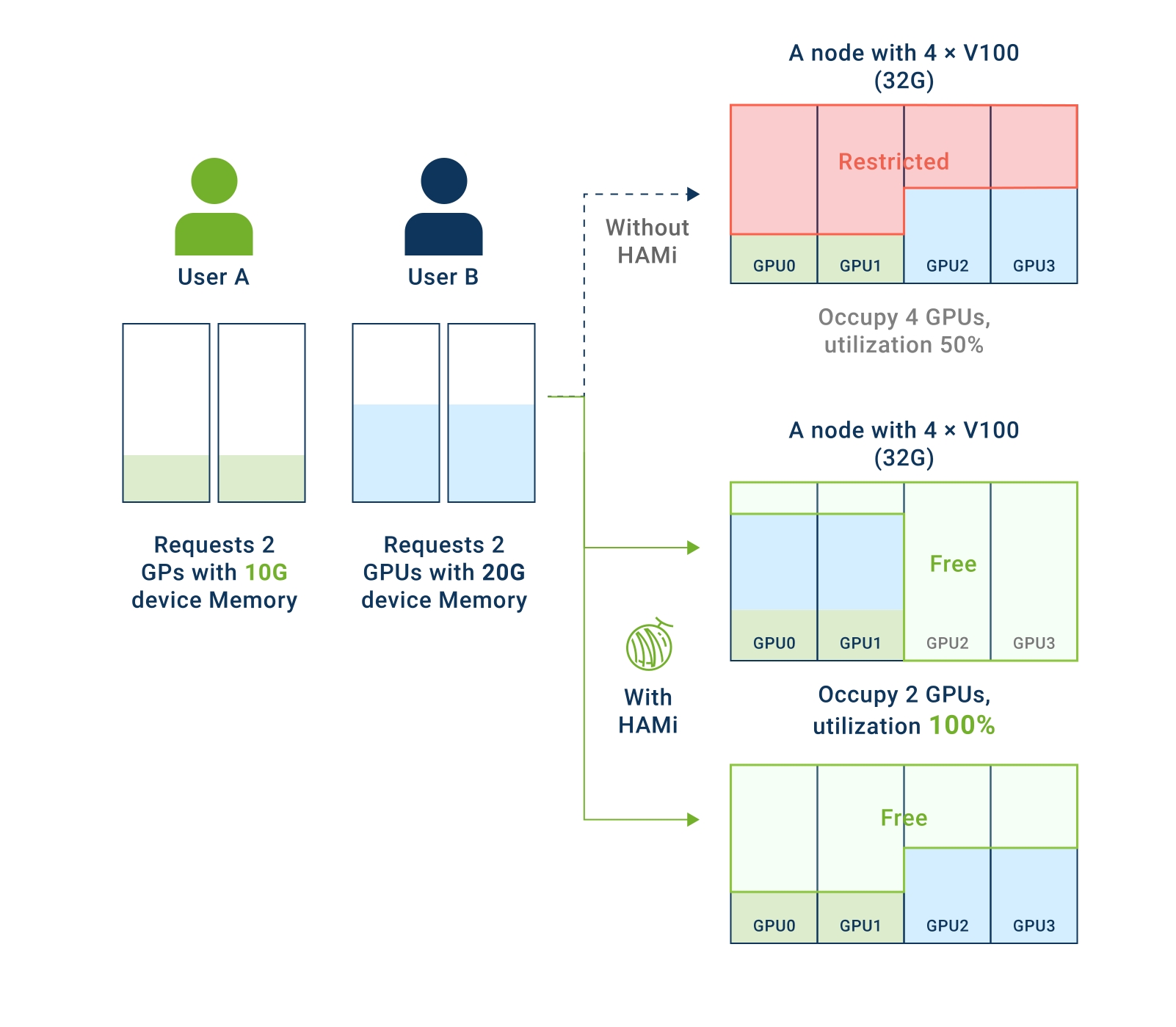
- Traditional Kubernetes Device Plugin only supports static GPU allocation, which monopolizes the entire card once assigned to a Pod[6]
- Small-scale inference tasks may only require partial memory or computing power, but monopolizing the entire GPU leads to resource waste
- Industry data shows that after adopting HAMi, GPU utilization can increase from 60% to over 90%[1]
- Traditional Kubernetes Device Plugin only supports
-
Huge cost pressure:
- Using the special chip H20 to complete the same scale of AI training requires 40%-60% more computing timeandover 35% higher power costcompared to H100[3]
- The Frost & Sullivan report points out that China’s GPU cloud market has entered a new stage of “usable, easy to use, and sustainable”, and the competition focus has shifted from single hardware performance to full-stack capability[3]
- Using the special chip H20 to complete the same scale of AI training requires
According to industry report analysis:
- 2024: 3.45 billion yuan
- 2025: 6.73 billion yuan (95.1% growth)
- The computing power management layer accounts for 64.6%, which is about 4.35 billion yuanin 2025[2]
- Frost & Sullivan report shows that China’s self-developed GPU cloud market has entered the “10,000-card era”[3]
- The global GPU cloud computing market is expected to reach 47.24 billion US dollarsby 2033, with a CAGR of35%from 2025 to 2033[3]
| Type | Representative Enterprises | Core Products | Advantages | Disadvantages |
|---|---|---|---|---|
| Cloud Vendor Self-developed | Alibaba Cloud cGPU, Tencent Cloud qGPU | Internal solutions of cloud vendors | Deep integration with cloud services, deep technical accumulation | Mainly serve own cloud customers, weak cross-cloud support |
| Professional AI Infra Vendors | SenseTime Large Device, Baidu Baige | End-to-end AI computing power platform | Full-stack capability, scenario-based solutions | Closed ecosystem, limited chip adaptation |
| Open Source Project | HAMi | Heterogeneous computing power virtualization middleware | Open source ecosystem, cross-chip compatibility, community-driven | Commercialization path not yet verified |
| Virtualization Vendors | QingCloud ZStack AIOS | Full-stack AI Infra platform | Enterprise-level virtualization experience | Focus on private cloud, weak cross-cloud capability |
- CNCF Certification: The world’s only CNCF project focusing on heterogeneous computing power virtualization[1]
- Cross-chip Compatibility: Supports more than 9 chips including NVIDIA, Huawei Ascend, Muxi, Moore Threads, Cambricon
- Cloud-native Architecture: Based on Kubernetes, naturally compatible with the cloud ecosystem
- Team Background: The founding team comes from DaoCloud and 4Paradigm, and are core contributors to Kubernetes
-
Technical Leadership:
- Solved the hardware virtualization problem of x86 architecture in the early stage
- ESXi hypervisor performance is close to native, laying the foundation for enterprise adoption
-
Business Model:
- Enterprise-level subscription services: Product combinations like vSphere and vCenter
- Tiered pricing: Gradient pricing from free version to enterprise-level functions
- Service ecosystem: Certified training, partner network
-
Ecosystem Construction:
- Deep integration with hardware manufacturers (servers, storage, networks)
- Established a huge technical partner network
- Open Source Core: HAMi’s core functions are provided for free in open source
- Enterprise Value-added Services:
- Enterprise-level technical support
- Advanced function modules (such as deep monitoring, automated operation and maintenance)
- Private deployment and customized services
- Training and consulting services
- Use community power to accelerate product development and innovation
- Reduce market promotion costs; open source itself is a powerful marketing tool
- Improve product transparency and credibility, facilitating security audits
- Avoid vendor lock-in, enhance user trust
- Cultivate developer ecosystem, expand potential user base[8]
- Uncertain commercialization path, need to balance open source and commercial interests
- Difficult to divide the boundary between core functions and value-added functions
- Face competition from cloud service providers, may be “hijacked”
- Complex open source community management, requiring professional teams to maintain[8]
| Dimension | VMware | HAMi | Similarity |
|---|---|---|---|
| Technical Positioning | CPU Virtualization Layer | GPU Virtualization Layer | ⭐⭐⭐⭐⭐ |
| Architecture Position | Infrastructure Layer | Infrastructure Layer | ⭐⭐⭐⭐⭐ |
| Business Model | Enterprise-level Subscription | Open Core + Enterprise Services | ⭐⭐⭐ |
| Ecosystem Dependence | Hardware/Software Ecosystem | Chip/Cloud Ecosystem | ⭐⭐⭐⭐ |
-
Changes in Technical Environment:
- VMware Era: Enterprise data centers were mainstream, private deployment was the mainstay
- HAMi Era: Public cloud, hybrid cloud, and multi-cloud have become mainstream, making cross-cloud scheduling more complex
-
Different Competitive Landscape:
- VMware Era: Few competitors, high technical threshold
- HAMi Era: Cloud vendors’ self-developed solutions are strong (Alibaba cGPU, Tencent qGPU), and competition is more intense
-
Maturity of Open Source Ecosystem:
- VMware Era: Open source ecosystem was not mature
- HAMi Era: CNCF/K8s ecosystem is mature, and open source has become the mainstream development model[9]
-
Different Market Rhythms:
- VMware: It took more than 10 years to reach mature commercialization
- HAMi: AI development is extremely fast, requiring faster commercial verification
-
Clear Technical Rigid Demand:
- Heterogeneous computing power scheduling is a bottleneck problem for AI industry implementation
- Strong customer pain points: Low resource utilization, high cost, complex management
- Leading enterprises like SenseTime and Baidu have verified market demand[5]
-
Open Source Ecosystem Advantages:
- CNCF certification provides community trust endorsement
- Kubernetes ecosystem is mature, easy to integrate
- Open source model can quickly accumulate users and developer communities
-
Driven by Domestic Substitution Policy:
- GPU domestic substitution accelerates, requiring a unified scheduling platform
- Key industries like finance and government have high requirements for independent controllability
- Policy orientation supports domestic AI infrastructure construction
-
Team Gene Matching:
- DaoCloud background: Deep accumulation of cloud-native technology
- 4Paradigm background: AI enterprise service experience
- Kubernetes core contributors: Technical authority
- Obtained 2 million yuan product order contractswithin one quarter of establishment (customers include SF Technology, Vietnam PREP EDU)
- Completed angel round financing of tens of millions of yuan, led by Fosun Capital[1]
-
Complexity of Cross-chip Adaptation:
- Large differences in GPU architectures (NVIDIA CUDA vs. Huawei CANN vs. domestic chips)
- High difficulty in performance optimization and stability assurance
- Need to continuously adapt to new chips (such as Muxi, Moore Threads, Iluvatar CoreX)
-
Performance Overhead Problem:
- GPU virtualization itself brings certain performance loss
- Time slice scheduling has a greater impact on performance
- Need to balance isolation and performance
-
Cluster Scale Challenge:
- The scheduling complexity increases exponentially from single cluster to 10,000-card cluster
- The stability of cross-domain training is a key variable[5]
- Need to support large-scale commercial deployment
-
Competition from Cloud Vendors:
- Alibaba Cloud cGPU and Tencent Cloud qGPU are mature and deeply integrated with cloud services
- Cloud vendors may choose self-development instead of third-party solutions
- HAMi needs to position itself as a “multi-cloud neutral” scheduling platform
-
Open Source Monetization Path:
- How to draw the boundary between open source core and enterprise version functions?
- How to avoid cloud vendors “free-riding” open source code?
- Can the subscription model support continuous R&D investment?
-
Long Ecosystem Construction Cycle:
- Need to establish deep cooperation with various chip manufacturers (such as completing compatibility certification with Muxi GPU[10])
- Need to cultivate developer communities and technical partners
- Need to establish industry benchmark customer cases
-
High Customer Education Cost:
- Heterogeneous computing power scheduling is a new concept, requiring market education
- Customers may choose to wait for cloud vendors’ solutions instead of independent procurement
-
Maturity of Domestic GPUs:
- Domestic GPU product performance has not yet拉开明显差距[4]
- Small market share, immature ecosystem
- Dependent on the rise of domestic GPUs
-
Profit Pressure:
- Angel round financing of tens of millions of yuan, but huge R&D and ecosystem investment
- Need to achieve product-market fit before funds are exhausted
- The initial 2 million yuan order proves demand, but needs to be scaled
Based on analysis, HAMi needs to:
- Quickly launch stable enterprise version products
- Establish industry benchmark customer cases (finance, government, large model companies)
- Improve core chip adaptation (NVIDIA, Huawei Ascend, Muxi)
- Achieve ten-million-level ARR (Annual Recurring Revenue)
- Build developer community and partner ecosystem
- Support more than 10 chips, covering mainstream domestic GPUs
- Realize unified scheduling across clouds and clusters
- Reach 100 million-level commercial revenue
- Become the de facto standard for heterogeneous computing power scheduling
- Establish an open source ecosystem similar to CNCF
- Explore internationalization (such as cooperation with Vietnam PREP EDU[1])
- Consider IPO or acquisition by strategic investors
- ✅ Huge market space and rapid growth (AI Infra platform is expected to grow by 95.1% in 2025, and the computing power management layer accounts for 64.6%[2])
- ✅ Clear technical rigid demand, strong pain points
- ✅ Open source ecosystem model has been verified by Red Hat
- ✅ Excellent team background, Kubernetes core contributors
- ✅ Initial customer verification, strong technical feasibility
- ✅ CNCF certification provides authoritative endorsement
- ⚠️ Fierce competition from cloud vendors, may be marginalized
- ⚠️ Risk of domestic GPU development falling short of expectations
- ⚠️ Open source monetization path not yet verified
- ⚠️ Need continuous large-scale R&D investment
- ⚠️ Long ecosystem construction cycle, difficult to profit in the short term
- Growth of GitHub Stars and Contributors
- Number of supported chips and adaptation quality
- Community activity and Issue response speed
- ARR (Annual Recurring Revenue) growth rate
- Customer retention rate and NRR (Net Revenue Retention)
- Number of benchmark customers (especially leading cloud vendors and large model companies)
- Number of partners (chip manufacturers, cloud vendors, ISVs)
- Size of developer community
- Completeness of technical certification and training system
Reasons are as follows:
- The AI Infra platform market is expected to grow by 95.1% in 2025, and the computing power management layer accounts for 64.6%[2]
- Heterogeneous computing power scheduling is the key technology to solve low GPU resource utilization (60%→90%+)[1]
- Domestic GPU substitution accelerates, requiring a unified scheduling platform to support (localization rate exceeds 50% by 2029)[4]
- Leading enterprises like SenseTime and Baidu have verified market demand[5]
Reasons are as follows:
-
Replicable Elements:
- Technical positioning: Virtualization middleware at the infrastructure layer
- Business model: Open core + enterprise services
- Ecosystem construction: Partner network and certification system
-
Elements That Need Adjustment:
- Shift from private deployment to cloud-native and multi-cloud architecture
- Shift from enterprise-level subscription to more flexible SaaS/hybrid models
- Shift from closed ecosystem to open source community-driven
- Accelerate commercial rhythm (AI era develops much faster than virtualization era)
-
Success Probability Evaluation:
- Technical feasibility: ⭐⭐⭐⭐ (4/5)
- Market demand: ⭐⭐⭐⭐⭐ (5/5)
- Team capability: ⭐⭐⭐⭐ (4/5)
- Business model: ⭐⭐⭐ (3/5)
- Competitive environment: ⭐⭐ (2/5)
- Comprehensive Score: ⭐⭐⭐⭐ (4/5) - Has good potential for success
HAMi is in a
- Establish industry benchmark cases within 12-18 months
- Rapidly expand open source community influence
- Establish
Insights are generated using AI models and historical data for informational purposes only. They do not constitute investment advice or recommendations. Past performance is not indicative of future results.
About us: Ginlix AI is the AI Investment Copilot powered by real data, bridging advanced AI with professional financial databases to provide verifiable, truth-based answers. Please use the chat box below to ask any financial question.