
Analysis of Cost Control Advantages of Apollo Go Autonomous Driving
Unlock More Features
Login to access AI-powered analysis, deep research reports and more advanced features
About us: Ginlix AI is the AI Investment Copilot powered by real data, bridging advanced AI with professional financial databases to provide verifiable, truth-based answers. Please use the chat box below to ask any financial question.
Related Stocks
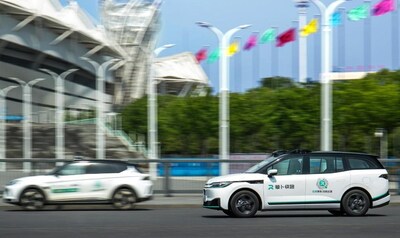
Based on the collected data, I will conduct a professional analysis of the cost control advantages and sustainability of Apollo Go’s autonomous driving.
The procurement price of Apollo Go’s 6th-generation autonomous vehicle, Yichi 06, is only
According to research data from Huaxin Securities, Apollo Go’s
- Vehicle cost depreciation: 112 yuan/day
- Energy replenishment cost: 113.75 yuan/day
- Operating cost: 61 yuan/day
- Maintenance and component replacement: 10.61 yuan/day
- Insurance costs: 11 yuan/day
The
Apollo Go plans to complete the deployment of
- The cost of the 7th-generation model is expected to further decrease
- Baidu Apollo ADFM large model improves autonomous driving efficiency
- The efficiency of the human-vehicle cabin continues to improve, and service costs are expected to decrease by 80% [2]
On June 30, 2024, Beijing issued the “Beijing Autonomous Driving Vehicle Regulations (Draft for Comments)”, which for the first time provides comprehensive and systematic support for the development of autonomous driving [1]. Since June 2022, Wuhan has gradually opened test roads and issued test licenses, providing a favorable operating environment for Apollo Go.
Apollo Go is the
Autonomous driving involves public safety, so there is a high possibility of stricter policy supervision. Attitudes towards autonomous driving may vary across cities, and nationwide promotion faces policy coordination challenges.
Autonomous driving needs to handle massive urban road scenarios, and continuous improvement of technical safety requires significant R&D investment. Any safety accident may affect public trust and regulatory policies.
- Traditional ride-hailing platforms may enter the autonomous driving field
- Tesla announced that it will release its Robotaxi on August 8, 2024 [1]
- Competitors such as Pony.ai and WeRide continue to make efforts
Although it is expected to achieve break-even in Wuhan by the end of 2024 and fully enter the profit period in 2025, this forecast is based on the continuous improvement of existing operational efficiency. Whether profitability can be maintained during large-scale expansion still needs to be verified.
- Cost control of the 7th-generation and subsequent models
- Operational efficiency of new city expansion
- Changes in the competitive landscape
Overall, Apollo Go has a high probability of maintaining its cost control advantage over the next 2-3 years, thanks to Baidu Apollo’s technical accumulation, China’s well-developed supply chain advantages, and first-mover advantages. However, the long-term sustainability requires continuous attention to the speed of technological iteration, policy environment, and changes in the competitive landscape.
[1] Huaxin Securities - Apollo Go Robotaxi Orders Surge, Expected to Gradually Achieve Regional Profitability (https://pdf.dfcfw.com/pdf/H3_AP202407121637816669_1.pdf)
[2] Huaxin Securities - Outlook on the Business Model of Robotaxi (https://pdf.dfcfw.com/pdf/H3_AP202409201639951334_1.pdf)
[3] Yahoo Finance - Baidu’s Apollo Go Robotaxi Seeks to Enter Australia (https://hk.finance.yahoo.com/news/百度旗下萝卜快跑无人驾驶出租车寻求进军澳大利亚和-011358303.html)
Insights are generated using AI models and historical data for informational purposes only. They do not constitute investment advice or recommendations. Past performance is not indicative of future results.
About us: Ginlix AI is the AI Investment Copilot powered by real data, bridging advanced AI with professional financial databases to provide verifiable, truth-based answers. Please use the chat box below to ask any financial question.