
Food Delivery Platforms' 100 Billion Subsidy Battle for Riders: Analysis of the Critical Point of Traffic Conversion Efficiency
Unlock More Features
Login to access AI-powered analysis, deep research reports and more advanced features
About us: Ginlix AI is the AI Investment Copilot powered by real data, bridging advanced AI with professional financial databases to provide verifiable, truth-based answers. Please use the chat box below to ask any financial question.
Related Stocks
In 2025, China’s food delivery market experienced an unprecedented ‘Three Kingdoms’ landscape reshaping. JD.com entered the market high-profile in February with ‘quality food delivery’, completely breaking the long-standing duopoly between Meituan and Ele.me [1]. The core of this battle has gone beyond simple food delivery order competition, extending to a comprehensive game of the instant retail ecosystem.
| Platform | Q3 Marketing Expense Increase | Annual Consumption Estimate | Strategic Positioning |
|---|---|---|---|
| Meituan | +16.3 billion yuan (YoY +90.9%) | ~40 billion+ | Defensive Offense, Full-domain Defense |
| Alibaba (Taobao Flash Purchase + Ele.me) | No less than Meituan | ~30 billion+ | Traffic Reuse, Ecosystem Synergy |
| JD.com | Key Investment | ~20 billion+ | Quality Breakthrough, Supply Chain Integration |
Total |
61.4 billion yuan |
Nearly 100 billion |
— |
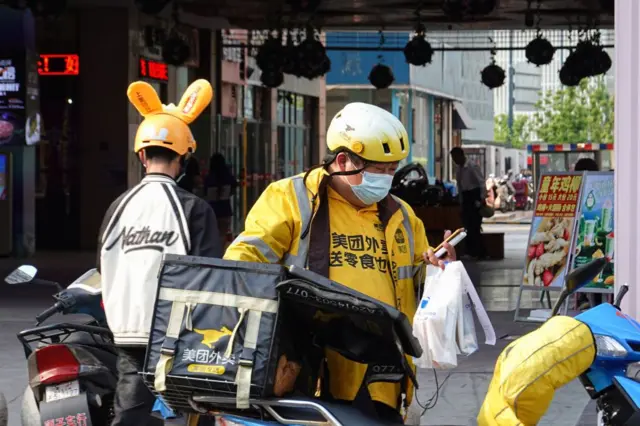
- Meituan: Provides a 2888 yuan reward to riders from competing platforms with monthly orders ≥720 and delivery punctuality rate ≥95%
- Taobao Flash Purchase: Offers a 3000 yuan reward + 1000 yuan referral bonus to riders who complete over 140 orders across multiple platforms
- : Full-time rider scale exceeds 150,000; first platform to pay five social insurances and housing fund for riders
The current food delivery industry is standing at the
| Indicator | Trend | Critical Point Interpretation |
|---|---|---|
| Per-order Profit | Continuously Compressed | Diminishing Marginal Benefits of Subsidies |
| User Acquisition Cost (CAC) | Exponentially Rising | Traffic Dividend Exhaustion |
| Rider Retention Cost | Significantly Climbing | Capacity Competition Enters Stock Game |
- Cost Transfer Chain: High platform subsidies → Profit compression → Transfer costs via increasing merchant commissions, raising delivery fees, etc.
- Distorted Consumption Habits: Massive subsidies lead to waste; consumers form ‘1 yuan purchase’ inertial expectations
- Merchant Profit Erosion: Some merchants cut costs on ingredients due to low-price sales, with quality and service giving way
- Meituan’s core local business turned from profit to loss in Q3, with operating loss reaching 14.1 billion yuan and operating loss rate of 20.9%
- Alibaba’s instant retail business revenue increased by 60% YoY, but adjusted EBITA decreased by 78% YoY
- The ratio of merchant dine-in to takeout changed from ‘50-50’ to ‘20-80’, with dine-in severely squeezed
Facing the critical point, each platform chose different response strategies [1][2][3]:
- Strengthen履约 network advantages, maintain 34-minute average delivery time relying on over 7 million active riders
- Promote commercialization of drone delivery, completing over 670,000 commercial orders累计
- Extend to full-category instant retail, with daily order peak exceeding 150 million in July
- High customer unit price order advantage: Orders with actual payment over 30 yuan account for over 70%
- Upgrade Ele.me to Taobao Flash Purchase, driving core e-commerce growth with high-frequency food delivery
- Integrate full-category ecosystem to achieve efficient traffic reuse
- Focus on full-category instant retail ecosystem of digital Shopping Mall
- Model innovation of 7Fresh Kitchen and pre-cut vegetable supply chain
- Super supply chain logic: Full-link integration from ingredient procurement, central kitchen to end delivery
- Five social insurances and housing fund system for riders enhances brand social reputation
Chen Liteng, analyst at NetEase E-commerce Research Center, pointed out
| Dimension | Subsidy-driven Period | Quality-driven Period (Post-critical Point) |
|---|---|---|
| User Decision | Chase Discounts | Meal Quality, Food Safety |
| Merchant Demand | Traffic Acquisition | Delivery Capacity, Transparent Commissions, Operation Empowerment |
| Platform Competition | Subsidy Burning for Market | Ecosystem Collaboration, Tech Innovation, Service Depth |
| Regulatory Focus | Prevent Monopoly | Protect Small and Medium Merchants’ Rights, Rider Protection |
Comprehensive industry analysis shows that
- Subsidy Marginal Benefits Exhausted: Nearly 100 billion investment only换来阶段性 market share changes; per-order losses continue to expand
- Tightening Regulatory Policies: State Administration for Market Regulation continuously supervises platform behaviors to prevent new round of disorderly competition
- Consumption Habit Reshaping: Nearly 40% of consumers develop multi-platform comparison habits; decision core shifts from price to quality
- Merchant Tolerance Limit: Merchants’ profit margins are severely compressed, forcing platforms to adjust strategies
- Subsidies gradually decline; platforms shift from ‘burning money for market’ to refined operation
- Merchants rebuild balance between dine-in and takeout, develop private traffic and own channels
- Industry forms ‘platform + high-quality merchants’ symbiotic ecosystem
- Instant retail market size is expected to exceed 1 trillion yuan (2026), and reach 2 trillion yuan by 2030
- Competition shifts from ‘capacity competition’ to ‘efficiency deepening’ and ‘service differentiation’
- Tech innovation (drone delivery, AI scheduling) becomes core barrier
- Food delivery upgrades from ‘emergency demand’ to ‘daily consumption’, with consumption frequency continuing to rise
- Category boundary of ‘everything到家’ instant retail continues to expand
- Industry transforms from ‘zero-sum game’ to ‘ecosystem win-win’
| Risk Type | Specific Performance | Impact Assessment |
|---|---|---|
| Policy Risk | Tightening regulation, commission ceiling control | Medium-term systemic risk |
| Competition Risk | Continuous price war erodes profits | Short-term profit pressure |
| Model Risk | Difficulty in戒除 subsidy dependence | Long-term transformation challenge |
| Operational Risk | Rising cost of rider rights protection | Cost structure adjustment |
According to Meituan (3690.HK) latest data
- Current Price: $103.30, Market Cap: $624.55 billion HKD
- Valuation Indicators: P/E -152.5x (Loss), P/B 3.1x
- Analyst Consensus: Sell (100% Sell)
- 1-year Drop: 31.41%, 5-year Drop:64.70%
[1] 36氪 - “复盘2025外卖’三国杀’,烧钱千亿后的市场何去何从” (https://m.36kr.com/p/3616456454980611)
[2] 品玩 - “2025落幕:'外卖大战’刚刚行至’中’局” (https://www.pingwest.com/a/310360)
[3] 北京日报 - “外卖市场的商业裂变三大平台的商业模式与竞争博弈” (https://news.bjd.com.cn/2025/12/31/11497565.shtml)
[4] 第一财经 - “年终盘点| 亲历外卖补贴过山车:他们的爆单、疲惫与重新算账” (https://www.yicai.com/news/102977537.html)
[5] 36氪 - “3000元挖一个骑手,红黄橙血拼背后,是即时零售的万亿赌局” (https://m.36kr.com/p/3615805470094086)
[6] 新浪财经 - “3000元抢人大战背后:外卖平台竞争进入运力决胜期” (https://finance.sina.com.cn/roll/2025-12-30/doc-inheqixq4290911.shtml)
[7] 消费日报 - “'外卖不可堂食’背后:餐饮业面临价格倒挂与边界隐忧” (https://m.gmw.cn/2025-12/26/content_1304279522.htm)
[0] 金灵API - 美团(3690.HK)公司概况与财务数据
Insights are generated using AI models and historical data for informational purposes only. They do not constitute investment advice or recommendations. Past performance is not indicative of future results.
About us: Ginlix AI is the AI Investment Copilot powered by real data, bridging advanced AI with professional financial databases to provide verifiable, truth-based answers. Please use the chat box below to ask any financial question.