
PlusAI SPAC Merger Transaction: Comprehensive Assessment of Valuation Impact and Investment Value
Unlock More Features
Login to access AI-powered analysis, deep research reports and more advanced features
About us: Ginlix AI is the AI Investment Copilot powered by real data, bridging advanced AI with professional financial databases to provide verifiable, truth-based answers. Please use the chat box below to ask any financial question.
Related Stocks
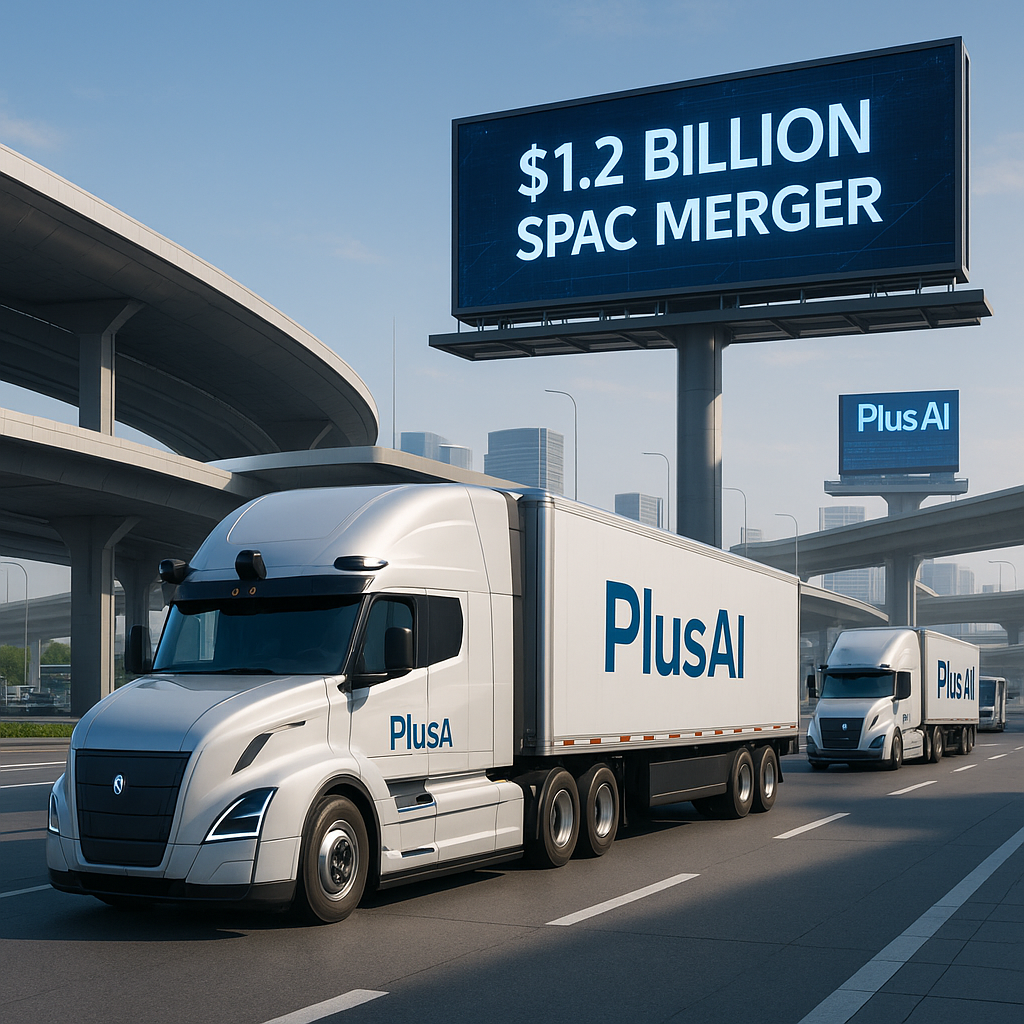
- Pre-money valuation: Approximately $1.2B (pre-money equity value) [1] (Source: Forbes report on S-4 progress)
- Expected fundraising: Up to approximately $300M (from Yahoo Finance) [2]
- Merger counterpart: Churchill Capital Corp IX
- Transaction status: Revised S-4 has been submitted, advancing towards shareholder voting and closing (reports on relevant revisions in September and December 2025) [1][2]
Based on currently listed autonomous driving benchmarks (AUR, TSP) and market conditions, we need to conduct
- Baseline: Assuming partial retention of $10 trust cash (refer to common SPAC range), actual capital received after redemption may be in the $200–300M range (upper limit of $300M is the target reported, actual amount depends on redemption rate) [2]
- Valuation range:
- Optimistic (low redemption, high PIPE support, rapid milestone validation): Pro-forma enterprise value may approach around $1.5B
- Neutral (typical redemption): Actual equity value may be significantly lower than $1.5B (depending on redemption and PIPE),subject to final S-4 disclosure[1][2]
The above ranges are sensitivity analyses based on current market and SPAC practices,
subject to final S-4 documents and shareholder meeting announcements. Key checks before investment: PIPE structure (price/lock-up period), redemption assumptions and cash usage, milestone trigger conditions.
- Commercial vehicle autonomous driving: Some reports predict approximately $10B in 2025, reaching $50.1B in 2034 with a CAGR≈19.6% [3] (Source: Yahoo Finance)
- Overall autonomous driving: Other reports predict approximately $72.64B in 2024, reaching $658.1B in 2035 with a CAGR≈22.19% [3] (Source: Yahoo Finance)
- Judgment: The two sets of forecasts differ in scope and range,we cannot confirm a single authoritative source. Investors should refer to multiple sources cautiously and use range scenarios (e.g.,15–25% CAGR) in modeling, with conservative assumptions on technology deployment pace, regulatory and infrastructure progress.
- FMCSA is advancing research on “triangle markers/emergency signs”, relevant documents explicitly mention “autonomous driving system progress” and exemption applications, aiming to establish an evidence base and possible alternative compliance paths for fault scenario handling of driverless trucks (from FreightWaves, tags include AUR) [4]. This indicates that regulators are building policy tools, but it does not mean all obstacles have been cleared.
- States like Texas have allowed commercial pilot programs of autonomous driving trucks under certain conditions [1].
- Conclusion: Regulation is “moving in a favorable direction”, but there are still uncertainties in state, federal, and compliance details. Continuous attention should be paid to subsequent rule dynamics and exemption progress.
| Company | Current Stock Price (2025-12-30) | Market Cap/Valuation | YTD Performance | Remarks |
|---|---|---|---|---|
Aurora (AUR) |
$3.92 | $7.60B[0] | YTD approx. -31.8%[5]; 3Y+ approx.249.6%[5] | Advancing regular capacity deployment with Detmar Logistics etc.; CEO increased holdings; regulatory research is conducive to subsequent breakthroughs [4][5] |
TuSimple (TSP) |
$0.25 | $57.47M[0] | 52-week high $2.68→current approx.-90.7%[5] | Geopolitical and regulatory pressures; increased transformation path and compliance challenges |
PlusAI (Pre-S merger) |
N/A | Pre-money approx.$1.2B[1] | N/A | Has cooperative layouts with TRATON, IVECO, Hyundai etc. [1] |
- Aurora: In the forefront of 24/7 regular freight deployment, integration with partners, and regulatory interaction; despite YTD pressure, market cap is significantly higher than PlusAI’s current valuation [5]. Its continuous advancement of commercial agreements (like Detmar) is also reported by media [5].
- TuSimple: Stock price is extremely pressured, reflecting market concerns about geopolitics/regulation and commercialization pace. Media reports mention regulatory and compliance issues related to IP transfer to Chinese partners [6].
- PlusAI: Entering the heavy truck ecosystem via B2B2C mode through cooperation with TRATON (Scania/MAN/International), IVECO, Hyundai etc. [1]. Compared with AUR/TSP, its cooperation network and OEM synergy have advantages, but publicly disclosed commercial mileage and revenue data are still limited and need further verification in the S-4.
##4. SPAC Market Environment and Historical Lessons
- 2025 SPAC recovery: Statistics show that the number of new SPAC issuances and financing amount in 2025 increased year-on-year (91 deals, approx.$16.5B vs.34 deals, approx.$5.3B in the same period of 2024) [7]. Butrecovery does not equal universal good performance.
- Post-transaction performance differentiation: Many companies that have completed SPAC mergers have long-term stock prices below the $10 issuance price, some approaching the $1 red line [7]. This reflects:
- Investors are highly sensitive to profit paths and valuation matching
- Vigilance against potential selling pressure after lock-up periods
- For early-stage technology companies, delivering milestones is key to valuation support.
##5. Investment Value Assessment (Based on Current Data)
###5.1 Advantages
- OEM ecosystem: Cooperation network with TRATON, IVECO, Hyundai etc., conducive to integration and scaling of technology and commercial deployment [1].
- Industry trends: In the long run, autonomous driving heavy trucks have significant optimization space in safety, efficiency, and cost structure; however, “market optimism” and “deployment pace” need to be considered separately.
- Regulatory progress: FMCSA’s research on fault emergency signs reflects attention and policy preparation for driverless truck compliance scenarios [4].
###5.2 Risks
- Commercialization uncertainty and cash flow pressure: Early-stage technology companies usually face challenges such as slow revenue recognition, high R&D/operation investment, and large capital consumption; attention should be paid to disclosure on cash runway and capital planning in the S-4.
- SPAC structure risks: Excessively high redemption rate will weaken actual received capital; PIPE terms (pricing/lock-up period) determine shareholder structure and subsequent supply pressure.
- Competition and execution: AUR etc. are faster in public deployment progress; technology/engineering/operation capabilities and milestone execution are core variables.
- Regulatory and regional risks: Regulatory paces vary across different jurisdictions globally; geopolitical and compliance risks need continuous tracking.
###5.3 Recommended Assessment Framework (For Investors)
- Valuation anchoring: Build valuation anchors with “pro-forma equity value/potential revenue or deployable fleet size”; make range judgments combining the distribution of price-to-sales ratios of comparables (AUR/TSP).
- Redemption and PIPE scenarios: Calculate actual net cash and equity value under different redemption assumptions (e.g.,30–70%); evaluate the shareholder-friendliness of PIPE price and lock-up structure.
- Milestones and KPIs:
- Commercial operation mileage (including the proportion of driverless mileage)
- Cooperation roadmap and delivery nodes with OEMs
- Customer structure (proportion of top logistics/resource customers)
- Single-vehicle/single-line economic improvement path
- Holding period and risk tolerance: SPACs have significant early volatility; it is recommended to determine position size and holding period based on one’s own liquidity needs and risk preferences.
###5.4 Risk Management and Monitoring Focus
- Closely track final S-4 documents: Focus on financial data, PIPE structure, redemption assumptions and hedging arrangements, related parties and governance clauses.
- Post-closing monitoring indicators: Deployment milestones, customer expansion, cash flow and refinancing arrangements, regulatory and compliance progress.
- Peer comparison: Continuously compare the dynamics of AUR/TSP and other autonomous driving technologies in technology/commercial/regulatory/capital markets.
##6. Summary
- PlusAI’s pre-money valuation of approximately $1.2B is in the medium-low range of industry benchmarks (compared to AUR’s approx.$7.6B) [1][0]. Under typical redemption scenarios, actual equity value may be lower than the simple sum of “upper limit fundraising”, subject to final S-4 disclosure and redemption facts.
- The long-term outlook for autonomous driving commercial vehicles is promising, but market forecasts from different sources have differences in scope and growth rates (e.g.,CAGR19.6% vs.22.19%) [3]; it is recommended to use range scenarios for valuation planning.
- Policy research progress favorable to driverless trucks has emerged at the regulatory level (e.g.,FMCSA’s triangle marker research) [4], but the overall compliance path is still in progress and does not mean “no obstacles left”.
- Investors should:
- Strictly verify PIPE and redemption assumptions
- Conduct dynamic tracking with milestones and cash flow as the core
- Base investment decisions on range valuation and scenario stress testing
Against the backdrop of the current SPAC market “recovering but diverging”, PlusAI’s investment value highly depends on:
- Real equity structure and capital strength after S-4 disclosure and closing;
- Differences in technology/commercial/compliance pace compared to competitors like AUR;
- Investors’ own tolerance for volatility of early-stage tech stocks and holding period.
[0] Jinling API Data (Real-time quotes and market cap: AUR, TSP; market indices)
[1] Forbes - “PlusAI A Step Closer To Public Offering With S-4 Filing To SEC” (2025/09/22) – Overview of pre-money approx.$1.2B, cooperation with TRATON/IVECO/Hyundai, S-4 progress
[2] Yahoo Finance - “Plus Automation to go public via SPAC deal” – Expected fundraising up to $300M; revised S-4 and transaction progress
[3] Yahoo Finance – Market size forecasts (commercial vehicle autonomous driving CAGR≈19.6%; overall autonomous driving CAGR≈22.19%)
[4] FreightWaves – “FMCSA’s Triangle Study Is All About Driverless Trucks” – FMCSA research progress and AUR-related tags
[5] Yahoo Finance/Tickertick – AUR/TSP related news and dynamics (stock performance, CEO增持, commercial deployment)
[6] TechMeme/Bloomberg – TuSimple regulatory/geopolitical related reports (IP transfer and compliance issues)
[7] Forbes – “The Case For SPACs” – 2025 SPAC issuance statistics and post-merger performance differentiation
Insights are generated using AI models and historical data for informational purposes only. They do not constitute investment advice or recommendations. Past performance is not indicative of future results.
About us: Ginlix AI is the AI Investment Copilot powered by real data, bridging advanced AI with professional financial databases to provide verifiable, truth-based answers. Please use the chat box below to ask any financial question.