
Analysis of the Impact of Moore Threads' MTT AIBOOK Launch on Domestic AI Chip and Computing Power Markets
Unlock More Features
Login to access AI-powered analysis, deep research reports and more advanced features
About us: Ginlix AI is the AI Investment Copilot powered by real data, bridging advanced AI with professional financial databases to provide verifiable, truth-based answers. Please use the chat box below to ask any financial question.
Based on the latest collected information, I will conduct an in-depth analysis of the impact of Moore Threads’ MTT AIBOOK launch on the competitive landscape of domestic AI chip and computing power markets.
The MTT AIBOOK, launched by Moore Threads at the first MUSA Developer Conference, is a strategic terminal product targeting
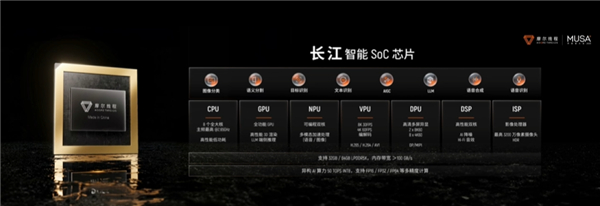
- Equipped with the self-developed “Yangtze River” AI SoC chip, adopting a multi-heterogeneous architecture integrating CPU, GPU, NPU, VPU, DPU, DSP, and ISP processing units
- AI total computing power exceeds 50 TOPS, supporting multi-precision computing such as FP64, FP32, FP16
- 32/64GB LPDDR5X memory with bandwidth over 100GB/s
- Built-in 1TB SSD,70Whr battery, as thin as 12.4 mm, weighing 1.35 kg
- Pre-installed with a complete AI development environment, including mainstream frameworks like VS Code, Python, PyTorch, vLLM, Pandas
- Runs the MT AIOS operating systembased on Linux kernel, supporting Windows virtual machines and Android containers
- Can run large models with up to 30B parameterson the edge, pre-installed with multi-modal models like Alibaba Qwen3-8B and Zhipu Wujie Emu 3.5
- Built-in digital human agent “Xiaomai” and rich AI applications
- Priced at 9999 yuan, pre-orders are now open
- Clearly targeting individual developersrather than ordinary consumers [2]
- Positioned as a “computing power laptop” and “development laptop”, balancing daily use
The launch of MTT AIBOOK marks Moore Threads’ completion of the
The current domestic AI chip market has formed a multi-level competitive landscape:
- Huawei Ascend:Builds a full-stack ecosystem of “chip-MindSpore framework-MindX application”. The Ascend 910B chip has FP16 computing power of 256 TFLOPS, comparable to NVIDIA A100, covering 80% of domestic AI computing power demand scenarios [4]
- Hygon Information:The only domestic x86 architecture CPU manufacturer. Its DCU products have a CUDA compatibility rate of over 90%, with a 30% market share in AI training chips, forming industry barriers in more than 20 industries and over 300 application scenarios [3]
- Cambricon:The 7nm思元590 chip has FP16 computing power of 256 TFLOPS, with a 4% market share in cloud inference, leading domestic large model adaptation capabilities, and is expected to turn profitable in Q1 2025 [3][4]
- Biren Technology:The BR100 series has FP32 computing power of 480 TFLOPS (3x that of A100), adopts Chiplet packaging technology, achieved revenue of 337 million yuan in 2024, with a two-year CAGR of 2500%, and is about to become the first domestic GPU stock on the Hong Kong Stock Exchange [5]
- Muxi Semiconductor:The 7nm曦云C600 supports 128B MoE large model training, has delivered over 28,000 chips cumulatively, and its stock rose by 692.95% on the first day of listing, setting an A-share record [3]
- Jingjia Micro:Focuses on military/aerospace/high-reliability information innovation fields
- Tianshu Zhixin:Customer concentration has decreased rapidly, product versatility has improved, and over 1/3 of the R&D team has more than ten years of experience [5]
The biggest difference between Moore Threads and other domestic GPU manufacturers lies in its
- Simultaneously layout B-end and C-end markets
- Supports full computing precision, with a single chip supporting AI computing, graphics rendering, and scientific computing
- The MTT S80 graphics card has single-precision floating-point computing power close to NVIDIA RTX3060, becoming the only domestically produced game card in large-scale production[3]
- Sold 5 AI clusters in the first half of 2025, showing product competitiveness in the intelligent computing center field [5]
- Listed on the Science and Technology Innovation Board on December 5, 2025, with a market value once exceeding 300 billion yuan, setting a new record for new stocks this year [6]
- Revenue in the first half of 2025 was 702 million yuan, a year-on-year increase of 238.71%
- Net loss was 271 million yuan, but the loss narrowed by 56.02% year-on-year
- Comprehensive gross margin has increased to around 70%[5][6]
- Expected to reach a maximum revenue of 1.498 billion yuan in 2025, with a year-on-year growth rate of over 240%, and is expected to achieve profitability as early as 2027 [5]
The launch of MTT AIBOOK opens up competition for domestic AI chip manufacturers in the emerging track of
- Does not directly compete with consumer brands like Lenovo and ASUS, but focuses on the productivity tool positioning for developers
- Reduces the threshold for developers to use by pre-installing a complete AI development environment
- Achieves the “cycle closed loop from model training, inference debugging to multi-end application deployment” [2]
- Huawei Ascend and Hygon Information mainly focus on cloud computing power and data centers
- Cambricon and Biren focus on AI training/inference chips
- Moore Threads enters the edge/terminal market through MTT AIBOOK, forming a differentiated layout [1]
MTT AIBOOK carries Moore Threads’ strategic intention to break through the CUDA ecosystem barrier:
- Directly reaches developer users through hardware terminals
- Provides an “out-of-the-box” AI development experience, reducing the threshold for using domestic GPUs
- Builds the MUSA Developer Program and Ecosystem Center to cultivate local development talents [2]
- MTT AIBOOK as a mobile node
- MTT AICube as the “data hub” for home/office (prototype stage)
- Kua’e 10,000-card cluster as cloud computing power support
- Forms a full-stack computing power layout of “terminal-edge-cloud” [1][3]
- Rapidly increases the number of developer ecosystem users for Moore Threads, enhancing brand influence
- May trigger other domestic chip manufacturers to follow suit in layout terminal products, promoting the heating up of the edge computing power market
- The 9999 yuan pricing strategy has strong competitiveness in the domestic high-end computing power terminal market
- If Moore Threads can form a positive cycle of “hardware+software+ecosystem” through MTT AIBOOK, it will significantly enhance its voice in the domestic GPU market
- May promote domestic AI chip manufacturers to shift from pure hardware competition to ecosystem competition
- Provides domestic computing power alternatives for individual developers and small and medium-sized enterprises, accelerating the popularization of AI computing power
- NVIDIA H200 was approved for sale to China and adopted a low-price strategy, directly impacting the domestic AI chip market. Leading enterprises like Cambricon, Hygon, and Huawei Ascend will face customer loss and price competition pressure [3]
- In the high-end AI training/inference market, domestic chips still have performance gaps with international top products
- The CUDA ecosystem barrier is still strong, and the MUSA ecosystem needs time to accumulate
- Continuous R&D investment is required. Moore Threads and Muxi have invested over 6 billion yuanin R&D cumulatively over the past three years [6]
- The completeness of the software ecosystem and the maturity of the developer toolchain still need to be improved
- Chip manufacturers face huge risks when crossing into terminal products, and the 9999 yuan pricing reflects the collective helplessness of domestic GPU manufacturers under the existing international hegemonic ecosystem [1]
- Moore Threads is not yet profitable and needs continuous capital investment. Although the IPO has alleviated financial pressure, it still needs to find a balance between R&D investment and commercial returns
The successful experience of MTT AIBOOK shows that domestic AI chip manufacturers need to seek breakthroughs in the following aspects:
- Differentiated technical paths:Moore Threads’ full-function GPU strategy vs Huawei Ascend’s full-stack ecosystem vs Cambricon’s technological innovation
- Differentiated market positioning:Segmented markets such as cloud computing power, edge computing, and terminal devices all have opportunities
- Business model innovation:A combination of hardware+software+services rather than simply selling chips
For domestic AI chips to truly break through, continuous investment is needed in the following aspects:
- Developer ecosystem:Cultivate local AI talents and reduce the development threshold
- Application ecosystem:Form large-scale applications in key fields such as government affairs, industry, and medical care [4]
- Standard system:Establish independently controllable technical standards and norms
2025 is called the “key dividing line for the domestic GPU industry”, which is inseparable from the dual drive of policy and capital:
- Eight Science and Technology Innovation Board Rulesopen up the listing path for unprofitable hard technology enterprises [6]
- Moore Threads’ rapid approval in 89 dayswith the “Science and Technology Innovation Board speed” releases a clear policy support signal [6]
- The four domestic GPU dragons (Moore, Muxi, Biren, Tianshu) gather for IPO, and hundreds of institutions accumulated in the primary market urgently need an exit channel [6]
The launch of Moore Threads’ MTT AIBOOK has the following far-reaching impacts on the competitive landscape of domestic AI chip and computing power markets:
- Opens up a new track for edge computing power, providing a differentiated competition path for domestic AI chip manufacturers
- Accelerates developer ecosystem construction, directly reaching developer users through terminal products
- Promotes computing power popularization, reducing the threshold for individual developers and small and medium-sized enterprises to use AI computing power
- Improves full-stack layout, forming an integrated computing power solution of “terminal-edge-cloud”
- Faces low-price strategy competition pressurefrom international giants like NVIDIA [3]
- High commercialization risksfor chip manufacturers crossing into terminal hardware [1]
- MUSA ecosystem constructionstill needs long-term investment and verification
- Other manufacturers in the industry may follow suit quickly, leading to homogeneous competition
In the short term, MTT AIBOOK will help Moore Threads quickly expand its developer ecosystem influence and enhance brand awareness. However, whether it can truly change the competitive landscape in the medium and long term depends on:
- Product experience:Whether the actual performance, stability, and development experience can meet the needs of developers
- Ecosystem completeness:Whether the MUSA ecosystem can attract enough developers and applications
- Commercial sustainability:Whether profitability can be achieved within a reasonable time
- Industry recognition:Whether it can form scale effects in key industry application scenarios
2025 is the
[1] Phoenix Net Technology - “Benchmarking NVIDIA, Moore Threads Reveals Its Family Background for the First Time After Listing” (https://tech.ifeng.com/c/8pN6HijvMRo)
[2] Eastmoney.com - “First Major Move After Listing! Moore Threads Announces Full-Function GPU Architecture Roadmap” (https://finance.eastmoney.com/a/202512233599828354.html)
[3] Caifuhao - “Record of 20 Domestic Computing Power Players: Numbered Disassembly of Life and Death Tracks, 2025 Pattern Determined?” (https://caifuhao.eastmoney.com/news/20251227055848363884340)
[4] QQ News - “Analysis of Competitiveness of Top 10 AI Infra Manufacturers: China’s Intelligent Landscape Under the Computing Power Revolution” (https://news.qq.com/rain/a/20251202A06I4700)
[5] Wall Street News - “Moore, Muxi, Biren and Tianshu! ‘Four Dragons of Domestic GPU’ Gather for IPO” (https://wallstreetcn.com/articles/3761844)
[6] Wenxue City - “Domestic Chip Breakthrough 2025: Behind the Collective IPO, a Race Against Time” (https://www.wenxuecity.com/news/2025/12/09/126442346.html)
[7] NetEase - “NVIDIA H200 Sets Low Price, Critically Hitting Cambricon, Hygon and Huawei?” (https://www.163.com/dy/article/KHLC5BL0055212U9.html)
[8] Sohu.com - “New Chips ×3, New Whole Machines ×2, New Clusters ×1: 5-Year-Old Moore Threads Burst Completely!” (https://m.sohu.com/a/969715833_163726)
Insights are generated using AI models and historical data for informational purposes only. They do not constitute investment advice or recommendations. Past performance is not indicative of future results.
About us: Ginlix AI is the AI Investment Copilot powered by real data, bridging advanced AI with professional financial databases to provide verifiable, truth-based answers. Please use the chat box below to ask any financial question.