
In-depth Analysis of the Lithium Iron Phosphate Industry: Path to Supply-Demand Balance and Evaluation of Core Competitive Enterprises
Unlock More Features
Login to access AI-powered analysis, deep research reports and more advanced features

About us: Ginlix AI is the AI Investment Copilot powered by real data, bridging advanced AI with professional financial databases to provide verifiable, truth-based answers. Please use the chat box below to ask any financial question.
Related Stocks
The current lithium iron phosphate industry is at a critical turning point. According to the latest market data, in December 2025, the price of power-type lithium iron phosphate rose to 40,850-46,050 CNY/ton, and the price of energy storage-type reached 38,750-42,050 CNY/ton, an increase of more than 30% compared to the mid-year low [1]. The direct driving forces behind this round of price increases come from three levels:
- The price of lithium carbonate rebounded by more than 50% from the mid-year low, and the quotation for battery-grade lithium carbonate exceeded 100,000 CNY/ton, accounting for more than 40% of the total cost of lithium iron phosphate [2]
- Precursor raw materials such as phosphoric acid, monoammonium phosphate, and ferrous sulfate collectively increased in price in the fourth quarter of 2025, with month-on-month increases of 6.9%, 8.5%, and 3.1% respectively in November [2]
In November 2025, 7 leading enterprises (with a combined market share of 74%) including Hunan Yonon, Wanrun New Energy, Desay Nano, Anda Technology, Fengyuan Lithium Energy, Zhejiang Youshan, and GCL Lithium held an industry meeting. The China Chemical and Physical Power Industry Association released the
From December 2025 to January 2026, three leading enterprises Hunan Yonon, Wanrun New Energy, and Desay Nano successively announced production cuts for maintenance:
- Hunan Yonon: Maintenance will start on January 1, 2026, for one month,预计 reducing output by 15,000-35,000 tons
- Wanrun New Energy: Maintenance will start on December 28 for one month,预计 reducing output by 5,000-20,000 tons
- Desay Nano: Annual maintenance will start on January 1, 2026, for one month [4]
The three enterprises have a combined market share of over 47%, and are expected to reduce monthly output by 20,000-55,000 tons in total, significantly tightening market supply in the short term.
Although the industry calls for “no expansion for the time being”, leading enterprises are still actively laying out capacity. This seems contradictory but actually has deep meaning:
Expansion is not comprehensive but focuses on high-end products such as high tap density and long cycle life. For example, Rongbai Technology acquired Guizhou Xinren (60,000-ton mature production line), and Longpan Technology and Fulin Precision Industry laid out new high tap density lithium iron phosphate projects [5]. This is essentially different from blind expansion of low-end capacity.
The industry saw a “lock-in wave” in 2025:
- Wanrun New Energy signed a 5-year agreement with CATL to supply 1.3231 million tons from May 2025 to 2030, with a total value exceeding 40 billion CNY
- The holding subsidiary of Longpan Technology signed a supply agreement of 106,800 tons with Sunwoda for 2026-2030 [5]
- From January to November 2025, the sales volume of lithium iron phosphate power batteries reached 760.5 GWh, with a market share of 72.8% and a year-on-year growth rate of 66.9%
- The shipment volume of energy storage lithium batteries is expected to reach 580 GWh, with a growth rate of over 75%, and lithium iron phosphate accounts for over 90% [1]
According to brokerage API data and online search information [6], the lithium iron phosphate industry in 2025 showed unique structural characteristics:
- Supply Side:Cumulative output from January to November 2025 was 3.1129 million tons, a year-on-year increase of 59.28%; capacity utilization rate in November was 75.75%
- Demand Side:Output of lithium iron phosphate batteries was 1,403.92 GWh, a year-on-year increase of 58.08%; inventory was 103,700 tons (early December)
- Structural Characteristics:“High-end products are in short supply, low-end products are in surplus”
Capacity utilization rate of leading enterprises has reached over 90%, and the top 10 enterprises are almost fully loaded, while capacity utilization rate of a large number of small and medium-sized enterprises that have not completed technical upgrading is still at a low level. Orders for Hunan Yonon’s CN-5 series and Desay Nano’s fourth-generation products have been scheduled until the first half of 2026, and some high-end products have even suspended order acceptance [3].
Based on brokerage data and industry analysis, I drew a supply-demand pattern forecast chart (see below):
- Demand: 3.75 million tons
- Supply: 4.5 million tons
- Capacity Utilization Rate: 75-78%
- Characteristics: Accelerated capacity clearance, exit of low-end capacity
- Demand: 4.7 million tons (+25.3%)
- Supply: 4.9 million tons (+8.9%)
- Capacity Utilization Rate: 85%
- Characteristics: Supply and demand approach balance, tight balance of high-end products continues
- Q4 2025-Q1 2026:First and second rounds of price increase negotiations are finalized, processing fees increase
- Q2 2026:Tension in supply and demand of energy storage cells eases, but high-end lithium iron phosphate is still in short supply
- Second Half of 2026:Low-end capacity clearance is completed, industry concentration further increases
- Power Batteries: From January to November 2025, production and sales of new energy vehicles in China were 14.907 million and 14.78 million units, a year-on-year increase of 31.4% and 31.2% [7]; global power and energy storage demand in 2026 is expected to reach 2,600-2,700 GWh, with growth of over 30%
- Energy Storage Boom: From 2025 to 2027, the national new energy storage installed capacity will exceed 100 million kW, reaching more than 180 million kW by the end of 2027 [7]; the global new energy storage installed capacity is expected to maintain a growth rate of over 75% in 2026
- Industry Concentration Increase: CR5 market share reached 65% in Q3 2025, an increase of 10 percentage points compared to the same period last year [5]
- Exit of Low-end Capacity: A large number of small and medium-sized enterprises with backward technology were forced to exit due to losses
- Orderly New Capacity: Leading enterprises focus on high-end products in capacity expansion, with controllable release rhythm
According to calculations by Zhuochuang Information analysts, if processing fees increase by 3,000 CNY/ton in 2026, the gross profit margin of lithium iron phosphate can rise back to 7.5%, an increase of more than 7 percentage points compared to the current level [3]. This round of price increases is expected to continue until 2026, then enter a medium-term channel of “stable with upward trend”.
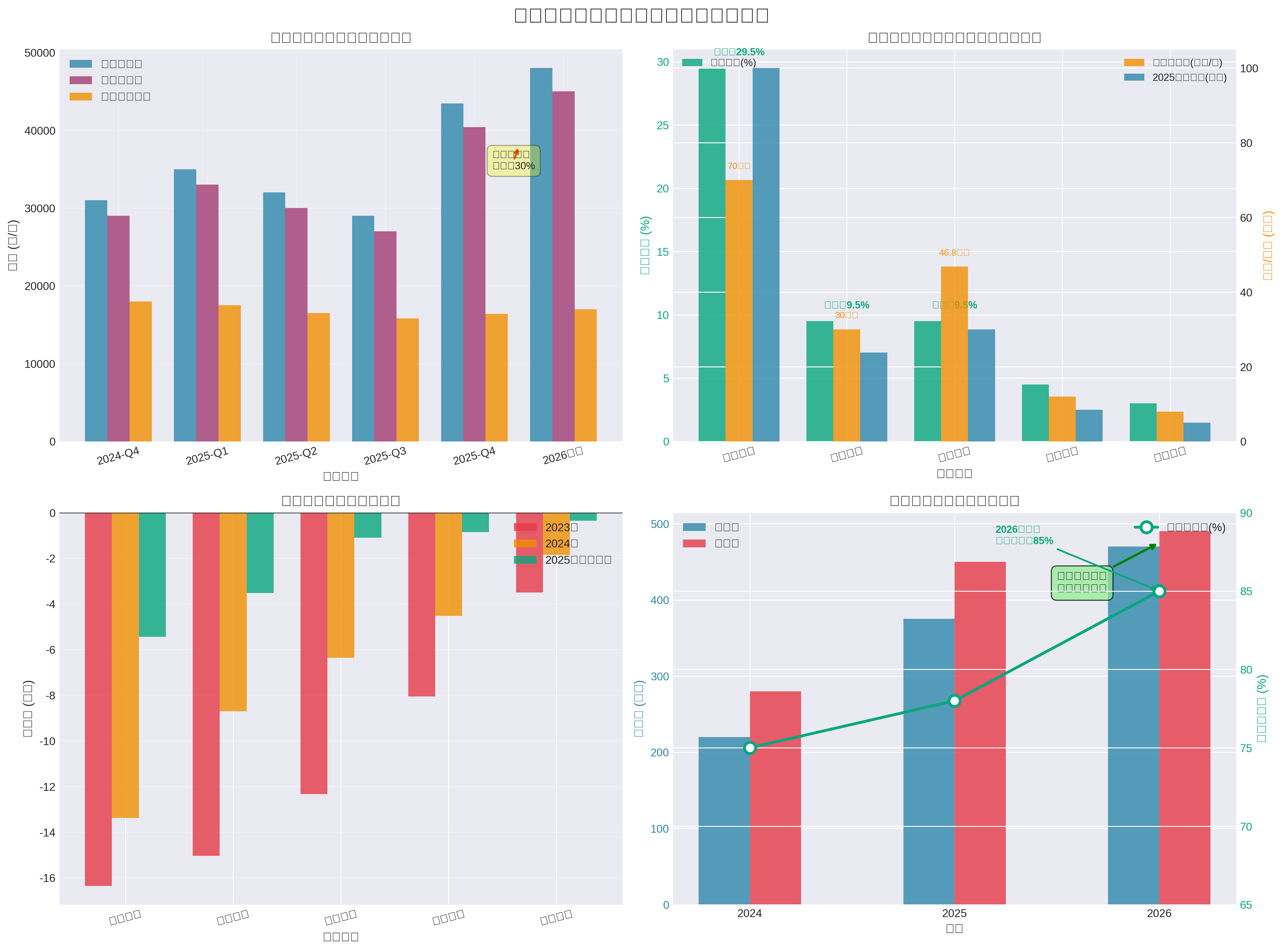
The chart shows the price trend of lithium iron phosphate, market share and capacity of leading enterprises, changes in enterprise profitability, and supply-demand balance forecast. Data shows that the industry is transitioning from overcapacity to supply-demand balance, with high-end products in short supply.
Based on brokerage API data and online search information, I established the following evaluation system:
- Market Share:28-30% (industry first)
- Completed Capacity:Over 700,000 tons/year
- Expected Output in 2025:About 1 million tons
- Core Advantages:
- Profitability:One of the few profitable enterprises in the first three quarters of 2025 [3]
- Technology Leadership:CN-5 series products are in short supply, orders scheduled until the first half of 2026
- **Capacity Utilization Rate:**持续超过100%, highlighting product competitiveness
- Customer Structure:Deeply bound to leading battery manufacturers such as CATL and BYD
- Market Share:9-10%
- Completed Capacity:468,000 tons/year
- Expected Output in 2025:Over 300,000 tons
- Core Advantages:
- Long-term Agreement Lock-in:Signed a 5-year agreement with CATL for 1.3231 million tons, with a total value exceeding 40 billion CNY [5]
- Demand Certainty:Annual revenue contribution of over 8 billion CNY during the agreement period
- Financial Pressure:Cumulative loss of 2.726 billion CNY from 2023 to Q3 2025, but long-term agreements provide profit guarantee
- Market Share:Close to 10%
- Completed Capacity:About 300,000 tons/year
- Expected Output in 2025:About 238,000 tons
- Core Advantages:
- Technology Barrier:Fourth-generation high tap density products are in leading position in the industry
- R&D Accumulation:Moat formed by years of technical iteration
- Financial Pressure:Cumulative loss of 3.518 billion CNY from 2023 to Q3 2025, high asset-liability ratio
- Technology Premium:Stable processing fee premium for high-end products, strong bargaining power
- Market Share:About 4.5%
- Completed Capacity:About 120,000 tons/year
- Core Advantages:
- Stock Price Performance:Cumulative increase of 99.12% in 2025, reflecting improved market expectations
- Strategic Layout:Signed a long-term agreement of 106,800 tons with Sunwoda for 2026-2030
- M&A Integration:Actively participate in industry integration to increase market share
- Financial Pressure:Cumulative loss of 1.979 billion CNY from 2023 to Q3 2025
- Core Advantages:
- Profitability:One of the few profitable enterprises in the first three quarters of 2025 [3]
- Technology Route:Focus on high tap density LFP, received capital investment from CATL
- Capacity Expansion:Has launched a new round of capacity expansion
- Core Advantages:
- Profitability:Achieved profit in the first three quarters of 2025 [3]
- Product Diversification:Layout ternary cathode materials to reduce single product risk
Enterprises such as Anda Technology and Fengyuan Co., Ltd. are in the stage of capacity climbing and technical upgrading, facing greater competitive pressure.
The industry competition logic has shifted from “competing for capacity and price” to “competing for technology and stable supply” [5]:
- High Tap Density Technology:Fourth-generation high tap density lithium iron phosphate has a stable processing fee premium due to large supply-demand gap
- Long Cycle Life:Energy storage application scenarios have high requirements for cycle life
- Technology Accumulation:It takes years of technical iteration from the first generation to the fourth generation, and new entrants are difficult to catch up quickly
- Deep Binding:Establish strategic cooperation with leading battery manufacturers such as CATL and BYD
- Long-term Agreement Guarantee:Long-term agreements such as 1.32 million tons of Wanrun New Energy and 106,800 tons of Longpan Technology provide demand certainty
- Verification Barrier:Battery manufacturers have long certification cycles for material suppliers and high switching costs
- Scale Effect:Capacity utilization rate of leading enterprises is over 90%, and unit cost is significantly lower than industry average
- Vertical Integration:Some enterprises layout upstream resources such as phosphorus and lithium sources to reduce cost fluctuation risks
- Location Advantage:Close to downstream customers or resource areas to reduce logistics costs
- Cash Flow:Long-term industry losses test enterprises’ cash flow management capacity
- Asset-liability Ratio:Leading enterprises generally have high asset-liability ratios, but have smooth financing channels
- Turnaround Capacity:After the increase in processing fees in 2025, the profit recovery rhythm is significantly differentiated
- Absolute leader in the industry, with a market share of 28-30%
- One of the few profitable enterprises, with the strongest ability to pass through the cycle
- Technology leadership, high-end products in short supply
- Obvious technology advantages, strong premium ability for high-end products
- Long-term agreement lock-in provides demand guarantee
- Large profit recovery elasticity in 2026
- Already profitable, low financial risk
- Technology route conforms to industry upgrading trend
- Q1 2026:Processing fee increase is finalized, gross profit margin recovers to 7.5%
- Mid-2026:Tension in supply and demand of energy storage cells eases, but high-end lithium iron phosphate is still tight
- Second Half of 2026:Low-end capacity clearance is completed, industry concentration further increases
- Raw Material Price Fluctuation Risk:If the price of lithium carbonate falls sharply again, it will compress enterprises’ profit margins
- Downstream Demand Less Than Expected:Slowdown in growth rate of new energy vehicles or energy storage installed capacity
- Disorderly Capacity Expansion in the Industry:If irrational expansion reappears, supply-demand balance will be delayed
- Technology Route Change:New technology routes such as lithium manganese iron phosphate replace lithium iron phosphate
- Intensified Overseas Competition:South Korean LG New Energy, Samsung SDI, etc. accelerate the layout of lithium iron phosphate, which may impact the global share of Chinese enterprises [3]
-
Supply-Demand Balance Time Point:2026 will be a key turning year for the supply-demand pattern of the lithium iron phosphate industry. High-end products will remain in tight balance, low-end capacity will be cleared at an accelerated pace, and the overall industry capacity utilization rate is expected to rise to over 85%.
-
Change in Competition Logic:From low-end competition of “competing for capacity and price” to value competition of “competing for technology and stable supply”, industry concentration will continue to increase.
-
Core Competitiveness Ranking:
- Technology Moat (40%)
- Customer Resources and Long-term Agreement Lock-in (30%)
- Capacity Scale and Cost Control (20%)
- Financial Status and Risk Resistance Capacity (10%)
-
Enterprises Through the Cycle:Leading enterprises such as Hunan Yonon, Wanrun New Energy, and Desay Nano are expected to further increase their market share after this round of industry clearance with their technology accumulation, customer resources, and scale advantages, achieving “the strong get stronger”.
[0] Gilin API Data - Price, Output, Inventory of Lithium Iron Phosphate Industry and Market Data of Leading Enterprises
[1] Sina Finance - “Behind the Price Increase Wave of Lithium Iron Phosphate, the ‘Anti-Involution’ Game of the Lithium Battery Industry” (2025-12-20)
https://finance.sina.com.cn/stock/wbstock/2025-12-20/doc-inhcmnmm6777245.shtml
[2] Sina Finance - “Behind the Price Increase Wave of Lithium Iron Phosphate, the Anti-Involution Game of the Lithium Battery Industry” (2025-12-22)
http://auto.ce.cn/auto/gundong/202512/t20251222_2658108.shtml
[3] Titanium Media - “Lithium Iron Phosphate Price Increase Wave Surges: Supply-Demand Reconstruction Under Demand Explosion, Rise May Continue Until 2026” (2025-12-17)
https://finance.sina.com.cn/cj/2025-12-17/doc-inhcavhm7547602.shtml
[4] Fortune No. - “Desay, Three Leading Enterprises Announce Suspension of Production for Maintenance Intensively, Is Lithium Iron Phosphate Paving the Way for Price Increase?” (2025-12-26)
https://caifuhao.eastmoney.com/news/20251226140314196775920
[5] Electronic Engineering Album - “Energy Storage Becomes New Explosive Point, Lithium Iron Phosphate Price Increase Wave Will Continue Until 2026” (2025-12-16)
https://www.eet-china.com/news/202512163871.html
[6] International Trade Futures - “Supply and Demand Both Increase, Price Center Moves Up” (2025 Annual Precious Metals and New Energy Report)
https://pic-test-gjmetal-1324067834.cos.ap-shanghai.myqcloud.com/newsv2/1b39c411d9144b858d40336306f64a7720251226174357.pdf
[7] Phoenix Net - “Behind the Price Increase Wave of Lithium Iron Phosphate, the ‘Anti-Involution’ Game of the Lithium Battery Industry” (2025-12-20)
https://i.ifeng.com/c/8pEj3I6EfWQ
Insights are generated using AI models and historical data for informational purposes only. They do not constitute investment advice or recommendations. Past performance is not indicative of future results.
About us: Ginlix AI is the AI Investment Copilot powered by real data, bridging advanced AI with professional financial databases to provide verifiable, truth-based answers. Please use the chat box below to ask any financial question.