
Analysis of Xibei Catering's Strategic Transformation: From 'McDonald's Dream' to 'Warm, Homely Dining Atmosphere'
Unlock More Features
Login to access AI-powered analysis, deep research reports and more advanced features
About us: Ginlix AI is the AI Investment Copilot powered by real data, bridging advanced AI with professional financial databases to provide verifiable, truth-based answers. Please use the chat box below to ask any financial question.
Based on the latest information found, I will detailedly analyze Xibei Catering’s strategic transformation journey from ‘McDonald’s Dream’ to ‘Warm, Homely Dining Atmosphere’ and its effects.
Jia Guolong began harboring the dream of building Xibei into ‘China’s McDonald’s’ in the early 2010s, a vision known in the industry as the ‘McDonald’s Dream’. Jia is a loyal student of the Haidilao model, firmly believing that chain catering expansion must be based on standardization [1]. In 2014, Xibei introduced the central kitchen model, which became a key catalyst for its rapid expansion. Data shows that Xibei opened 53 new stores in 2015 alone, significantly accelerating its expansion pace [2].
Jia Guolong once publicly expressed his extreme pursuit of efficiency: “High efficiency beats low efficiency; this is the essence, the truth.” [1] In his plan, Xibei announced the ambitious goal of achieving 100 billion yuan in sales by 2030 in 2020, with fast food and online food retail as the main drivers. However, this highly industrialized model also laid the groundwork for the subsequent public opinion crisis.
In September 2024, a dispute over pre-made dishes with Luo Yonghao pushed Xibei into a public opinion whirlpool. Jia Guolong initially responded强硬ly, insisting that Xibei had “no pre-made dishes” and saying he would sue Luo Yonghao. However, this confrontational stance not only failed to calm the controversy but also escalated the conflict [3]. Luo Yonghao offered 100,000 yuan to collect evidence; netizens posted photos of Xibei’s pre-made food packaging; reporters visited stores and found frozen fried eggplants being used. Even more embarrassing, Jia’s earlier statement that “all good dishes are pre-made” was dug up, creating a contradictory situation [3].
Data doesn’t lie: During the controversy, Xibei’s daily revenue plummeted by 2-3 million yuan, and over 370 stores nationwide were in the spotlight [3]. Jia later admitted that he relied on sleeping pills to get through this period.
After the pre-made dish controversy, Jia Guolong reflected deeply. In an exclusive interview with Southern Weekend at the end of 2024, he attributed the problem to two words: “pride”. He admitted: “My first mistake was choosing to confront directly, saying I’d rather stop doing business than clarify right and wrong. The public opinion field is not a place to clarify right and wrong; the public opinion field is right and wrong itself.” [4]
Jia clearly stated: “Dining restaurants still need to do banquets and experiences, so Xibei can’t become McDonald’s.” [4] This marked Xibei’s official abandonment of the ‘McDonald’s Dream’ of being ‘China’s McDonald’s’ and a shift to a new path emphasizing ‘warm, homely atmosphere’ and experience value.
Xibei’s current average customer spending is about 75 yuan, a 20% drop from before. Jia clearly stated that the reduced prices will not be raised again; this adjustment is long-term [4].
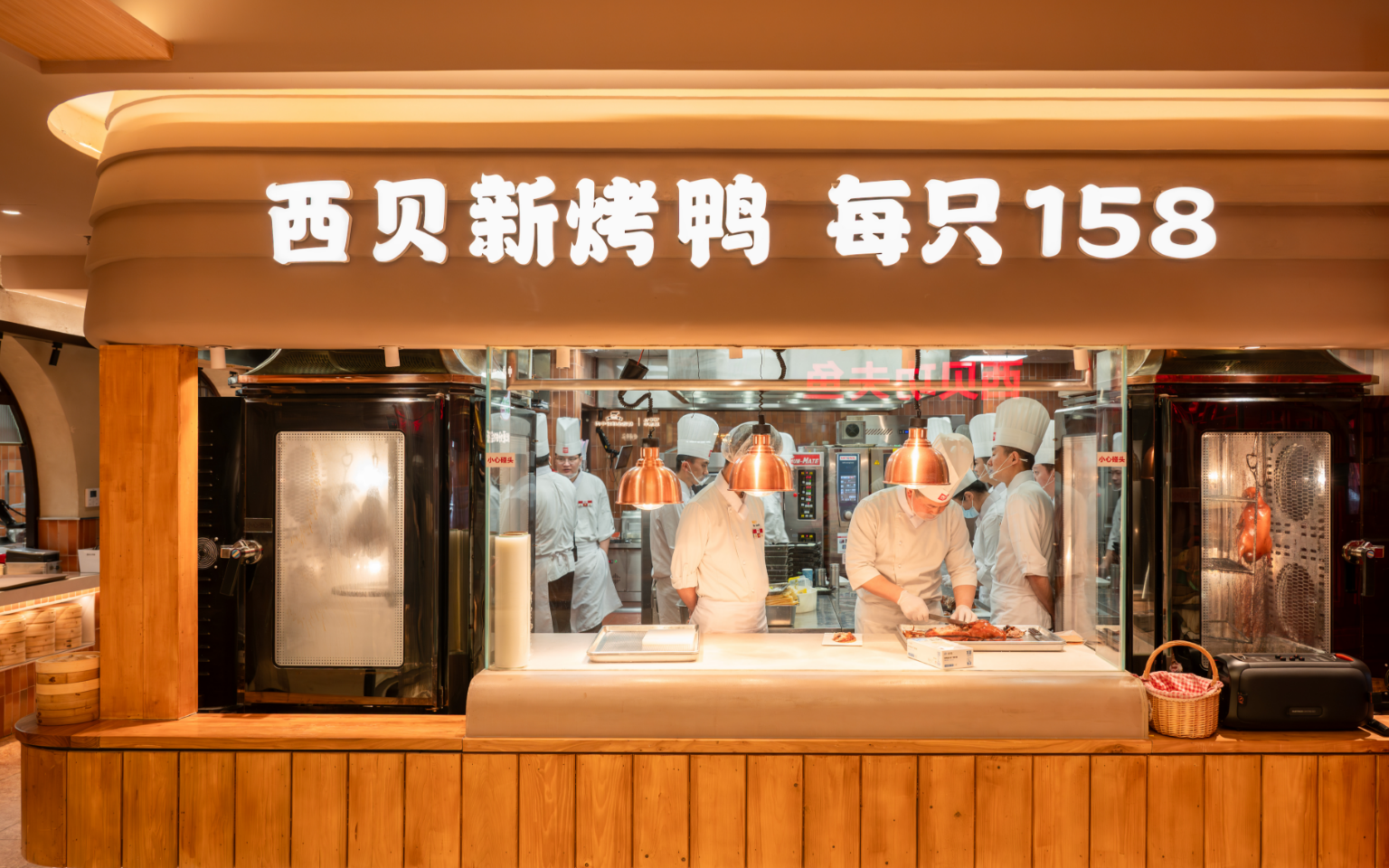
Xibei focused on strengthening the scene display of “made-to-order”. Open-kitchen operations in stores are fully transparent: processes like fresh lamb skewing, fresh dumpling wrapping, fresh chicken soup boiling, and fresh meat sauce stir-frying are moved to the front of customers [5].
Jia announced that Xibei will build family-friendly restaurants and continue to deepen children’s meals. Unlike the previous “standardized, labor-saving” approach, Xibei began to use more people and better people in stores [4]. Specific measures include:
- Renamed the Hohhot Elite Training Camp to Happy Training Camp
- Trained “Happy Ambassadors” to celebrate customers’ birthdays with magic themes in stores
- Each store has 10 such ambassadors with monthly salaries exceeding 10,000 yuan
- Labor cost ratio will increase from 30% to about 35% [4]
Jia said that Xibei cannot completely abandon the central kitchen because food safety is the bottom line. But it will carefully adjust the central kitchen to let stores take on more processing links and return to the ‘warm, homely atmosphere’ [4].
Jia clearly stated that he will “slow down expansion, curb desires, and manage the existing 300+ stores well” [3]. This is in sharp contrast to the previous “10,000-store plan” and IPO dream, marking Xibei’s shift from aggressive expansion to steady operation.
The pre-made dish controversy had a severe short-term impact on Xibei. According to Jia’s own words, daily revenue dropped by over 1 million yuan after the controversy broke out [1]. In 2024, “Xibei Youmian Village’s national average sales decreased by about 10%” [6]. Data from the Beijing Municipal Bureau of Statistics shows that from January to June 2024, the total profit of 2,628 large-scale catering enterprises in Beijing was only 180 million yuan, a year-on-year drop of 88.8%, and the profit margin fell to a low of 0.37% [1]. The entire catering industry was in a downturn, and Xibei, as a leading brand, could not avoid it.
After three months of adjustments, Xibei’s business began to show signs of recovery. By October 2024, Xibei’s overall foot traffic increased by 5% year-on-year [5]. By December 31, Xibei opened 8 new stores in core cities like Beijing, Shenzhen, and Nanjing [5]. Some stores had long queues, and the implementation of “sunshine kitchens” made many consumers say “they are willing to give it another chance” [3].
Xibei is shifting from “high-quality, mid-to-high-end positioning” to “value-for-money” positioning. Jia said: “Xibei has always had its own niche; cost and quality mean Xibei won’t become a low-price brand, but it’s not a high-price brand either. We hope customers eat at Xibei with peace of mind and get value for their money.” [4] This adjustment means Xibei abandoned its previous high-end route and turned to pursue cost-effectiveness and consumer trust.
The transformation also brings non-negligible challenges:
- Labor cost ratio will increase from 30% to 35%, an increase of about 5 percentage points [4]
- Price cuts have broken Xibei’s high-end brand positioning, and some loyal members feel betrayed [3]
- Finding a balance between “cost-effectiveness” and “brand premium” to avoid falling into the vicious cycle of “low-price引流 → quality decline → customer loss” remains a test [3]
The Xibei controversy became a “necessary turning point” for China’s catering industry in the transformation period. The impact of the event is not just short-term pain; it forced the modernization of Chinese cuisine to shift from a purely “industrial efficiency-oriented” approach to a new stage that must balance “consumer trust and value perception” [5]. Wang Hongtao, vice president and secretary-general of the China Chain Store & Franchise Association, pointed out that the core of communicating with consumers is “transparency”, which is a process of eliminating information asymmetry and building trust [5].
Whether Xibei’s “return path” works depends not on the sincerity of the apology but on the strength of the rectification execution [3]. If it can continuously implement transparent labeling, stabilize product quality, and balance cost and price, it may gradually win back consumer trust; if it’s just “temporary reflection” and fails to fundamentally change the business logic, this controversy may be the start of Xibei’s decline.
Jia said: “Dining restaurants are毕竟 not the same species as fast food.” [4] How to restore the “warm, homely atmosphere” to the maximum extent while ensuring food safety and basic efficiency is a topic Xibei needs to explore continuously.
Xibei’s “10,000-store plan” and IPO dream once relied entirely on the central kitchen and pre-made dish model [1]. Now, after the strategic transformation, these plans face re-evaluation. Xibei needs to redefine its capital market story under the new strategic framework.
Jia admitted: “I’ve thought a lot during this time. First, slow down expansion, curb desires, and manage these 300+ stores well.” [4] This statement means Xibei is shifting from pursuing scale to pursuing quality. In the short term, Xibei needs time to restore consumer trust; in the long term, the success of its transformation depends on whether it can truly “return to the essence of catering”—delicious, affordable, safe, and experiential [3].
Xibei’s transformation journey has just begun. As a leading enterprise in the Northwest Chinese cuisine track, its exploration will provide an important reference sample for the entire industry. The catering industry has never had a shortcut; only by doing a good job of products and services down-to-earth can it go far [3].
References
[1] NetEase - “The Truth Behind the Xibei Incident”
[2] CBNData - “Review of the Xibei Controversy: The Scale Trap of Chain Catering”
[3] Guancha.cn - “Jia Guolong’s ‘Tribulation’: From Confrontation to Admission”
[4] Southern Weekend - “After 100 Days of Silence, Jia Guolong First Responds to Xibei’s Pre-made Dish Controversy”
[5] 6park.com - “Xibei’s Blow Was Not in Vain”
[6] Baidu Encyclopedia - “Xibei XIBEI”
[7] Securities Times - “Xibei’s Reputation Plummets, Revenue Suffers, IPO Plan Cast in Shadow”
[8] Huxiu.com - “Is Jia Guolong Regretting It Too Late?”
[9] 36Kr - “Redefine the New Decade! 2025 China Catering Full Category”
Insights are generated using AI models and historical data for informational purposes only. They do not constitute investment advice or recommendations. Past performance is not indicative of future results.
About us: Ginlix AI is the AI Investment Copilot powered by real data, bridging advanced AI with professional financial databases to provide verifiable, truth-based answers. Please use the chat box below to ask any financial question.